Oxymel was traditionally made by simmering honey and vinegar into a syrup. Some of the earliest written documentation of oxymels used as remedies can be found in the Hippocratic treatise On Regimen in Acute Diseases written around 400 BCE.
Oxymel was recommended by Hippocrates as a dietary intervention during acute illnesses. “You will find the drink, called oxymel, often very useful in these complaints, for it promotes expectoration and freedom of breathing.” He goes on to mention that the acridity of vinegar corrected the undesirable qualities of honey or hydromel (honey-water) so that the drink moistens the mouth and throat, promotes expectoration, quenches the thirst, and agrees with the viscera (organs) seated in the hypochondrium which was a name he used for the area of the abdomen between the ribcage and your belly button.
There were several types of medicinal honey mixtures including oenomel which was made by mixing wine and honey, and hydromel which was made by mixing rain water and honey. Hippocrates considered a hydromel, which was a mixture of honey and water to be more acidic than an oxymel. He especially recommended oxymel for people of a bilious nature who would not tolerate the acidity of hydromel. Oenomels and wine-mixtures in general were recommended for people who often feel cold or cold illnesses.

Chapter VI of Galen’s Hygiene covers making oxymel and hydromel. To make an oxymel we are told that after we have “skimmed the best honey over charcoal, throw into enough vinegar so, so that to the taste it is neither acid nor sweet; and then again boil it over charcoal so as to combine their qualities perfectly, so that to the taste the acid will not seem raw; then, setting it away, add water to it for use, mixing them like wine.”
What he means by this is that the honey should be simmered over a braiser fired with charcoal as pictured in the image below, and any foam that rises off the top should be skimmed. Then you add the vinegar and cook it until the raw bite of the vinegar has dissipated.
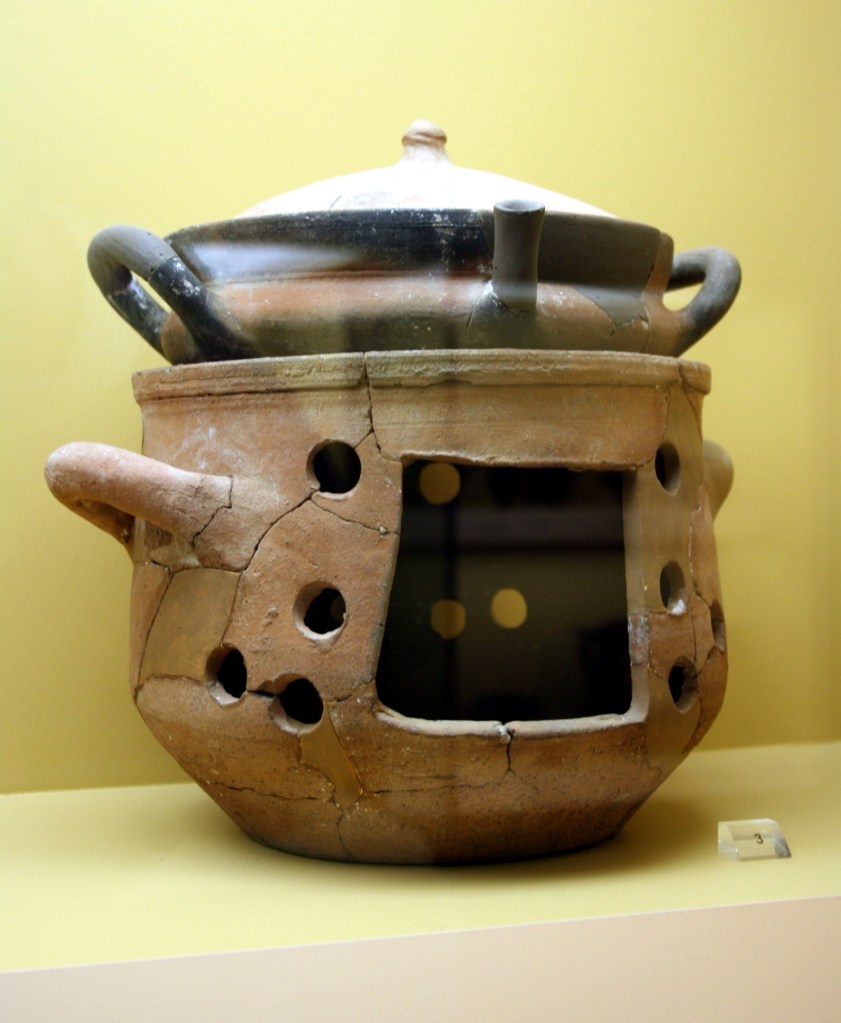
That’s what I really want to pull out of his directions is ” that to the taste the acid will not seem raw:” This is the primary difference between an oxymel and an acetum. Oxymels are quite pleasant tasting. I have made them for classes I have taught over the years and many very hesitant people have been surprised by the lack of biting acidity.
I don’t know, nor do I really care where the modern idea of making oxymels without cooking them came from. What I know is that people who don’t work with this preparation in its traditional form are missing out. I have never seen a historic receipt for an oxymel that wasn’t cooked.
The recipe that is included in An Anonymous Andalusian Cookbook of the Thirteenth Century also only calls for honey and vinegar and suggests it for fevers: “sikanjabîn syrup is beneficial in phlegmatic fevers: make it with six ûqiyas of sour vinegar for a ratl of honey and it is admirable.“
Sikanjabîn is the Arabic word for oxymel, derived from the Persian terms serkeh (vinegar) and angebin (sweetness of honey) and translates literally to vinegar honey. This has evolved into the name for a modern beverage with mint and cucumber. That happens. Keep in mind Coca-Cola was once considered a tonic blend of medicinal herbs and we know that oxymels were compounded with various herbs for many reasons.
“A diuretic oximel is made of the roots of this herb [horse radish] together with roots of fennel, parsley, celery, burnet, maidenhair spleenwort, and hart’s tongue fern, when it is boiled in vinegar and honey is put in it, and it should be drunk like any simple drink, as we have said.”
An Irish Materia Medica 1415
The oxymel receipt we will be duplicating is very nearly a copy of one in Galen’s Hygiene and was included in the Leech Book penned by the Anglo-Saxon scribe Cild in the late ninth or early 10th century. He shares that you make a stronger syrup by just using honey and vinegar. I think starting with the weaker oxymel might go over better with the modern palate.
Take of vinegar, one part; of honey, well cleansed, two parts; of water, the fourth part; then seethe down to the third or fourth part of the liquid, and skim the foam and the refuse off continually, until the mixture be fully sodden. If thou wish to work the drink stronger then put as much of the vinegar as of the honey…”
Ingredients
2 cup honey
1 cup water
1 cup white wine vinegar
Directions:
- Place the vinegar, honey, and water in a pot with a thick bottom and tall sides.
- Bring this mixture to a boil.
- While it is boiling stir it occasionally to keep the pan mixture from boiling over.
- Skim any foam off the top. I use a fat skimmer spoon for this.
- Continue to cook until the mixture has reduced by at least one-fourth. If you let it go to one-third it will be thicker and more shelf-stable.
- Allow this to cool completely and then bottle it in an airtight bottle.
Medicinal Use: 3 tbsp syrup to 9 tbsp water. To be served cool in the summer months and hot in the winter months per Hippocrates in On Regimen in Acute Diseases. When someone is quite ill you can just give them small tastes of the syrup as this was also traditional use.
References
Hippocrates, “On Regimen in Acute Diseases,” in Hippocratic Writings/On the Natural Faculties, translated by Francis Adams, (Chicago: Encyclopaedia Britannica Inc., 1956), 40.
Galen, and Robert Montraville Green. A Translation of Galen’s Hygiene: (De Sanitate Tuenda). Thomas, 1951.165.
Cild, Bald’s Leechbook II. in Leechdoms, Wortcunning and Starcraft of Early England Vol.II, by Thomas Cockayne, (London: Longmans, Green, Longman, Roberts and Green, 1865), 287.
Brazier image attribution: By G.dallorto – Own work, Attribution, https://commons.wikimedia.org/w/index.php?curid=9806314
 Domestic Medicine
My apologies. When I wrote this some time ago, I had been given a handout which cited you and quoted you to the end of the author of the modern cookbook's name. I have since purchased the book on Amazon and see that you gave further explanation. You will have to let me know what you think of the Anglo Saxon recipe. I have many like it.
LikeLike
“He also laments being unable to find the recipe referred to in period literature. “Actually, I mention a reference in period literature (The Fihrist) and give a recipe from a period source (13th c. Andalusian). But I wasn't aware of your Anglo-Saxon recipe, which I expect I'll try.The Andalusian recipe is in a chapter of drinks whose medicinal properties are mentioned.
LikeLike
It is true. It is fairly common for herbalists to include stimulants in their preparations. We do it now, except that we use far less potent chemicals.A stimulant helps to increase circulation and thereby promotes delivery of the other constituents to the peripheral parts of the body. Especially useful when clients complain of numbness or cold in hands and feet.
LikeLike
A Small fact about Coca Cola.Until 1905, the soft drink, marketed as a tonic, contained extracts of cocaine as well as the caffeine-rich kola nut.
LikeLike