
I suppose I should start this out by saying that I am not wild about fluid extracts or tinctures. The term “folk tincture” annoys me very much because it implies that at some point “the folk” used tinctures when they are in fact, a standardized product of professional medicine and industrial pharmacy.
I much prefer getting plant medicine into my clients using methods that the folk truly used such as a hot diaphoretic yarrow infusion, or a cold mucilaginous Irish moss lemonade. Steams, chest rubs, and poultices are the kind of medicine my people used. External preparations (especially those made with saturated fats) work better to bring relief to the avascular parts of the body. I recommend broths, hydromels (syrups/cordials), oxymels (shrubs), or even just a good old-fashioned wine decoction.
There are times though, especially in today’s “take this pill and get back to work” society when these preparations are useful, especially for a clientele who are conditioned to TID-type prescriptions and are unlikely to go to the extra work to make the medicines I have listed above.
I mentioned that I have a formulation spreadsheet in the clinical forum the other day and then became self-conscious about sharing it. My tinctures are quite a bit different than a lot I see for sale at conferences these days. This is partly to do with my early training. I was not educated in the “herbal community” that I am a part of today and the fact that some of my teachers at school were trained in the UK.
So, I thought I would just offer some background about my methods. I am not at all invested in people agreeing with my approach, nor are people likely to change my mind about it. It’s been working for me for a long time.
The first thing I would advise is not to use canning jars with traditional lids to make or store your tinctures. Rings/bands are not airtight and if you are using them to store tinctures, your alcohol is evaporating away.
Also, I recommend getting a proofing hydrometer so you can test the potency of your preparation and bump it up, if necessary before it gets too weak. Proofing hydrometers take so much math out of medicine-making. There’s an idea out there that you can’t use a hydrometer to test solutions. I talked to a friend who owns a distillery and he said that’s but that’s not the case, they must test all liqueurs sold on the market before they are marketed this way, and they all have dissolved solids in them.
US Method vs. UK Method
Here in the US herbal extract making is often approached with a “go big or go home” attitude which has been very much influenced by pharmacologists in the profession, such as the Eclectic physicians. The goal of today’s medicine maker is often to extract substantial amounts of the most biologically active constituent in a plant.
British tinctures aren’t quite as bracing. Take a barberry tincture made by Baldwins in England which starts with 45% alcohol and a 1:3 plant ratio. A lot of Americans will tell you that preparations of barberry made this weak are inferior because it fails to extract as much pure berberine. Pharmacologists are pretty hung up on the idea that one isolated constituent is the one we “want” from the plant.
Most Brits seem to think their weaker preparations work fine. I should point out they generall use standard 3-5mL dosing which is more affordable when you use less alcohol. Using less alcohol concerns some people, but you needn’t be. From a preservation point of view, it doesn’t take that much alcohol to safeguard a preparation.
“A minimum of 15% alcohol is required to preserve the product from microbial growth if no other preservative agents are present. Industrial pharmacists usually regard 15% alcohol as adequate for the preservation of products with a pH of 5, while 18% has been considered adequate for neutral or slightly alkaline preparations.”1

Fluid Extracts
A fluid extract is a hydroethanolic extract made at a 1:1 ratio. Fluid extracts are useful because they are standardized and help to deliver large daily doses of plant constituents in a concentrated form. You use equal amounts of dried plant material and strong ethanol.
1 ml of fluid extract = 1 gm of dried herb.
These are most often produced by cold percolation. My British Physick garden curator friend who gets me all the fun seeds, says that hardly anyone in the UK makes percolations, probably because the process entails using stronger alcohol than they can easily get their hands on. This is a cheat he taught me that I use sometimes because I might harvest small amounts of a plant several times over the course of the summer.
Cheaters Fluid Extract
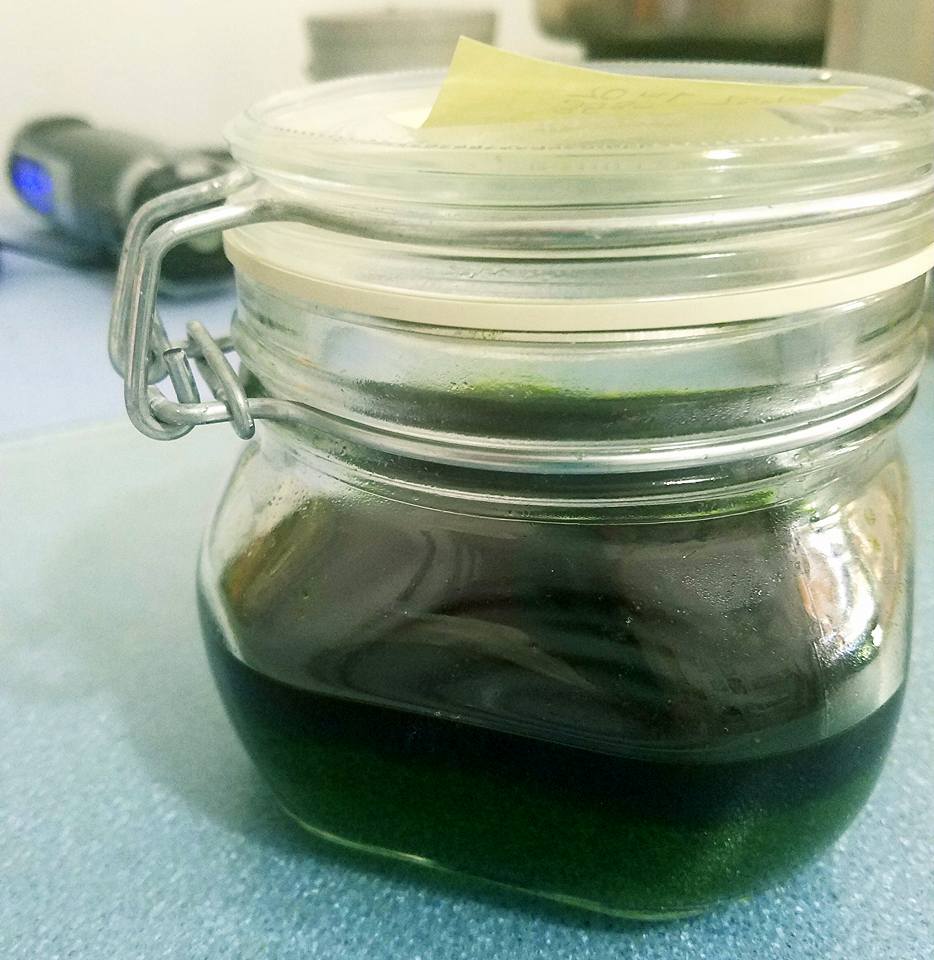
Macerate 125 g of dried herb in 500 ml of alcohol. If you grind your herbs well and have a good press you won’t lose much. It is usually just short of 500 ml of 1:4 tincture. You can top it off if you would like. Use this tincture to macerate a further 125g of herb and you are at 1:2. Do this until at the end, you have macerated 500 g of dried herb in 500 ml of alcohol.
Why Use Tinctures?
If we have fluid extracts which deliver a uniform-ish amount of concentrated plant constituents every time, what is the purpose, or usefulness of making tinctures? Making a tincture is a process that recognizes that we can’t catch all the useful constituents of a plant, with high-potency alcohol nor is it necessarily desirable.
My Tincturing Spread Sheet.
I take a kind of middle-of-the-road approach based on what I learned in phytochemistry and decades of fiddling around. I have attached a printout from my Excel sheet where I keep most of my notes.
If you don’t see something on here it is because I don’t make an alcohol preparation with certain plants such as marshmallow, astragalus, Irish moss, and so on. Some plant constituents just don’t extract ethanol and they are not for tincturing.
Some plants are on here, but I don’t do them like this a lot. I am more likely to make a mugwort or wormwood acetum than I am a tincture. There are also some plants there that you might be surprised to see. I work with historical herbs, and I don’t advise that people without advanced training make these tinctures or use them.
I work mostly with fresh herbs I’ve grown myself. I usually wilt my herbs for 24 hours because I can’t buy 95% alcohol in Iowa. It is illegal. I work with all resins the same way, so I don’t repeat them.
Finally, when I am making tinctures, there are a couple of tricks I use to save money on alcohol, while at the same time making more potent preparations.
Recycling Tinctures
You can use the previous year’s tincture as a menstruum for this year’s batch of tinctures if you have checked the alcohol content and it has a sufficient amount. This does not produce uniform preparations from year to year.
So, you must keep good records to adjust your dosing strategies. Most people don’t want to bother with this, but it can save money for people on a budget due to running a free clinic or working on sliding fee scales.
Secondary Extracts
You can also use a spent percolation marc to make a secondary extract that will be used as the menstruum a second batch with dry plant material if you run out during the winter.
- Shrewsbury, Robert P. Applied Pharmaceutics in Contemporary Compounding. 3rd ed. Denver, CO: Morton Publishing Company, 2015. ↩︎
 Domestic Medicine
You must be logged in to post a comment.