As much as I love manuscript receipt books, I want to mention another favorite source that I draw my research from. On a whim one day, I volunteered to do some transcription for The Schools’ Collection which is a body of folklore collected by Irish schoolchildren in the 1930’s and compiled into handwritten volumes. I thought it would be interesting to see the similarities and differences between what I learned from country folk of the diaspora in the US, as opposed to what the country folk knew over there.
Reading those leigheasanna & pisreóga reminded me very much of my family folkways – especially those pertaining to rural living. The entries have been influenced by some romantic nationalism but are old enough not to be tainted by all the Llewellynized neopagan inventions about “The Celts” that cropped up in the late 20th century.
I admit that I bought into it all at one point. I grew up in a leprauchaunized diaspora and I still dedicate March to lots of good green plastic hat fun. My daughter is a step-dancer who danced with the Chieftains, Lunasa, and Gaelic Storm. I play a Killarney Whistle, and have done a bit of dancing myself.
I think that’s why it was so easy for me to understand when I read about the monastic invention of Irish druids and “things you think are Celtic but are not.” Unlike a lot of people who are looking for the sensational and fanciful from their dive into Celtic fakelore, I was looking for reminders of my family. I wanted to see the every day and the mundane.
Aside from the personal appeal what I found particularly compelling about the entries in the Schools Collection is that they are evidence of the continuous use of particular remedies that were written about in earlier manuscripts. There are other entries that simply advise cooking the turnip and eating it. That’s something that you see in Elizabeth Grey Kent’s published work.[1]
There are so many entries that mention turnip juice for a sore throat that I think it to be one of the more common folk remedies along with black currant drink for a cold. I think that’s significant because it speaks to the longevity and persistence of domestic medicine. There are no “lost remedies.” That’s just something people have told you to sell classes and books. The information is out there for free if you just poke around.
That brings me to our receipt. I had heard people in my family talk about turnip syrup for sore throats but no one ever mentioned how to make it. I thought that was because it was a lot easier to juice an onion. It didn’t seem very practical to juice turnips until I stumbled upon the methodology in the Schools’ Collection.
There are many cures suggested for a “Cough”-: slice a turnip and place two slices of it in a bowl and put Sugar between them and the juice that is extracted from the turnip is very good for a “Cough.”
Mr. William Moloney Co. Tipperary
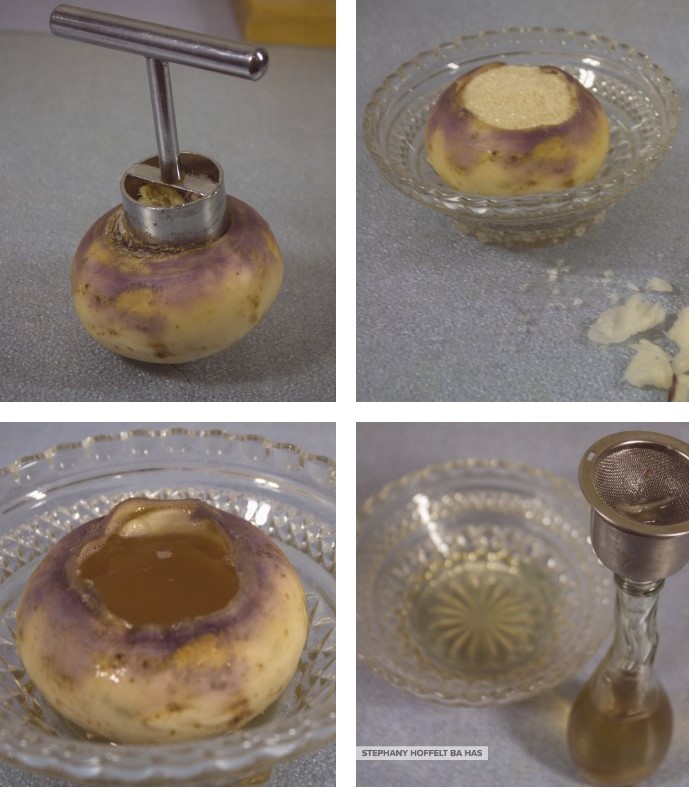
That is so easy. I also learned that you can juice onions this way too and I am absolutely doing this in the future because it will lead to far fewer tears in the kitchen. Many of the entries mention using brown sugar, but none of them suggest honey. I would imagine that because honey is hygroscopic like sugar it would work similarly.
I like to leave the bees alone as much as possible and work with a lot of vegans, so I stick to using fair-trade raw sugar. Sugar is a known humectant which means that as it coats the epithelial tissue it draws moisture from deeper in the tissue and hydrates dry irritated tissue.
There are certainly many more pleasant additives to choose from, so you might be wondering, why turnips? Turnips contain chemical constituents called glucosinolates. These constituents have many constituents that inhibit inflammation but perhaps the most pertinent to our remedy is that they act as mast cell inhibitors. This means that they stop mast cells from breaking down and releasing histamines, which makes them particularly helpful to folks who suffer from seasonal allergies.[2]
It’s meant to be taken like any OTC syrup, so one tablespoon three times daily, or as needed. They also used this method to “juice” turnips with salt and applied it topically to chilblains which is a very mild form of frostnip, and to remove corns.
References:
[1] Kent, Elizabeth Grey. A Choice Manual of Rare and Select Secrets in Physick and …; Published by W.I., Gent. 1st ed. London, England: Printed by G.D., and are to be sold by William Shears …, 1653.
[2] Akram, Muhammad, et al. ‘Health Benefits of Glucosinolate Isolated from Cruciferous and Other Vegetables’. In Preparation of Phytopharmaceuticals for the Management of Disorders, edited by Chukwuebuka Egbuna, Abhay Prakash Mishra, and Megh R. Goyal, 361–71. Academic Press, 2021. https://doi.org/10.1016/B978-0-12-820284-5.00006-X.
 Domestic Medicine