
We have the first three confirmed cases of this blasted virus in our town and not surprisingly all contracted it on a cruise ship. I am reminded of a story I heard once about the cnotan na gall – the “strangers cold” that came in on a vessel from a faraway land.
I needed a break from the WHO modules I have been running through, so I decided to write a history post because I felt the need to connect with my roots a little. My maternal grandmother was born in 1907. This means that when the flu pandemic of 1918 hit, she was an eleven-year-old helping her mother care for her siblings. As I’ve mentioned before her dad died during that pandemic and her mother had a premature baby due to complications of the flu so you can imagine life lessons came early for her.
It seems that when Grandma was little the lives of poor, rural people were similar on both sides of the pond. When I came across first-hand accounts of the 1918 pandemic in the NFCSC material, they sounded like stories older family members had told me. These stories in the collection were gathered about 20 years or so after the pandemic swept Ireland.
“In the year nineteen hundred and eighteen an epidemic of influenza spread over the country. It was one of the most fatal diseases in history. It sent more people to the grave than were killed in the great war. Owing to the war there was a scarcity of foodstuffs and beverages which if plentiful would hinder the spread of the disease. This disease which started as a germ in the air spread from Europe to the United Kingdom. It was an uncommon sight on an Irish country – side to see coffin after coffin being borne to the grave-yard.
Very few houses escaped its ravages. This was the first time that influenza became known as a fatal disease. No year has passed since, without it claiming some victims. The influenza of nineteen hundred and eighteen ranks in the hearts of the people as the greatest disease in living memory. It carried away hundreds of victims, including priests, nuns, doctors, and nurses.” [1]
Mr. Patsy Corrigan of Co. Cavan as told to Breda Callaghan,
One of those nuns had this to say:
“An epidemic of influenza broke out in Ireland in the year 1918 and it lasted for about three months. There were a lot of people stricken down with it and many of them died from the effects of it. It was different from the usual influenza cold, as very often people were nearly better of it, but got pneumonia and died.
In some houses all the inhabitants were sick together, and as the neighbors were frightened of the dread disease they did not like to go near them, so they suffered great hardship as they had nobody to nurse them. The Doctor was kept so busy that he had not time to visit all his patients every day. The shops in the villages were closed and a gloom was cast over the place. When people died their coffins were not brought to the Church fearing the germs of the disease would be spread, when crowds congregated for the funeral.”[2]
Sister Ní Chonaire Co. Westmeathe
It gave me a moment’s pause to reflect on what it would be like to live during a pandemic like that when there was no PPE, no antibiotics, and no oxygen therapy. It hurts my heart because I know many people in our society still don’t have access to those things today. I sometimes feel foolish making recommendations about herbal adjuncts they don’t have access to either.
What I wanted to do was to look at these first-hand accounts and draw some conclusions about how people weathered these events in the past. I don’t think it’s particularly surprising that social interactions were curbed considerably. We should be following that lead.
Mr. Corrigan’s observation that the war had left people short on healthy foods and beverages bears thinking about. Back in those days, it was typical for households to put up a good store of relishes, jams, jellies, cordials, and liqueurs made from a variety of fruits and vegetables.
The variety of phenolic compounds in the condiments in their diet was probably triple that of the standard American diet (SAD). I don’t have any good proof of that other than knowing that mine was growing up. The fact that people don’t eat a wider variety of nutritional phytochemicals anymore contributes to the modern epidemic of chronic diseases.
My people weren’t putting up closets full of herbal tinctures. They were putting up preparations full of wholesome foods and the kind of herbal “remedies” that we should be eating every day. My grandmothers and mother had huge gardens and gleaned fruit from all over the countryside to put up a variety of syrups, juices, jams, and jellies for the winter along with their garden produce. I loved it when Mom made jelly because she sealed the jars with paraffin, and I liked to dip my fingers in it and play with the wax.
I grew up country-poor. We had to put enough food away in the fall to get through winter. If we didn’t, we ate mealy potato soup for weeks in the spring. As a young single parent, I lived with the reality that I was going to run out of food in the pantry long before the next paycheck arrived, and there were no food pantries to help in small rural towns. I still don’t love potatoes and I will never get over the fear of running out of food before the garden comes in or the next paycheck.
Those skills I learned as a kid serve me well. I am pretty stocked up most of the time. The only thing I bought compulsively was a big box of apples and a bag of oranges, while everyone else is stockpiling hand sanitizer and toilet paper. I am laughing about this now as I reread this because we ran out of toilet paper and a friend had to save us.
This brings me to another thing these stories brought up for me.
Sr. Ní Chonaire felt like it was their neighbors’ fear of going in and taking care of people like they would have normally done that led to so many people passing on. I think that’s worth thinking about. Today in most places neighbors don’t do that at all, but then it was customary for people in a community to stop in and help when someone was sick or had just given birth.
I am not suggesting we all put ourselves in harm’s way, but I am suggesting that we need to pull our heads together and plan to do something. The kind of preparedness I advocate for is being prepared to help yourself and your neighbors like that regardless of what comes along- be it a pandemic or just general hard times.
This weekend I made up a roaster full of broth so that I can make some “sorry you are sick” soup and drop it off on people’s doorsteps. We are making the brew pot full of ham and bean soup because we have some care packages for the mutual aid collective to deliver this week, too.
A lot of the things I send like chest rub and herbs for steams are not things you will have around your house, but I thought I would give you a few recipes for other things you could include in a care basket to comfort people when they are ill that contain ingredients that you could pick up at the store and not have to order online. And you know me, I love to trace things back to my roots, so I included some historical references just for fun.
Black Currant Tea or Syrup
Judging by the folklore commission accounts, black currant tea was probably the most common cold remedy made in homes at the turn of the 20th century in Ireland. They also called them Quinsy berries. Quinsy is a complication of tonsillitis that we call a peritonsillar abscess, these days. The tried-and-true grandma’s way of making the “tea” is explained here:
“This is a cure for a bad cold. Before going to bed at night make a good mug of black currant drink. But only put a tea spoon-ful of black currant jam in the mug. Then fill it up with hot water and let it cool off. Do that for two or three nights and your cold will be gone in three days.” [3]
Mrs. Quinn of Co. Dublin
You also see black currant syrup recommended for relieving coughs. There is modern clinical research to support the idea that current preparations are a useful adjunct when you are ill. It’s been studied a lot because it is a long-standing tradition in Ireland and the UK.[4]
You can tuck a jar of black currant jelly in a basket with instructions on how to make it. If you can’t find black currant jelly, blackberry would work too. For what it’s worth I think a teaspoon is a little stingy. I use a good tablespoon, but maybe my mugs are bigger, or my spoons are smaller?
Blackberry Brandy
Modern herbalists often write about taking blackberry root infusions for diarrhea (the leaves work just as well), but the anthocyanins in from the berries are what you want during cold and flu season. Some old-timers simply stewed the dried berries and strained the juice through a jelly bag. Others preserved the fresh juice by making it into wine.
“Blackberry Wine. Stew the blackberries with sugar. This cures colds.”[5]
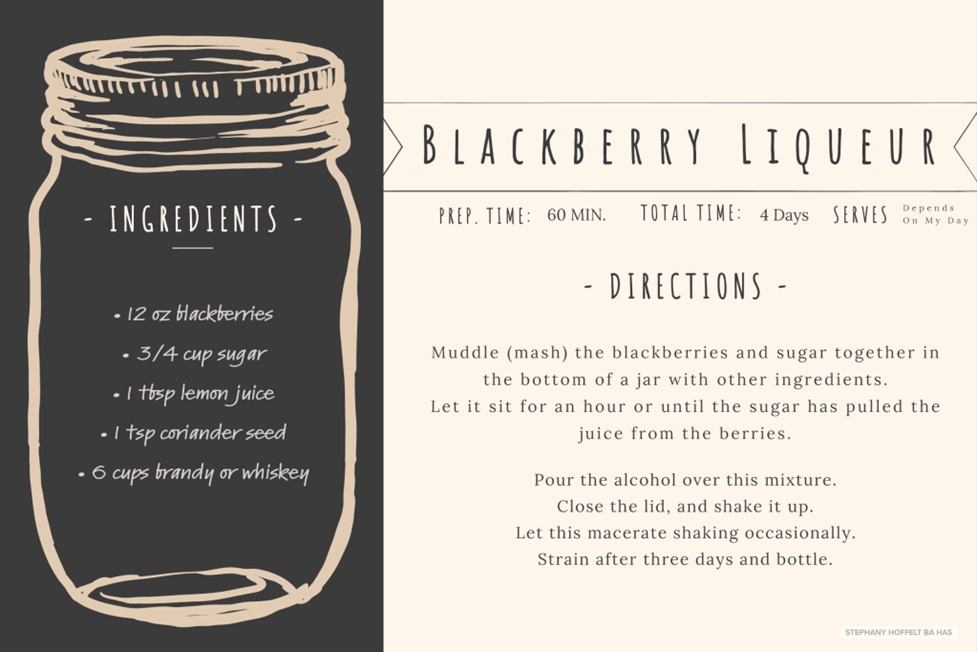
I don’t have any blackberry wine made and we drank up the cranberry wine, but I am thinking I will make up some blackberry liqueur to have on hand. I have this quick recipe for making it:
Highland Bitters
This bitters recipe is quite simple. I’ve adapted it from one of my favorite history books in which the author shared this anecdote.
“On the sideboard there always stood before breakfast a bottle of whisky, smuggled of course, with plenty of camomile flowers, bitter orange-peel, and juniper berries in it — ‘ bitters ‘ we called it — and of this he had a wee glass always before we sat down to breakfast, as a fine stomachic.[6]
Osgood McKenzie A Hundred Years in the Highlands 1921
Normally I would say that fresh is best, but it is winter and if fresh can’t be found dry will do. They sell juniper berries in the spice section of the bigger grocery stores, and you can use chamomile from tea bags. If you can’t afford juniper berries look for a cedar tree or use some pine needles.
Ingredients
1 cup chamomile flowers (you can use the tea bags you buy at the store)
¼ cup orange peel
¼ cup juniper berries
1 bottle of whiskey
Directions
- Grind the ingredients, and put them in a jar with an airtight lid
- Pour the whiskey over top.
- Close the lid and shake every couple of days for two weeks.
- Strain through butter muslin and bottle it.
You can drink it like Sir Mackenzie up there did or you can put just a small amount in some hot tea or in some sparkling water.

Also, think about tucking useful things in a care package that could provide people comfort like a hot water bottle with a wool cover. or you can also sew up DIY rice heating pads. Heat is a wonderful adjunct. It can relieve aches and pains by causing muscles to relax which in turn helps people rest. It can ward off the chills that often accompany an illness. People who know me know that I have had a long love affair with my hottie, so it made me smile to come across this recommendation:
“Yarrow is one of the most valuable herbs that grows in the district. It is great for curing colds influenza and all classes of fevers. If you have a cold, influenza or fever, go to bed between two blankets, have a hot-water bottle placed to your feet and drink a cup of hot yarrow-tea.”[7]
Ellen Evans of Co. Wicklow
You could also share a reusable ice bag and a big bag of ice. I recently discovered these cooling cloths which work nicely also. I find that tucking an ice bag under the base of my neck helps with a headache. Migraine sufferers should try my favorite trick which is an icebag under the neck and a hot water bottle at the feet.
References
[1] NFC: The Schools’ Collection Volume 1000, Page 337-338
[2] NFC: The Schools’ Collection, Volume 0734, Page 402
[3] NFC: The Schools’ Collection Volume 0798, Page 103
[4] Ikuta, Kazufumi, Koichi Hashimoto, Hisatoshi Kaneko, Shuichi Mori, Kazutaka Ohashi, and Tatsuo Suzutani. ‘Anti-Viral and Anti-Bacterial Activities of an Extract of Blackcurrants (Ribes Nigrum L. ): Anti-Microbial Activity of Blackcurrants’. Microbiology and Immunology 56, no. 12 (December 2012): 805–9. https://doi.org/10.1111/j.1348-0421.2012.00510.x.
[5] NFC: The Schools’ Collection Volume 0740, Page 101
[6] MacKenzie, Osgood Hanbury. A Hundred Years in the Highlands. London, England: Arnold, 1921. http://archive.org/details/hundredyearsinhi00mack
[7] NFC: The Schools’ Collection Volume 0915, Page 165
 Domestic Medicine
One thought on “Pandemics and Preparedness”
Comments are closed.