
I wanted to put this up before our green friends started to pop up and I thought today was fitting. Although with all the snow we have, it seems silly to be thinking of that now. In the days before we had year-round access to produce, spring was when people often addressed nutritional deficiencies of the winter by loading up on the early greens that pop up.
I know that you have been told that they did this by drinking a lot of “nourishing infusions” but that’s not the case. They mostly just ate them. It’s a long-held Irish belief that eating nettles three times in May, specifically the three days between old May Day and new would protect your health for the coming year.

I shared my base recipe for a spring pottage using leeks as the potherb when I posted my Brotchán Foltchep recipe, years ago. When I make a nettle pottage, I simply replace the leeks with blanched and chopped nettles.
In my opinion a pottage must have some sort of fresh ingredient. When reading through old receipts I have noticed that fresh potherbs are the key ingredient that often distinguishes a pottage from other dishes such as mortrews. Potherbs can be loosely defined as any fresh plant picked from the garden and thrown into dish. Robert May, a well-known cook who worked for Elizabeth Grey, Countess of Kent, shared this receipt in which he lists some suggestions.
Pottage of Mutton, Veal, or Beef, in the English fashion
Robert May 1660
Cut a rack of mutton in two pieces, and take a knuckle of veal, and boil it in a gallon pot or pipkin, with a good store of herbs and a pint of oatmeal
chopped amongst the herbs, as time, sweet marjoram, parsley chives, salt, succory, marigold-leaves, and flowers, strawberry-leaves, violet-leaves, beets, borage, sorrel, blood-wort, sage, penny-royal; and being finely boiled, serve them on fine carved sippets with the mutton and veal, &c.
Modern Directions
1. Place the meat in a pot and cover it with water. A rack of mutton would be cut perpendicularly to the spine and include the 16 rib bones. You can also still purchase veal knuckles. You could also use a whole chicken or any game animal.
2. Mince the herbs and then throw them in the pot with the oatmeal.
3. Simmer this for a long time until the meat is cooked off the bone.
4. Remove the bones from the pottage and serve over sippits.
Herbs put in the spring pottage were those that popped early in the spring and were said to nourish or “sweeten” the blood. Nettles, wild garlic, leeks, and cleavers were common ingredients in spring pottages. The English surgeon, John Gerard wrote of a pottage made with mutton bones, cleavers, and oatmeal. Elizabeth Clelland shares a recipe for a summer pottage in her cookbook published in 1755, that calls for sorrel, beet greens, endive, and spinach.
I think clever women just devised a way that was easier to get certain greens into people in the form of creamy soups. That brings me to another important part of this which is how to cook with leafy greens.
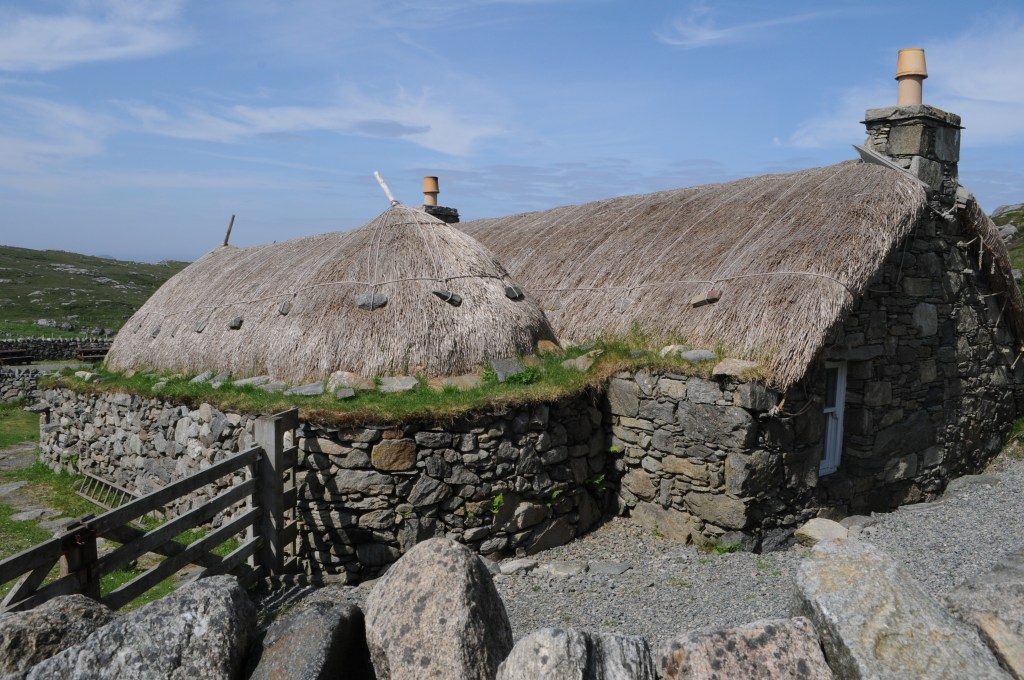
In The Scots Kitchen (1929) we are told to gather young nettles from patches growing high on the wall (nettles were often planted on the walls of Taigh-Dubh like the one below) and strip the 4 or 5 most tender young leaves from the top of the plant and then wash in several changes of salted water. So even though my family didn’t use salt, I started adding a little salt.
There’s a very sensible reason to do this. Nettles and a lot of other leafy wild greens are particularly high in soluble oxalates. Too much prevents our body’s assimilation of soluble calcium by binding with it to create insoluble complexes which contributes to diseases like kidney stones. Oxalates also contribute to inflammatory issues like gout.
Boiling leeches out soluble oxalates in vegetables by 30-87%1 so if you discard the water the greens are first cooked in, you are pouring a lot of them down the drain. It didn’t matter if you were putting it in a tart or soup. That’s how they managed greens.
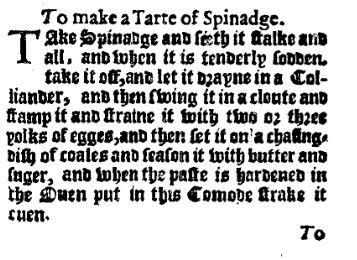
It’s the same way Southerners work with poke leaves. I can mention dozens of examples where cooks of old recommended blanching the leaves and tossing out the cooking water at least once before eating them.
I was taught to do this three times for some greens like nettles. We sometimes used the first batch of nettle water as a hair rinse. I might add a post about using the roots for decoctions and making nettle drink at some point.
My recommendation to you is to harvest your spring greens and eat them in tasty dishes when they are fresh, and then move on to other greens as they pop up. It’s far more enjoyable than choking down a bland infusion of dead dry leaves and it’s a little safer in terms of the oxalate content.
Nettle Kail is a twist on a pottage. It was traditionally served on Shrove Tuesday in Scotland. I can’t do that here because my nettles are still slumbering that early in the year and I wouldn’t eat or drink dried nettle unless I was actually starving. You can easily make this recipe with spinach, chard or some other green from the grocery store if you want to serve it on the day.
Nettle Kail
Adapted from The Scots Kitchen (1929)
Ingredients
1 small chicken
1 pint of blanched/chopped young nettles
1 handful hulled barley (appr. 1/2 cup)
4 ounces oatmeal (appr. 3/4 cup)
2 ounces butter (1/4 cup)
Salt
Pepper
Wild garlic, mint, chives
Directions
- Prepare the nettles by tearing off the tender leaves and blanching them in boiling water.
- Cut the butter into the oatmeal with a pastry blender. This is not referring to rolled oats but a coarsely ground meal of oats similar to corn meal. If you do not live where oatmeal is available, you will want to grind steel cut oats to a fine meal or use oat flour.
- Add the salt, pepper and chopped garlic or mint and then stuff the chicken with this mixture and use a couple of bamboo skewers to close the bird back up as best as you can. You can sew it shut if you are really ambitious.
- Put this stuffed bird and 1/2 cup barley into a large soup pot with two quarts of cold water. If you have a pan with a rack, you might put it on the rack. My Instant Pot rack fits in my soup pot.
- Bring the chicken to a slow simmer over medium heat and add the nettles when the water boils.
- Simmer over low heat until the temperature of your chicken is 180 degrees. This chicken is tender and falls off the bone very easily, so you are going to want to lift it out of the mixture very carefully and then serve the chicken and stuffing with the soup as a side dish. I’ve read that some people strain some broth off the soup for using for another purpose.
References:
- Hamid, Ns Thakur, and Pradeep Kumar. ‘Anti-Nutritional Factors, Their Adverse Effects and Need for Adequate Processing to Reduce Them in Food’. AgricINTERNATIONAL 4, no. 1 (2017): 56. and Chai, Weiwen, and Michael Liebman. ‘Effect of Different Cooking Methods on Vegetable Oxalate Content’. Journal of Agricultural and Food Chemistry 53, no. 8 (20 April 2005): 3027–30. ↩︎
 Domestic Medicine
You must be logged in to post a comment.