
Friends saw me complaining on social media that since we had COVID-19, we have just had a bad run of getting ill every time one of our beloved germ carriers (otherwise affectionately known as the grandchildren) sneezes in our direction. We are working on immune building around here.
In the meantime, I get to sharpen my skills. We started out last week with norovirus and moved on to a head cold with out-of-control nonallergic rhinitis and sneezing. It’s been grand, let me tell you. But I digress. I was talking about my mastic syrup on social media, and someone asked if I would share the receipt.
I thought this was a suitable time to talk a little bit about my use of one of my favorite plant resins. Resins and gums were truly the “superfoods” of ancient medicine and are one of the distinguishing features of the Dioscoridian materia medica.
I use them often although I try to substitute local resins such as pine, spruce, or the resin of cottonwood buds when that substitution makes sense. But oftentimes I have found that they don’t work interchangeably, and I so use gums and resins that are sourced from far away — mastic, gum arabic, benzoin Boswellia, myrrh, and amber.
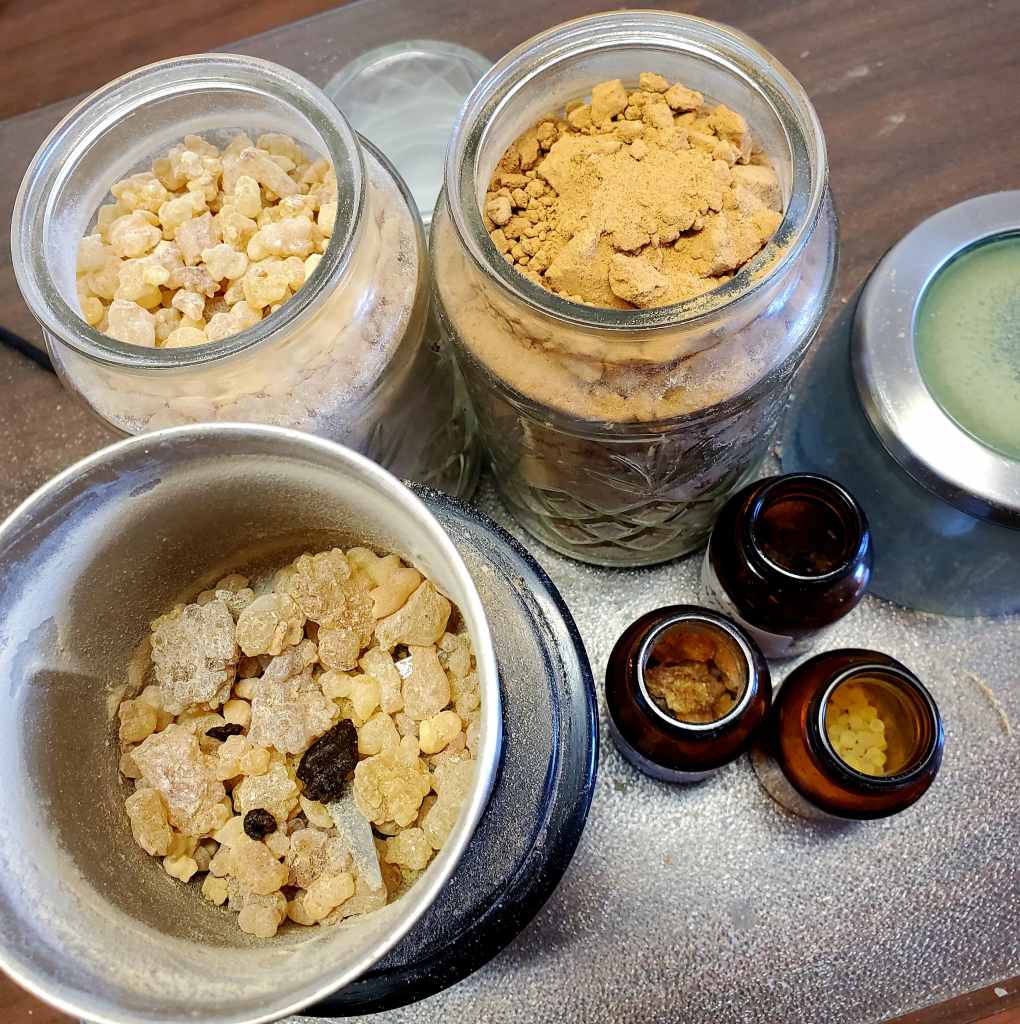
I feel like there is a difference between using newly “discovered” superfoods that pop into the market and ancient medicines in terms of sustainability issues. The communities that have grown up around areas where these resins are harvested have been involved in this commerce since antiquity. Their way of life is intrinsically tied to this commerce. So, while surges in popularity may cause harm to Indigenous cultures in other places, the production and sale of these resins are the Indigenous practice in these places.
My favorite of all is mastic because I love its story. There are four villages called mastichochoria on the Greek isle of Khíos whose day-to-day life completely centers around the production of Mastíha (gum mastic). It is a resin obtained from the Pistacia lentiscus var. Chia tree endemic to the island, although it has been naturalized in parts of Turkey.
The United Nations has added the knowledge of cultivating mastic to the UNESCO Intangible Heritage list. I am not entirely sure of the process except that it has something to do with cleaning the harvested resin in vinegar and letting that evaporate away. What I do know is that I only use mastic sourced from Chios.

The traditional method of delivery was chewing, and mastic was frequently an ingredient in the category of medicinal preparations known as masticatories. A masticatory is a medicine that was to be chewed in the mouth and was thought to hasten the evacuation of serous (watery, thin) humor. The simplest of these involved chewing mastic and then spitting it out. Here is a more sophisticated masticatory.
Take of Mustard-seed, Roots of Pellitory of Spain, Master-wort, Capers, Mastick, Amber, of each one drachm; let them be all beaten into a gross Powder, and tye up some of it in a Linen-rag and chew it in the mouth every day before Dinner and Supper.
Johnson, Robert. Praxis Medicinæ Reformata. (1700)
Mastíha (gum mastic) has been written about as a medicinal since the Greeks first started writing about medicine, and it continues to be researched by bioprospecting researchers today. The European Medicines Agency has confirmed its traditional use in addressing mild dyspeptic disorders and healing minor wounds and skin inflammation.
Clinical trials have featured mastic as a remedy for diverse GI complaints such as irritable bowel disease and the control of Helicobactor pylori. Mastic interferes with inflammation by inhibiting various steps of the inflammatory cascade including prostaglandin secretion, Nitric oxide synthase, and cycloosygenase (COX-2).1
The clinical trial on H. pylori2was interesting because mastic gum worked reasonably well on its own but did not work when used as an adjunct to the proton-pump inhibitor pantoprazole which leads researchers to theorize that mastic needs an acidic stomach environment to work. This makes sense in terms of digesting the powder.
There have also been clinical trials that compared the effectiveness of crude mastic to processed products as hypolipidemics and not surprisingly the crude mastic was more effective which was probably the opposite of the results they wanted to produce3. This study has led some to believe that the special way of cleaning and processing the resin in Khios lends to its efficacy.
Mastic was once widely available due to its use in dentistry and in the United States Pharmacopeia. While it passed out of use by physicians, you see it pop up in the empiric practice of the folk through the mid 20th century. This is what anthropologists call cultural sedimentation.
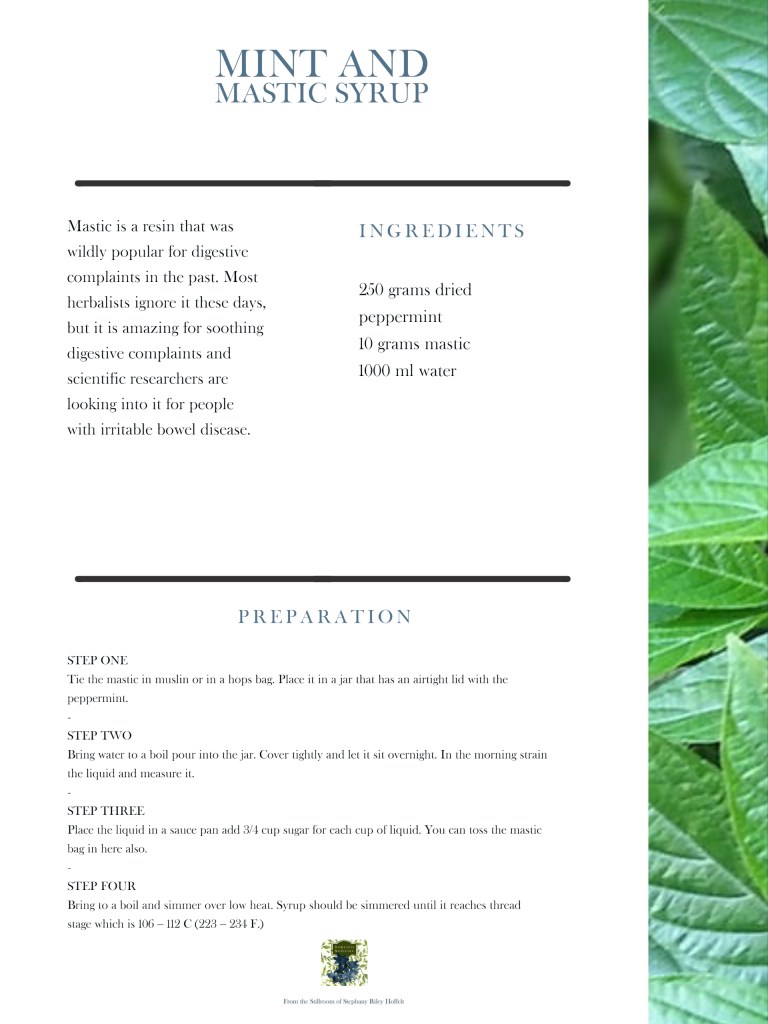
As I said I choose to work with it sparingly, so I really love making the syrup which I found in the Kitab al tabikh fi-l-Maghrib wa-l-Andalus fi `asr al-Muwahhidin, limu’allif majhul. It uses a reasonable amount of mastic, and I can put up a few 12 oz bottles of the syrup. (I bottle my syrups with our beer-bottling equipment.)
According to the source I use, this syrup is superior for its benefits to the stomach and digestion as it “cuts vomiting and binds the bowels and fortifies the liver4. My kids call it mom’s homemade Pepto-Bismol, but that is not necessarily a good analogy because peppermint is not appropriate for all GI complaints.
Peppermint relaxes the GI tract and the lower esophageal sphincter. It works well for any condition that would benefit by decreasing tone in the GI tract such as nausea, vomiting, diarrhea and possibly irritable bowel disease.5
This ring of smooth muscle fibers is located where the esophagus meets the stomach and it acts like a valve, opening to allow food and liquid to pass into the stomach, and then closing to prevent the contents of the stomach from flowing back into the esophagus. This backflow, when it occurs, is what we often refer to as acid reflux or heartburn, so we would not use this preparation for those conditions.
References:
- Zhou, L.; Satoh, K.; Takahashi, K.; Watanabe, S.; Nakamura, W.; Maki, J.; Hatano, H.; Takekawa, F.; Shimada, C.; Sakagami, H. Re-evaluation of anti-inflammatory activity of mastic using activated macrophages. Vivo 2009, 23, 583–590. ↩︎
- Dabos KJ, Sfika E, Vlatta LJ, Giannikopoulos G. The effect of mastic gum on Helicobacter pylori: A randomized pilot study. Phytomedicine. 2010;17(3-4):296-299. doi:10.1016/j.phymed.2009.09.010 ↩︎
- Kartalis A, Didagelos M, Georgiadis I, et al. Effects of Chios mastic gum on cholesterol and glucose levels of healthy volunteers: A prospective, randomized, placebo-controlled, pilot study (CHIOS-MASTIHA). European Journal of Preventive Cardiology. 2015;23(7):722-729. doi:10.1177/2047487315603186 ↩︎
- Anon. Kitab al Tabikh Fi-l-Maghrib Wa-l-Andalus Fi `asr al-Muwahhidin, Limu’allif Majhul. Edited by Martinelli, Candida. Translated by Perry, Charles. 2012 Reprint. CreateSpace Independent Publishing Platform, 1200. ↩︎
- Alammar N, Wang L, Saberi B, et al. The impact of peppermint oil on the irritable bowel syndrome: a meta-analysis of the pooled clinical data. BMC Complementary and Alternative Medicine. 2019;19(1). doi:10.1186/s12906-018-2409-0 ↩︎
 Domestic Medicine
You must be logged in to post a comment.