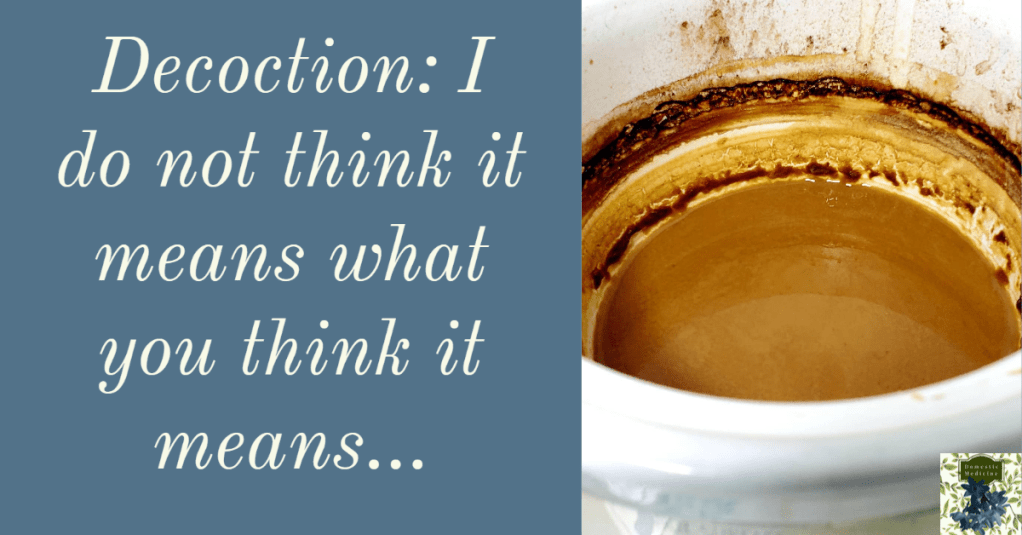
For years we have been told that the only difference between a tea and a decoction is that a tea is macerated while a decoction is simmered and that both are strained before drinking. I try to push back against this idea occasionally, but I always get put firmly in my place by the tea drinkers.
The more I transcribe receipts, the more I find myself questioning if this was the case during the period I typically research (pre-1700CE). Normally when transcribing, I only carry down the words the author has written because that is what is of historical importance, so I don’t have to think about it.
When I have my herbal practitioner hat on, I modernize receipts in a way that assumes certain things and one of those things is that a decoction is meant to be strained, because that is what I was told by modern herbalists.
Truly though we have no way of being certain that the author meant for you to do so. Especially if they mentioned straining other preparations in the same document while omitting it in others. It was something that I had been stuck on for a while.
It wasn’t until a friend sent me a link to an article about the way the early Chinese consumed tea (Camellia sinensis) leaves, by chewing on them or eating them in gruel-like dishes, that I began to seriously research what humoral physicians might have meant by the word decoction. That recipe for pounded tea reminded me a lot of some of my decoctions. I decided to jump into a rabbit hole and here’s my brief summary.
In ancient Greek medicine optimal health depended on proper “coction” of the humours so that they could be easily eliminated from the body. That’s why medicines that were thought to thin or cut the humours supposedly made them easier to eliminate from the body. Coction is often poorly translated as cooked. That doesn’t make any sense at all if you think about it. It’s better to think of coction as the substance having been somehow brought to a proper consistency or ripeness.
When a food or medicine is decocted, it is broken down by simmering with water to be more easily digested. Greek physicians stressed that the proper digestion of food and drink, was necessary for the humours to be of the proper consistence for elimination and considered χυλός (slops or gruels) to be a vital part of nutrition and medical treatment.
The Hippocratic corpus “prescribed” a gruel made of alphita (ground barley meal), red wine, goat cheese, and honey called kykeôn. They also recommended medicinal beverage ptisanē, made by simmering barley grains. The name was derived from the root ptíssein meaning to peel or crush, and likely spoke to cooking the barley grains to a crushable softness.
There seemed to be no consensus as to whether the grains should be strained away or not, and the Hippocratic author of Regimen in Acute Diseases didn’t seem to think it much mattered.
“Certain physicians, during their whole lives, are constantly administering unstrained ptisans, and fancy they thus accomplish the cure properly, whereas others take great pains that the patient should not swallow a particle of the barley (thinking it would do much harm), but strain the juice through a cloth before giving it; others, again, will neither give thick ptisan nor the juice, some until the seventh day of the disease, and some until after the crisis… For the most part, then, the results are the same, whether the patient have used the unstrained ptisan or have used the juice alone…”[i]
Galen didn’t think much of watery beverages and insisted that unstrained ptisanē would be better for digestion.[ii] “For, supposing a rapid descent were dependent upon emulsification,2 then soups, milk, and barley-water would at once pass along in every case. But as a matter of fact this is not so. For in people who are extremely asthenic it is just these fluids which remain undigested, which accumulate and produce gurglings, and which oppress and overload the stomach...”
Over a thousand years later we find a much busier version of a barley decoction in the Pharmacopoeia Londinensis and there’s still no clear guidance on whether or not it is supposed to be strained. Given the obsession with emulating Galen humoral physicians displayed, there’s no reason to believe that they would disagree with him about this.
A common Decoction for a Medicine.
Take of French Barly a pugil, six sweet Prunes, Rai∣sons of the Sun, Tamarinds, Liquoris, of each half an ounce, Annis seeds, sweet Fennel seeds, of each two drachms, in Summer time ad of the four greater cold seeds, of each two drachms, of each of three of the cordial Flowers, a pugil and an half, boyl these in two pints of water till half be consumed.
It’s not as if our ancestors were averse to drinking sludgy beverages. In medieval times the difference between a gruel and a pottage was that a gruel was meant to be drank while pottages were sopped up with bread and eaten like soup, although soup is a French fad that would come later.
While Culpeper vaguely defined decoction as the liquor in which something was boyled, that doesn’t always play out in other documents. Some practitioners direct readers to strain some decoctions and not others. Sometimes they would spread a decoction on a piece of linen and apply it like a poultice. There are times when receipts instruct readers to take them for break fast in place of their morning gruel.
Obviously, they strained decoctions meant to be used as clysters (enemas). They suggested straining decoctions meant for a medical solution known as a gargaris which is an archaic name for a gargle. There seems to be a pattern of straining decoctions that contained roots or other plant material that would not cook down enough to be drank, but again our idea about what is drinkable is quite different than theirs.
The question of straining aside, medieval and early modern practitioners would still probably get a chuckle out of what we call decoctions. Their formulas and receipts usually call for using fresh plant material (when available), chopping ingredients finely, and decocting them in water, ale, or wine until the liquid is reduced by half.
Once you begin making these decoctions according to early modern directions, you will find that the result is often, as many of our domestic medicine practitioners are fond of saying, “the consistency of an electuary.” This means that they are thick like reductions. You can see my astragalus decoction in the header picture. It doesn’t make for a very aesthetic photoshoot, does it? That’s one of my thinner decoctions. Some of them end up looking a lot like creamed spinach.
Medieval and early modern infusions were not even like our infusions. The practice of pouring hot water over dried or fresh plant material to make a beverage was not at all common. It’s not because the water wasn’t safe. That’s a myth. It is because it went against that basic principle of Galenic theory that food and medicinal preparations must be cooked for some length of time for optimal assimilation.
I rarely encounter the word infusion aside from describing preparations made from flowers for turning into syrups or infusing ingredients in some sort of alcohol before distillation. Culpeper used the word infusion very specifically for placing flowers in water to make infusions for making syrups. “That one pound of Rose flowers may be infused in four pints water, and those being taken out, infuse as many more in the same water, do so nine times. He also advised that “it is not best to boyl any syrup made of infusions, but by adding the double weight of Sugar (viz. two pound of Sugar to each pint of Infusion) melt [dissolve] it over a fire only.“[iii] I think this suggestion may ultimately define the difference, in the UK at least, between their non-alcoholic cordials and syrups, but that’s just conjecture.
He seems to have the same concern I have about boiling away aromatics. I am not sure I think much of his workaround. It’s not going to store well because it would be prone to fermentation. My personal opinion is that it is better to take the extra steps and just make wine, mead, or a distillate out of aromatics. There’s also the nifty trick of infusing aromatics with a simple syrup, but again these are going to have a substantially shorter shelf-life than a syrup. I do love elderflower cordial made this way, though.
Towards the end of the 1600s, people seemingly began to rethink their relationship with sludgy beverages. Coarseness…. whether it be in the texture of a fabric, the milling of grains, or the consistency of a beverage…. was associated with the common people. The wealthy became accustomed to the “finer” things. In Kenelm Digby’s directions for making water gruel (another name for a thin oatmeal gruel), he advised allowing the oats to settle to the bottom and ladling off the clearer liquid for the household members, while leaving the thicker gruel at the bottom for household staff to drink.I don’t think that it is a coincidence that this is the time coffee, black tea, and French tisanes, also gained in popularity.
They were also starting to use chemical ingredients like sulfur and mercury more and herbal medicines took a back seat to those preparations in terms of efficacy, so the need for strong decoctions dwindled.
I wager some people won’t agree with what I have to say here but this explains a lot to me about why I often hear “herbs don’t work for some people” and why I can get away without turning to tinctures as often as some practitioners. My decoctions are far stronger than anything many people make.
Please don’t misunderstand me, I love beverage teas. I am sipping on a hibiscus and orange blend, as I write this. I absolutely recognize their value as a source of nutrients and beneficial phytochemicals.
I don’t believe for a moment that they replace my more concentrated preparations in terms of efficacy. Whoever gave people the idea of a small amount of plant material simmered for 15 minutes being a medicinal decoction, has missed the mark.
[i] Hippocratic Corpus. On Regimen in Acute Disease. Translated by Adams, Francis, 400AD. http://classics.mit.edu//Hippocrates/acutedis.html.
[ii] ‘Galen, On the Natural Faculties., BOOK THREE, PART 4’. Accessed 27 February 2023. http://www.perseus.tufts.edu/hopper/text?doc=Perseus:text:1999.01.0256:book=3:section=4&highlight=barley#note-link3.
[iii] Culpeper, Nicholas. Pharmacopoeia Londinensis: A Physicall Directory, or, A Translation of the London Dispensatory Made by the Colledge of Physicians in London. London, England: Printed for Peter Cole and are to be sold at his shop, 1649. https://archive.org/details/b30336879_0001 pp 114.
 Domestic Medicine
One thought on “Decoction: I do not think it means what you think it means”
Comments are closed.