
Sometimes when we are digging in old texts we find phrases we don’t have any context for like “the consistency of an electuary” or “according to art.” It can be really frustrating to be told to make a particular medicine “according to Arte” if you haven’t apprenticed with an apothecary.
Sometimes physicians and apothecaries reinforced the exclusive nature of the “Arte” of Physick by publishing things in Latin and giving vague directions that only someone in the industry would understand. Unfortunately, most people translating books into English didn’t address that. You even find this in handwritten receipt books, probably because they had copied the receipt verbatim out of some book.
Usually if you look around, you will find a receipt or two that provide more instruction. In this post, I wanted to help you to understand what “the consistency of an electuary” means when you see it in receipts, and how to make one.
An Electuary to be taken for the Plague.
Take the weight of ten graines of Saffron, two ounces of the kernels of Walnuts, two or three Figs, one drachm of Mithridate, and a few Sage leaves stamped together, with a sufficient quantity of Pimpernel water, make up all these together in a masse or lump, and keep it in a glasse or pot for your use, take the quantity of twelve graines fasting in the morning, and it will not onely preserve from the Pestilence, but expel from those that be infected.[1]
Elizabeth Grey 1653
Unless you find yourself inspired to try to recreate Mithridate we can’t approximate this receipt modernly, but it’s a good description of the consistency, storage, and dosage. In another receipt she gives us even more specific instructions.
“Stamp it [a syrup] with the pouders in a Morter until all be well mixed and hang to the Pestle, and then it is perfectly made, then put the Electuary in a stone pot well sealed, and so it will continue twenty or thirty years.”
I don’t know about all that. I tend to make mine up in small amounts as I need them because I like them better fresh. But this gives you an idea of the consistency of an electuary and the process of making one.
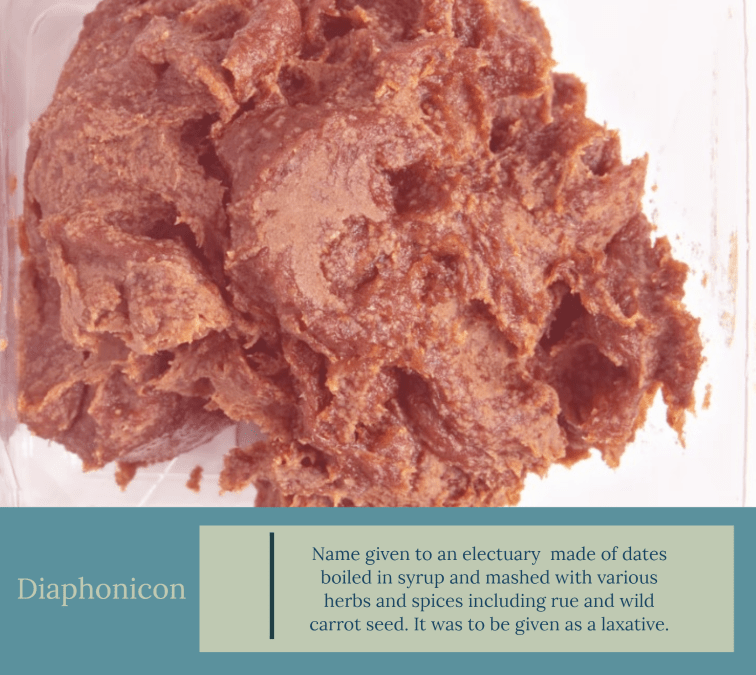
A “well formed” electuary is meant to be a thick paste. This is important if you plan to move back to a more traditional form of medicine-making. Following older receipts precisely will help us to maximize the potency of the remedies that we make when we aren’t falling back on using ethanol as a menstruum.
The more fluid electuaries that people make today are closer to what Culpeper called a lohoch which he explained had a consistency between a syrup and an electuary.[2] I have also seen this type of preparation called a soft or thin electuary.
The French apothecary Moyse Charas called them looches saying, “Looches are Internal compositions, of a consistency between Syrups and soft Electuaries, and chiefly appointed for Diseases of the Lungs.”[3] He went on to say that the Latin was Linctus or Lambatives and that they were meant to be licked up.
Perhaps you are already noticing there is a decided lack of honey in the receipts I am sharing. Today the definition of electuary has been modernized to “a mixture of dry herb powders and honey” when historically that was anything but the case. This is once again due to the fact that for a very long time we only learned the history of the educated elite.
While honey has been a popular choice in electuaries for centuries, it’s important to acknowledge that it is not a necessary component. Historical recipes for electuaries show thatusing honey was often a matter of convenience and preference, not necessity.
Some electuaries were made quite simply using only the moisture of fresh fruit such as in this receipt. These were often included in receipts fitted “for the service of country people” or the “poorer sort” of people. Your clue here to the consistency is that is something that could be formed into a lump to be compared to the size of a chestnut.
To make a Purging Electuary, especially for Children.
1694TAke an Ounce of choice Rhubarb reduc’d to fine Pouder, and eight ounces of very good Currans, pick’d, wash’d and rub’d dry; beat these together in a Glass or Marble Mortar for neartwo hours. Of this Electuary, let the Patient take about the bigness of a small or a large Chesnut in the Morning fasting, and if need be at Bed-time. If the case be very urgent, the Medicine may be taken thrice in twenty four hours.[4]
This is another electuary that uses the juice from the fresh ingredients to achieve a paste-like consistency and your consistency cue is the comparison to a walnut.
An Electuary for the Liver.
Queen Henriette Marie 1659Take Cichory roots, wash and rub them very dry in a cloth, then slit them and take out their pith, and cut them in small pieces; of these roots thus ordered take eight ounces, and beat them small in a Mortar, and put to them two ounces of currans well washed and dry rubbed in a cloth, and beat them well together, put one ounce of the best grated Rhubarb, and half a pound of double refined Sugar, beaten to powder, and beat all well together in the Mortar to the consistence of a well formed Electuary, and keep it in a galley-pot for your use close covered. Take as much thereof as a Walnut in the morning fasting, and as much at four a clock in the afternoon.[5]
Other receipts call for hydrosols like the plague receipt above or syrups. Treacle is a corruption of the word theriac. This particular receipt might have been dreamt up to hide the taste of the theriac. Your cue that this receipt was written for wealthier people is that it uses a nutmeg as reference rather than the common chestnut or walnut.
Dr. Syndenhams prescription for the Pill for the head
Lady Sedley’s Book 1686Take conserve of roman wormwood [Artemisia pontica] and orange peel candied of each 1 oz. angelico and nutmegs & venice treacle of each 3 drachms with a sufficient quantity of Sirup of candied citrons to make it into an electuary of which take the quantity or bigness of a nutmeg every morning and night.[6]
This gives us another thing to do with the syrup that is leftover from making mixed peel.
You may come across many receipts in handwritten books that call for syrups, as our lady experimenters tended to save their honey for making mead. At this point, Brits were consuming more than they could produce, and had to import honey from Eastern Europe. It was not considered “nature’s inexpensive sugar.” Apothecaries, on the other hand, used honey extensively, possibly due to Galenists insisting on adhering to classical formulas.
Keep in mind though that there was never any absolute. Terminology was as inconsistent as spelling. The Royal College even confused people sometimes. When Culpeper commented on the following electuary receipt included in the Pharmacopoeia Londinensis, he asked, “Is not this then more like a syrup than an Electuary?” I think it looks like a jelly receipt but agree that it’s too thin to be an electuary.
Diacydonium with Pouders. Gallen.
Take of the juyce of Quinces, and white Sugar, of each two pound, white-wine Vinegar half a pound added in the end of the decoction, let them boil over a gentle fire, and let the scum be taken off, then ad Ginger two ounces, white Pepper ten drachms and two scruples, boil them again over a gentle fire to the thickness of Honey.[7]
Vegan-friendly options such as fruit pastes or syrups make equally useful electuaries and also allow us to align our remedies with contemporary dietary preferences. As we reconsider traditional remedies within our modern lens, this greater flexibility in our electuary formulation offers us an opportunity to craft more medicines that do not require alcohol or distillation. Don’t get me wrong, I love distillation but sometimes I just don’t have time.
We need to get past this notion that all electuaries were luxurious blends of honey and spices. In reality, they were often practical remedies made with locally available ingredients. Romanticizing these medicines overlooks the inventiveness of domestic medicine-makers, who tailored treatments to their community and environment. Understanding the true nature of electuaries allows us to appreciate the rich history of medicine beyond simplified narratives.
[1] Grey, Elizabeth. A Choice Manual of Rare and Select Secrets in Physick and Chyrurgery …London, England: Printed by G.D [Gartrude Dawson]., and are to be sold by William Shears, 1653.
[2] Culpeper, Nicholas. Pharmacopoeia Londinensis: A Physicall Directory, or, A Translation of the London Dispensatory Made by the Colledge of Physicians in London. London, England: Printed for Peter Cole and are to be sold at his shop, 1649.
[3] Charas, Moyse. Pharmacopée Royale Galénique et Chymyque. London: England: Printed for John Starkey at the Miter within Temple-Bar, and Moses Pitt at the Angel in St. Pauls Church-Yard, 1678.
[4] Boyle, Robert. Medicinal Experiments, or, A Collection of Choice Remedies for the Most Part Simple, and Easily Prepared by very useful in families and fitted for the service of country people. London, England: Printed for Sam. Smith, 1694.
[5] Queen Henrietta Maria. The Queens Closet Opened. Ed. W.M. London, England: Printed for Nath. Brooke, 1659.
[6] Sedley, Lady Catherine. ‘The Lady Sedley, Her Receipt Book, 1686’, 1686. MS534. Royal College of Physicians.
[7] Culpeper, Pharmacopoeia Londinensis.
 Domestic Medicine
You must be logged in to post a comment.