Of all the herbs I read short blurbs about online and in research papers, I think willow is the most misrepresented, except perhaps for mugwort. Many of the PubMed references I used to write the monograph for this article have incorrect historical references in them.
You will read that the Egyptians used the bark for fevers or that willow is “nature’s aspirin” which I think is a shame because this trope has completely stamped out the actual history of the use of the herb.
Willow’s Physical Features
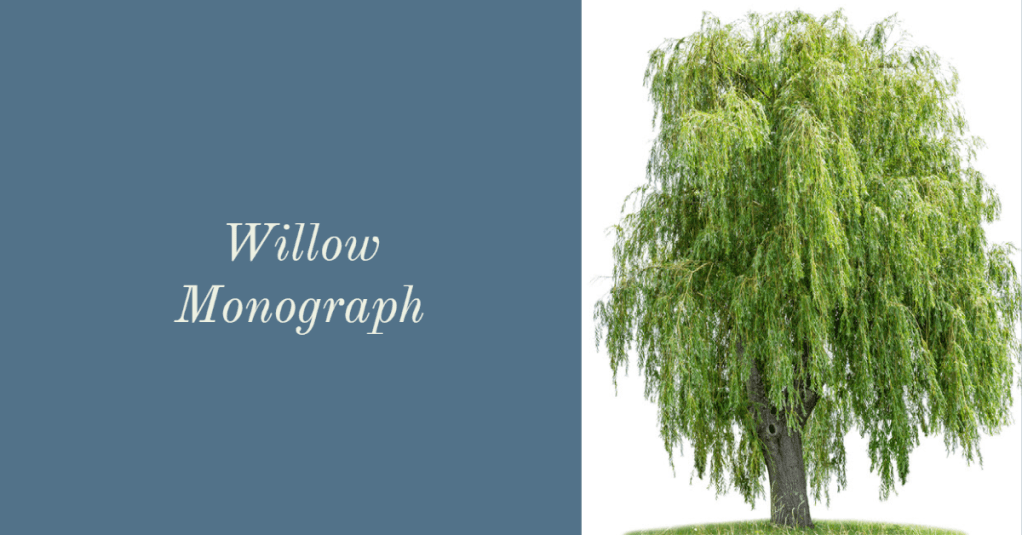
There are 100s of species of willow that can be roughly sorted into three groups. Sallow willows are tall narrow-leaved willow trees (S. nigra, S. fragilis, and S alba) which easily grow to be 65 feet or taller. Osiers are some of the shorter shrub-like willows such as Salix viminalis and Salix purpurea. You might see them called by the common name basket willow. The weeping willow (Salix × sepulcralis) grows with what botanists sometimes call a “drooping habit” and is more likely to be planted near water because their tenacious roots help to stabilize creek banks and riverbeds and stop them from eroding.
All willows are dioicous – the flowers on a tree are either male or female and they are pollinated by insects that visit the catkins — cylindrical flower clusters that grow fuzzy “hairs” instead of petals. Once they are pollinated, they fall off the tree and fruit develops in the form of 1/16″ (3mm) long, brown, conical capsules
The linear-lanceolate leaves of willow trees grow alternately on noticeably short petioles. Sometimes the leaves look as if they are growing directly off the stem. They begin to set on early in the spring. S. alba is known for having pale leaves covered in fine white hairs on the underside.
The young bark is smooth and brownish-grey or green. As it ages it becomes very woody with deep fissures that form an almost rough diamond-shaped pattern. Willow bark is best harvested when in the first year or so. Older woodier growth tends to have lower salicylate content and higher tannin content.
The 2018 USP-NF states that Salix species bark is to be “prepared from the whole or fragmented dried bark of the young branches, or whole dried pieces of the current-year twigs, obtained from Salix species.”[1]
I am going to throw some chemistry at you right from the start to address the most common misconception about willow. Phenolic compounds found in the Salix species include various salicylates including, salicin, and its derivatives: saligenin, salicortin, remulodin, tremulacin, and salicoylsalicin.[2] S. daphnoides, S. fragilis, and S. purpurea are the members of the species which are said to contain the highest concentration of salicylates.[3]
Salicin is metabolized into saligen in the intestinal tract and is then converted to salicylic acid after it is conjugated by the cytochrome P-450 system of the liver and absorbed into the bloodstream.[4] Salicortin degrades to salicin after about 4 hours of exposure to intestinal juices.[5] and then goes through the same process. Metabolism of 240mg salicin from willow bark could yield a low amount (113 mg) of salicylic acid.[6]
Salicin is the chemical that researchers first extracted and altered to make aspirin. They did this by adding an acetyl group to salicylic acid. Salicyclic acid is not the same chemical as the chemically synthesized acetylsalicylic acid. The acetyl group added in the laboratory changes the way the chemical is metabolized and alters its actions significantly.[7]
There are two reasons it is important to understand this. Because salicylic acid is metabolized in the intestines, preparations won’t inhibit Cox-1 in the stomach wall and therefore are unlikely to cause stomach discomfort the way aspirin does for some. Secondly, you cannot expect to take willow tincture and have it cure a headache in any sort of reasonable timeframe. So no, willow bark is not nature’s aspirin.
Additional constituents which contribute to the anti-inflammatory actions of willow preparations include catechol flavonoids (catechin, epicatechin, gallocatechin), dimeric procyanidins (B1, B3), and trimeric procyanidin (various epicatachins), chalcone glycosides, diol glycosides, catechol, and trans-p-coumaric acid.[8] It is a whole plant action not one isolated constituent.
The next questionable claim I will tackle is the historical trope that Egyptians used the bark for fever. They did not. That is a marketing hook. While some find statements like “Egyptians used the bark for fevers” to be acceptably vague, I find them to be positively annoying. Especially because I know this is not the case.
Willow leaves were one of the plant remedies mentioned in the Egyptian medical papyri by the name tr.t. A formula containing willow and other plants ground with salt was recommended as a topical preparation “to cool the mt.w” which is translated to the vessels, so it’s unclear whether this was a febrifuge or used to relieve inflammation but given the long-lasting folk tradition of using them for rheumatism, it was probably the latter.
A remedy to cool the vessels in all limbs: zizyphus leaves 1; willow leaves 1; acacia leaves 1; Lower Egyptian salt 1; leek ‘fruits’; is ground finely and applied as a bandage for four days.[9] H 238
In ancient societies where it was believed most diseases had a supernatural cause, priests often used plants in their ceremonies as protection against illnesses and a willow wood club was something that the Egyptians used. It is mentioned in the following “spell for bringing medicine.”
I have thrown out protection as (safe as) a threshingflooT
which is fenced. For Isis has bandaged (гйг)
with the tip of her hair.
Fever (šmm) will not descend upon
me; <my> body will not be dislocated (sfh)…
My club (hi) affords protection (sm).
Hail to you, club of willow-wood (ht m try) that protects
the body, whose knob is (made) of the pure acacia. The
seven Hathors—they will take care of the protection over
the body until the body is sound like the rising
of Re’ over the land. Protection is at my hand! Isis, the
great one practises the art (hmw.t) of Rė’, (she) the physician
of the god who soothes the god.
Borghouts, J. F., trans. Ancient Egyptian Magical Texts. Religious Texts Translation 9. Leiden: E.J. Brill, 1978.
Warding off a fever with a staff is not the same thing as treating a fever with the bark so to claim that’s how they used it is a stretch. Interestingly, willow leaves were commonly used to make garlands to adorn mummies in Ancient Egypt. The garland of Ahmosi was made of willow leaves, blue lotus, and flowers of larkspur while some for the princess Nesikhonsu were simply made with willow leaves and Picris asplenioides.[11] Perhaps, this was their way of protecting the deceased from evil spirits in the afterlife?
The Greeks were known for using Salix nigra. Many ancient Greek physicians wrote about the black willow grove at Ameria. Dioscorides attributed the usefulness of Salix to its astringency. He suggested pounding the leaves into small pieces and drinking them with a bit of pepper and wine for painful conditions of the intestine. He wrote that the decoction of the leaves or bark was an excellent foment for those suffering from gout and he also said that it was used for cleaning away scurf. Scurf is thin dry scales of skin detached from the epidermis. Beck incorrectly translate it as dandruff, but it can refer to any skin disorder that causes scaley skin. ”[12] He suggested the sap for dissolving cataracts and said “the fruits helps people who spit blood when drunk.”
The Roman Celsus wrote that plantain or willow leaves which had been pounded and boiled in vinegar should be applied to prolapses of the anus or the “mouth of the womb” then covered with lint and wool.[13] A very similar recommendation is found in the Trotula later.
Pliny had a lot more to say about the medicinal uses of willow. He defined three types of exudates obtained from the tree.
- The gum that the tree exudes.
- The sap that runs from the bark when it is cut in the spring.
- The juice obtained by cutting young branches and letting them drip.
Pliny recommended the sap as spissare which is a word that he used often meaning “to give tone to or strengthen.”[14] He seemed to use the word in place of the Greek tonikas for agents that improved tone and consequently function of tissue. He suggests mixing the ash mentioned above with the juice to “remove spots” from the face mixing it with rose oil and drinking this in pomegranate juice to address soreness in the ears. He also mentioned burning willow tips and mixing the ash with water to apply it as a poultice for corns and callouses.
He suggested decocting the bark and leaves in wine and applying that as a fomentation for gout and gathering the fruit (catkins) before it “develops a kind of cobweb” to be used as a remedy for the “spitting of blood.”He claimed that pounding the leaves and taking them in wine will check the libido which is repeated throughout history.
Galen classified willow leaves as cold and dry in the first degree which are medicinal agents thought to cool natural heat as opposed to the unnatural heat of disease. He was more likely to recommend second-degree agents for fever.
Many centuries later Paulus Aegineta recommended willow leaves as an agent of agglutination which basically means that he recommended it for closing open sores and he considered willow to be able to address very large sores.[15] He also suggested applications of willow to tone “relaxed” joints.[16]
The first time I stumbled across a direct mention of fever is in the Irish translation of the Rosa Anglica which suggests packing leaves of rose, willow, and lettuce around the extremities of people suffering from hectica (hectic fever)[17] , which is a fever that continuously burns hot originating in the heart instead of with a humoral imbalance.
The Rosa Anglica was written around the same time as the monastic manuscript A Book of Sovereign Medicines which contained directions to make a decoction of the leaves in ale to benefit the Spleen which is interesting because I have found instances of it being used for the yellow jaundice in the Schools’ Collection. It may be something that was an indigenous use in the UK rather than something passed down through the Greco-Roman Tradition.
Conrad Gesner advised stripping the leaves of the twigs of white willow in the springtime and distilling them to make a hydrosol that could be sweetened as desired and drank to “helpeth the stone and procureth vryne (urine)”[18] He also recommended the distillate applied topically for shingles, anal fistulas, and redness of the eyes.
Master Barber Surgeon, John Gerard had an interesting entry on willow in his Great Herball[19]. He suggested that both the leaves and bark, decocted in wine and drank, worked equally well staunching all types of blood flow. I believe he might be the first to write about bringing green boughs of willow into the sick room to “cool the air.” Culpeper’s entry is very similar to Gerard’s in utilizing the astringency of the herb.
Salix. Willow-leaves, are cold, dry, and binding, stop spitting of blood and fluxes, the boughs stuck about a chamber wonderfully cool the air and refresh such as have feavers, the leaves applied to the head help hot diseases there, and frenzies.
When I went to look at how some of my favorite domestic practitioners used it, I was surprised to find that it did not really come up much at all. One Spanish manuscript mentioned that she used willow charcoal for making perfume tablets and Aletheia Talbot mentioned it in this receipt, I am going to try it.
An ointment to make hair grow.
Take willow leaves, seeth them in oyle, and annoint the bare place, and hair will grow.
Willow and Reproduction
Willow is mentioned by Pliny, Dioscorides, and the Mulieres Saleritanae (female physicians of the Salernitan medical school who wrote De Passionibus Mulierum Curandorum) as a plant that somehow related to the reproductive system. Pliny and Dioscorides both say that plant works as birth control. Dioscorides suggested taking the leaves in water caused barrenness, while Pliny suggested the seeds.[20] Culpeper also shared saying “The Leaves bruised and boyled in Wine and drunk staieth the heat of Lust in man or woman, and quite extinguisheth it, if it be long used.”[21]
The Mulieres Saleritanae spoke of using the root for addressing amenorrhea. It is believed they used Salix laevigata for their preparations.
For provoking the menses, take vervain and rue, and pound them heavily, and cook them with bacon and give them to the patient to eat. Afterward, grind root of delicate willow and root of madder, and give the juice to the patient with wine[22].
De Passionibus Mulierum Curandorum (The Trotula) ca. 1100
Willow and Victorian Whimsy
While I have learned not to take almost anything the Victorians said about the folk use of herbs too seriously, it is still interesting to read some of the poetic associations they made. To them, the willow’s drooping demeanor signified melancholy and sorrow, leading to some overly maudlin poetry.
Thus o’er our streams do Eastern willows lean
In pensive guise; whose grief-inspiring shade,
Love has to melancholy sacred made.[23]
I have to admit that I’ve never quite understood that association. I tend to agree with the Egyptian priests of long ago and see the tree as a protector guarding over the rivers whose banks it tends.
Willow and Basketmaking
If we are going to write a thorough ethnobotanical account, we must include the many practical uses that our ancestors had for willows. Willows have been used for making baskets for a very long time and although the Greeks were certainly not the first to do this what they have written about this gives us a little insight into the practice.
Virgil wrote in the Georgics, “The twigs of the willows are used to bind the vines, and to make all sorts of wicker works” and suggested cultivating them in the manner recommended by Pliny.[24] who had suggested coppicing with willows by planting them in rows and lopping off the young branches for weaving.
Thomas Hill mentioned that many people used willow for making waddle fences in his gardening book[25] and Francis Bacon wrote that soaking the willow branches in water made them more flexible and easier to weave.[26]
Here’s a slightly more modern explanation of how they would make willow baskets.
Long ago the people used to make cleaves. They used to stick eight willow rods down in the ground in the shape of a circle. When they had all the willow rods stuck down in the ground they kept weaving a sally rod in and out between the willow rods until they came to the top of the sally rods. The sticks that were in the ground were pulled up and knotted from (side to) one side to the other.[27]
Sally rods refer to the rods obtained from a sallow willow, while willow rods would have been obtained from osiers[28] Sally rods used to be used for thatching roofs, as well.
There are a few historical names that do not refer to willow plants. Pliny called hops Lupus salictarius which translates to “willow wolf” because they grew up sallow willows in the wild.[29] If you see an author mention willow-weed or will hearb, they are most likely talking about loosestrife, which is defined as a “red, seedy flower which grows chiefly in vegetables.”
What you will note is that in this whole long history, there is no mention of using the bark to address fever. Edward Stone who lived in 1796 is given credit for using a willow bark extract for fever, and I have not been able to find an earlier source, so this may be his innovation.[30] It has been repeated continuously since then, so now I will move into the modern part of this monograph.
Willow as an Astringent
As you can see above, aqueous extracts of willow have a history of being used as topical astringents. There has not been as much research about that as there should be since it has been eclipsed in the materia medica by other astringents. One successful clinical trial was conducted using a formula containing willow, licorice, and gentian root to address atopic dermatitis.[31]
Given what we know about the chemistry of the bark you would think that the older bark would be better, but clinical trials are usually done with plant material that meets the U.S.P guidelines I mentioned above.
Mechanism of Anti-inflammatory Action
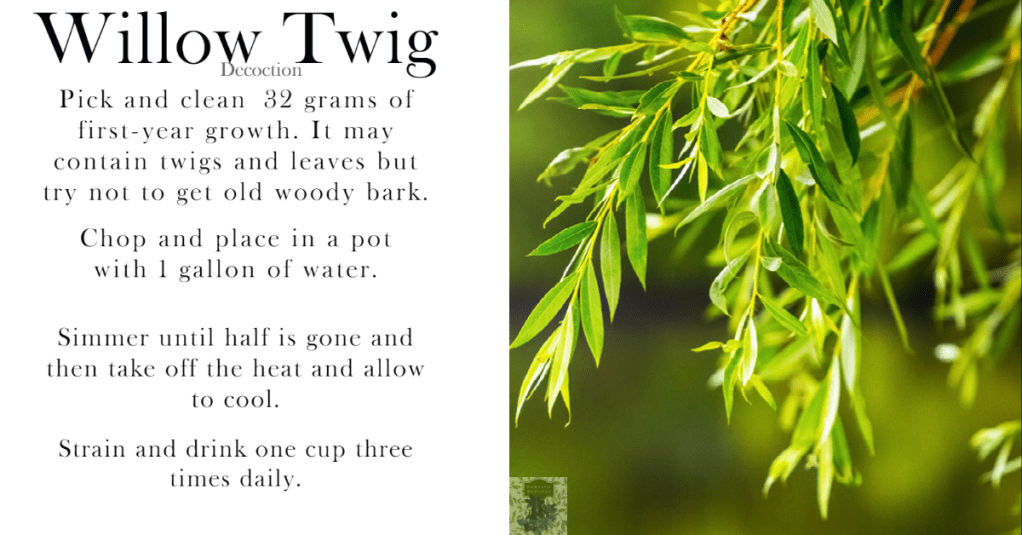
As a clinician, I recommend using a whole plant extract made from young willow twigs in the spring for internal use for inflammatory conditions. That’s the way it was done in many folk traditions and those preparations are infinitely preferable to the older bark except in cases where you are wanting the astringency. I prefer decoctions to hydroethanolic extracts.
There was a time when researchers believed whole plant preparations of willow bark to have the same effect as commercial acetylsalicylic acid which inhibits both Cox-1 and Cox-2 in the body. In one research trial, a 240 mg dose of the commercial extract Assilex (which is standardized to contain 15% salicin) has been shown to be effective at addressing pain caused by inflammatory conditions and held its own against the Cox-2 inhibitor rofecoxib.[32]
Subsequent research has shown that this is not necessarily the complete story and that the whole plant preparation is associated with the down-regulation of various proinflammatory cytokines including IL-6, IL-1β, tumor necrosis factor‐α (TNF-𝝰 ), and nuclear factor‐kappa B. (NF-κB).[33]
The suppression of the release of IL-1β may explain its beneficial actions on joints because this cytokine is known to regulate the biosynthesis of matrix proteins like collagen.[34]
A recent study comparing multiple herbal extracts supports that conclusion saying, “Amongst the herbal extracts, willow bark had the greatest anti-inflammatory activity at reducing the [pro-inflammatory] cytokine IL-6 and TNF-𝝰 production.[35] This was surprising to many who would have guessed that the apigenin from chamomile would have the strongest effect.
The pain reduction capacity of willow bark extract is undoubtedly related to anti-inflammatory actions. It has no anodyne qualities nor any seeming effect on the nervous system in terms of relaxing muscles or anything of that nature.
There have been human clinical trials to determine the efficacy and side effects of willow bark extract. One randomized, double-blind, placebo-controlled study compared the effects of a 240mg dose of willow bark extract against a 120 mg dose. Both groups receiving the extract reported better results than the placebo group at controlling pain.[36]
The consensus is that willow extracts are moderately effective as analgesics for conditions of the back/spine, soft tissue disorders, inflammatory polyarthritis, and natural breakdown of cartilage due to old age.[37]
Due to a question from a reader, I want to explain that especially in historical pharmacy pain relievers that are sleep-inducing are referred to as anodynes while analgesics are those pain relievers that are not. The implication is that an anodyne’s mechanism of action interferes with the brain’s perception of pain which has a side effect of making you sleepy as opposed to an anti-inflammatory that reduces pain by reducing pressure.
Note that these are mostly chronic conditions. Salix effectiveness is, at least in part, due to the actions of salicylic acid which takes a good deal of time to be metabolized. This also presents us with a clinical limitation. Due to the time that it takes for salicin to be metabolized to salicylic acid in the body, willow decoctions are likely to less useful as an adjunct for acute conditions.
Safety Considerations:
There have been some concerns about whether willow preparations shared the same blood thinning properties as aspirin, however current thinking is that willow bark extract does not seem to have the strong antiplatelet action that commercial acetylsalicylic acid exhibits, and those concerns are unwarranted.[38]
There is also lingering concern about giving children willow bark due to Reye’s syndrome. The FDA does not have data to show that non-aspirin sources of salicylates cause this problem, but it’s also not an appropriate use of the preparations.
The most concerning adverse reaction occurs in salicylate‐sensitive individuals. This last issue should not be dismissed lightly though because up to 5% of the population may have varying degrees of salicylate sensitivity. This concern may carry over to nursing mothers because we know that some salicylates are expressed in breast milk and there could be theoretical concerns about nursing infants with sensitivities.
In 2017 the Salix Species Bark family of monographs in the USP was revised to read: “Dosage forms prepared with this article should bear the following statement: Not for use in children, women who are pregnant or nursing, or by persons with known sensitivity to aspirin”[39] with which I concur.
Usage Strategies:[40]
Decoction: 3 x daily
Tincture (1:5, 25% ethanol), 5-12 ml (3-4 times daily)
Capsules: 240 mg daily
[1] United States Pharmacopeial Convention. The United States Pharmacopeia: The National Formulary. Vol. 3. 5 vols. Rockville, Md.: The United States Pharmacopeial Convention, 2018. pp. 4850.
[2] Maistro, Edson Luis, Peterson Menezes Terrazzas, Fábio Ferreira Perazzo, Isabel O’Neill De Mascarenhas Gaivão, Alexandra Christinie Helena Frankland Sawaya, and Paulo Cesar Pires Rosa. ‘Salix Alba (White Willow) Medicinal Plant Presents Genotoxic Effects in Human Cultured Leukocytes’. Journal of Toxicology and Environmental Health, Part A 82, no. 23–24 (2019): 1223–34. https://doi.org/10.1080/15287394.2019.1711476.
[3] Mills, Simon, and Hutchins, Roberta, eds. ‘Salicis Cortex: Willow Bark’. E/S/C/O/P, 2017.
[4] Meier, B., O. Sticher, and R. Julkunen-Tiitto. ‘Pharmaceutical Aspects of the Use of Willows in Herbal Remedies’. Planta Medica 54, no. 06 (1988): 559–60. https://doi.org/10.1055/s-2006-962554
[5] Meier B, Meier-Liebi M. “Salix” In: Hagers Handbook of Pharmaceutical Practice. Vol. P-Z. Blaschek W, Hänsel R, Keller K, Reichling J, Rimpler H, Schneider G, editors. Berlin-Heidelberg, Germany:Springer 2014.
[6] Oketch-Rabah, Hellen A., Robin J. Marles, Scott A. Jordan, and Tieraona Low Dog. ‘United States Pharmacopeia Safety Review of Willow Bark’. Planta Medica 85, no. 16 (November 2019): 1192–1202. https://doi.org/10.1055/a-1007-5206.
[7] Conway, Peter. The Consultation in Phytotherapy: The Herbal Practitioner’s Approach to the Patient. Ediburgh, Scotland: Churchill Livingston Elsevier, 2011. pp. 11.
[8] Freischmidt, A., G. Jürgenliemk, B. Kraus, S.N. Okpanyi, J. Müller, O. Kelber, D. Weiser, and J. Heilmann. ‘Contribution of Flavonoids and Catechol to the Reduction of ICAM-1 Expression in Endothelial Cells by a Standardised Willow Bark Extract’. Phytomedicine 19, no. 3–4 (2012): 245–52. https://doi.org/10.1016/j.phymed.2011.08.065.
[9] Manniche, Lisa. An Ancient Egyptian Herbal. Austin, TX: University of Texas Press, 1989. pp 70.
[10]Borghouts, J. F., trans. Ancient Egyptian Magical Texts. Religious Texts Translation 9. Leiden: E.J. Brill, 1978.
[11] Ibid. pp 32.
[12] Dioscorides. De Materia Medica. – Five Books in One Volume: A New English Translation. Translated by Osbaldeston, T. Vol. Book One Aromatics. Johannesburg: IBIDIS Press, ca. 65. pp 138.
[13] Celsus, Aulus Cornelius. De Medicina LIBRI V and VI. Translated by Spencer, W.G. 1938 Translation. Vol. II. III vols. London, England: Loeb Classical Library, ca. 45. pp. 287.
[14] Plinius Secundius, Gaius. Pliny Natural History LIBRI XXIV-XXVII. Translated by Jones, W.H.S. 1956 translation. Vol. VII. London, England: William Heinemann LTD. ca. 77 CE. pp. 40.
[15]Aegineta, Paulus, Paulus. Medical Compendium in Seven Books. Translated by Adams, Francis. 1847 Translation. Vol. II. III vols. London, England: Sydenham Soc., 600. pp. 102.
[16] Ibid. pp. 139.
[17] Anglici, Johannis. Rosa Anglica Sev Rosa Medicinæ Johannis Anglici: An Early Modern Irish Translation of a Section of the Mediaeval Medical Text-Book of John of Gaddesden. Translated by Wulff,Winifred. 1923 Translation. London, England: Simpkin Marshall LTD., 1314. pp. 111.
[18] Gesner, Konrad. The Newe Iewell of Health …. Translated by George Baker and Hill, Thomas. Early English Books, 1475-1640 / 296:01. Printed at London: By Henrie Denham. 1576. pp 61.
[19] Gerard, John. The Herball Or Generall Historie of Plantes. London, England: Norton, John, 1597.
[20] Dioscorides Pedanius. De Materia Medica. Translated by Beck, Lily. 2005 Translation. Altertumswissenschaftliche Texte Und Studien, Bd. 38. Hildesheim ; New York: Olms-Weidmann, 65. Pp75.
[21] Culpeper, Nicholas. The English Physitian : OR AN Astrologo-Physical Discourse of the Vulgar Herbs of This Nation. London. England: Printed by Peter Cole, at the sign of the Printing-Press in Cornhil, near the Royal Exchange., 1652.pp. 236.
[22] Green, Monica, trans. Trotula: An English Translation of the Medieval Compendium of Women’s Medicine. 2001 Translation. Philadelphia, PA: University of Pennsylvania Press, ca. 1100. pp 153.
[23] Osgood, Frances Sargent Locke. The Poetry of Flowers and Flowers of Poetry: To Which Are Added, a Simple Treatise on Botany, with Familiar Examples, and a Copious Floral Dictionary. New York, NY: Derby & Jackson, 1859. pp 154.
[24] Virgil. Georgicorum Libri Quatuor. The Georicks with an English Translation and Notes by John Martyn. Translated by Martyn, John. 1741 Translation. London, England: Richard Riley, ca.35 BCE. pp 193.
[25] Hill, Thomas. The Gardener’s Labyrinth. Translated by Mabey, Richard. Oxford, England: Oxford University Press, 1577. pp. 12.
[26] Bacon, Francis. Works of Francis Bacon. Vol. 11. London, England: Printed for M. Jones, Patternoster-row, 1815. pp. 68.
[27] Conry, Martha. ‘Basket-Making’. dúchas.ie. Accessed 13 May 2020. https://www.duchas.ie/en/cbes/5008972/4972326/5110773.
[28] Ellis, William. The Timber-Tree Improved … London, England: T. Osborne, 1742. pp. 189.
[29] Plinius Secundius, Gaius. Pliny Natural History LIBRI XXIV-XXVII. Translated by Jones, W.H.S. 1956 translation. Vol. VII. London, England: William Heinemann LTD. ca. 77 CE pp 347.
[30] Stone, E. ‘An Account of the Success of the Bark of the Willow in the Cure of Agues. In a Letter to the Right Honourable George Earl of Macclesfield, President of R. S. from the Rev. Mr. Edmund Stone, of Chipping-Norton in Oxfordshire’. Philosophical Transactions of the Royal Society of London 53 (1763): 195–200. https://doi.org/10.1098/rstl.1763.0033.
[31] Seiwerth, Jasmin, Georgia Tasiopoulou, Julia Hoffmann, Ute Wölfle, Kay Schwabe, Karl-Werner Quirin, and Christoph Schempp. ‘Anti-Inflammatory Effect of a Novel Topical Herbal Composition (VEL-091604) Consisting of Gentian Root, Licorice Root and Willow Bark Extract’. Planta Medica 85, no. 07 (May 2019): 608–14. https://doi.org/10.1055/a-0835-6806.
[32] Vlachojannis, J. E., M. Cameron, and S. Chrubasik. ‘A Systematic Review on the Effectiveness of Willow Bark for Musculoskeletal Pain’. Phytotherapy Research 23, no. 7 (2009): 897–900. https://doi.org/10.1002/ptr.2747.
[33] Shara, Mohd, and Sidney J. Stohs. ‘Efficacy and Safety of White Willow Bark (Salix Alba) Extracts: Willow Bark Extract Efficacy and Safety’. Phytotherapy Research 29, no. 8 (2015): 1112–16.
https://doi.org/10.1002/ptr.5377. and Jürgenliemk, G., F. Petereit, and A. Nahrstedt. ‘Flavan-3-Ols and Procyanidins from the Bark of Salix Purpurea L.’, no. 3 (March 2007): 231–34. https://doi.org/10.1691/ph.2007.3.6577.
[34]. Sharma, Shikha, Debasis Sahu, Hasi Rani Das, and Deepak Sharma. ‘Amelioration of Collagen-Induced Arthritis by Salix Nigra Bark Extract via Suppression of pro-Inflammatory Cytokines and Oxidative Stress’. Food and Chemical Toxicology 49, no. 12 (2011): 3395–3406. https://doi.org/10.1016/j.fct.2011.08.013.
[35] Drummond EM, Harbourne N, Marete E, et al. Inhibition of Proinflammatory Biomarkers in THP1 Macrophages by Polyphenols Derived from Chamomile, Meadowsweet and Willow bark. Phytotherapy Research. 27 no. 4 (2012):588–594. doi:10.1002/ptr.4753.
[36] Chrubasik, Sigrun, Elon Eisenberg, Edith Balan, Tuvia Weinberger, Rachel Luzzati, and Christian Conradt. ‘Treatment of Low Back Pain Exacerbations with Willow Bark Extract: A Randomized Double-Blind Study’. The American Journal of Medicine 109, no. 1 (July 2000): 9–14. https://doi.org/10.1016/S0002-9343(00)00442-3.
[37]. Saller, R, J Melzer, and M Felder. ‘Pain Relief with a Proprietary Extract of Willow Bark in Rheumatology. An Open Trial’. Swiss Journal of Integrative Medicine 20, no. 3 (2008): 156–62. https://doi.org/10.5167/UZH-13538.
[38] Gardner, Zoë, and Michael McGuffin. American Herbal Products Association’s Botanical Safety Handbook, Second Edition. Boca Raton, FL: CRC Press, 2013. pp. 765.
[39]USP-NF Botanical Dietary Supplements and Herbal Medicines Committee. ‘Salix Species Bark Family of Monographs’. Notice of Intent to Revise. United States Pharmacopeial Convention, 2017. https://www.uspnf.com/sites/default/files/usp_pdf/EN/USPNF/revisions/salix_species_bark_rb.pdf.
[40] Mills, Simon, and Hutchins, Roberta, eds. ‘Salicis Cortex: Willow Bark’. E/S/C/O/P, 2017.
 Domestic Medicine
You must be logged in to post a comment.