So now that we have covered the “how” of syrups , I am going to briefly touch on the “why.” First, you need to understand that many herbal remedies are more effective if they come in contact with the tissue that is your therapeutic target. I am going to be coming back to that idea often.
Syrups are known humectants. When you take a syrup, they go down more slowly than water. They coat the epithelial tissue of the pharynx and upper GI tract, drawing moisture from the air and from deeper layers of tissue to hydrate dry irritated epithelial tissue.
Syrups work well as carrier agents of herbal constituents you want to contact with that tissue because they hang out for a while. This is why many syrups contain antimicrobials, expectorants, or mucolytics which are agents that help to thin mucus and make it easier to expectorate.
Honey works the same way, but I like to leave the bees alone as much as possible and work with a lot of vegans, so I stick to using barley malt or fair-trade sugar to make syrups. Besides barley malt makes almost everything taste better.
Some people seem to think you can substitute for syrups by drinking tea, putting a few drops of essential oil in some water, or squirting a tincture in your mouth, and it will work the same, but it doesn’t. In fact, if you want your syrup to ease hoarseness, sore throats, or cough most effectively you want to wait for a bit after taking a syrup to eat or drink anything. The only thing that works better is syrup turned into a lozenge.
Just remember not to add anything to your syrups that interferes with your body’s innate defense mechanisms. Resinous substances, for example, may interfere with the action of the cilia in the epithelial tissue and slow down mucociliary clearance. Smoke may also do this. You also don’t want to use essential oils at too high a concentration because they can damage epithelial tissue.
Giving spoonsful of ginger, mint, or lemon syrup can also be useful for people who are experiencing nausea and having a hard time keeping liquids down. I remember during pregnancy my midwife told me to drink a cup of mint or ginger tea when I woke up and I was like please I can’t keep anything down in the morning. Thankfully, I knew better.
Popular Syrups of the Irish Tradition
I thought it might be fun to talk about some of the traditional syrups that inform my practice of domestic medicine. I want to begin this by saying many Irish works have been neglected or lost. My own upbringing was a mix of Scottish, Irish, Cornish, and English traditions so it’s hard to say for sure who learned what where, although the Irish branch definitely wins points for being the loudest.
But medicine was kind of like that back then too, even domestic practice. The idea that there were uniform national practices is a product of romantic nationalism. Irish medicine was influenced by the Western European traditions taught at the Salernitan school and the medical schools at Montpellier, as well as translations that came to them via the Toledo School of Translators. A lot of early Irish and Scottish medicinal texts used in their medical schools are translations of texts written or translated at these schools.
Tadhg Ó Chuinn was an Irish physician who had obtained a “bachelor in physic” presumably at some continental college. He put together an “Irish” Materia Medica “drawn from the Antidotaries and Herbals of the city of Salerno, according to the united studium of the doctors of Montpellier” in 1415.
I appreciate the translation of the Irish text, but I stopped taking the commentary too seriously when they mentioned yarrow and willow as possibly being “purely Irish tradition.” The materia medica doesn’t seem particularly unique to me, but it does reinforce the idea that Irish physicians were very much influenced by the same works as the rest of Western Europe.
Tadhg’s entry on violet syrup is interesting to me because of his commentary on the “wetness” of violets. Violets contain mucilage that roses don’t that is extracted by boiling and has traditionally been used to cool inflamed tissue. I also noticed he uses a cheat to make his syrups similar to the one that Culpeper suggested centuries later. So, I feel like he had some experience in medicine making.
This is how one makes syrup of violets; boil the flower of violet in water, and when it is cold put sugar in it, and that syrup is appropriate against hot illnesses. Another way to make it: put flower of violet in water for a night and strain it the following day; then put sugar in it, and it will be a syrup…Note that the violet should be boiled when making syrup of it more than the rose should, because its wetness is viscous and not capable of being dissolved, whereas the wetness of the rose is easily dissolvable and flowing.
I am mentioning this syrup even though it is technically an oxymel because I have seen horse radish mentioned a lot in the Schools’ Collection, so I know the use of it persisted. Besides, this is as close as I have come to finding a receipt that resembles fire cider.
If its [horseradish] roots be pounded, put in vinegar for three days, boiled thereafter, have sugar put in it, and it be drunk with one-third water before going to bed and when getting up, it will serve against quotidian fever and false tertian fever, and this compound is called oxyzacara.
Here are some entries that I dug up from the Schools’ Collection pertaining to syrups that persisted in domestic practice into the early twentieth century. I looked for receipts that call for plants that we don’t see used all the time in medical texts as that might indicate a history of indigenous use.
Hoarhound. The whole herb is used either boiled of powdered as syrup for all kinds of cold and coughs.~ Mrs. Anne Sullivan (d1927)
Black Currant used for hoarseness, sore throats and coughs. It is made into syrup and taken at nightime…a syrup made from ivy leafs is excellent for a cough. ~ The Sisters of St. John of God Convent Rathdowney, Co. Laois
Then there is the carrageen moss [Irish Moss] which is collected along the sea-shore and dried on the bank by the sun in the summer time. This when boiled and made into a syrup with lemon and other things is a wonderful cure for coughs and colds. ~ S. Bean Uí Rinn Co. Kerry.Turnips were used as a cure for cough. The turnips were skinned and cleaned and cut into slices. A coat of brown sugar was put between the slices and left in a bowl for twenty four hours. The juice of the turnips and the brown sugar would melt into a juicy syrup. A spoon of this syrup was taken three times a day. ~ Fanny Sexton Liscasey, Co. Clare
National Folklore Collection UCD c.1935-38
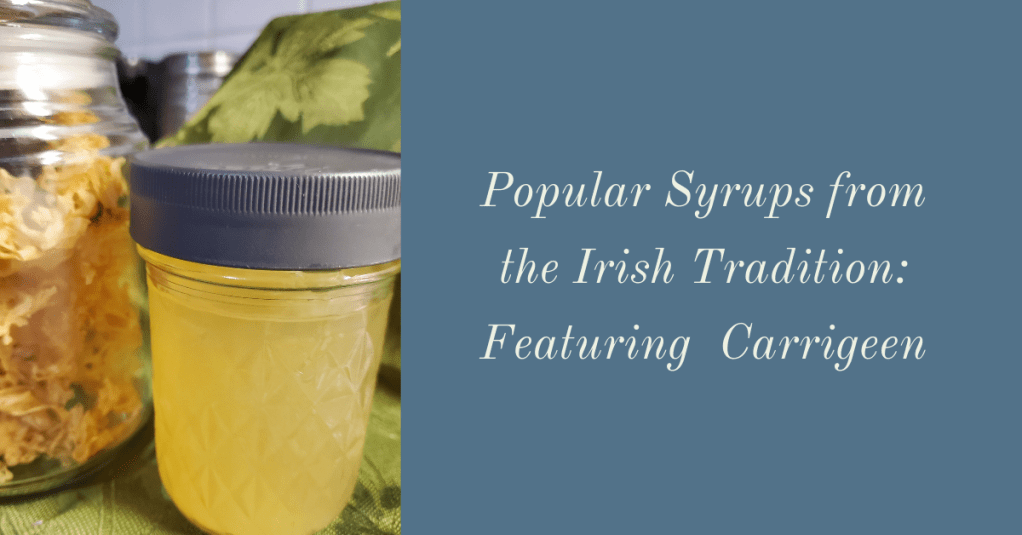
Since I’ve already covered turnip syrup and black currant preparations in other posts. I thought I would showcase one of the Irish herbs that I am betting not a lot of people work with and that is Carrigeen, aka Irish moss. It comes in purple and “golden” and I recommend the golden if you want to make blancmange.

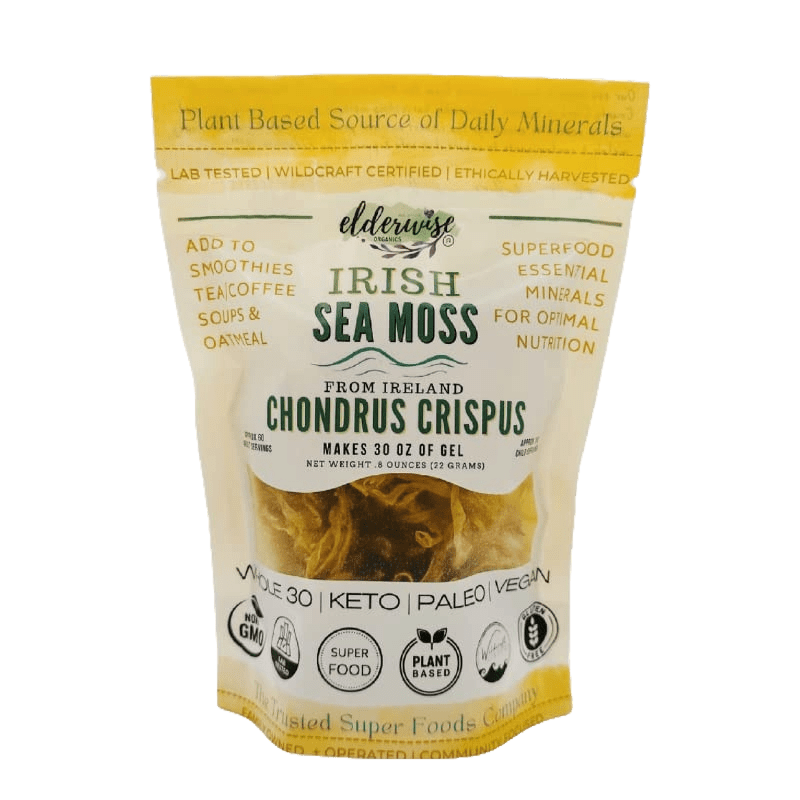
Irish moss (Chondrus crispus) is the source of carrageenan. It probably got that name from the little rocks that it grew on near the seashore. Seaweed was pretty important to the Irish in the scheme of things. The earliest farmers created soil in their fields by harvesting seaweed and using it as green manure. They fed their livestock with it, and they used it for medicine.

It seems as though someone “discovered” Irish moss in the mid-1800s and rebranded it as Sea Moss Farine and it suddenly became an official thing. It was marketed as a “new food source” and they sure did have a lot to say about it.

As you can see, “Custards, Soups & Gruels made from SEA Moss FARINE can be taken by invalids at all times and retained upon the stomach while all other preparations are rejected.” That sounds like marketing hyperbole but there is some modern research about natural mucoadhesive polymers that lines up with this. I will talk about it when we get to specifics for GI complaints.
The establishment even seemed interested in Irish moss enough that they tried to co-opt its use. I found a letter in the transactions of the London Pharmaceutical Society saying that cocoa with Irish moss added was considered medicated cocoa and you would need a license to sell it. That’s pretty much a sure indication that a superfood has arrived.
In domestic medicine circles, Irish Moss was frequently recommended for making beverages for people who were ill, especially with upper respiratory and bronchial conditions.
Carrageen is a very nutritious and light article of food for children, and invalids… The following decoction for consumptive patients is recommended. Steep half an ounce of the moss in cold water, for a few minutes, and then take it out, boil it in a quart of milk until it attains the consistency or warm jelly, strain it, and sweeten it to the taste, with white sugar or honey, flavor it with whatever spice is most agreeable.
Maria Rundelll A new system of domestic cookery 1838
Although this was not always the case, blancmange, as we know it now is sweetened milk thickened with gelatin or Irish moss and it was often found in invalid cookbooks.

Irish moss is used for a lot of things. We have it around the house for fining beer, and I even found it mentioned as a good lubricant for coitus, but I had never heard of making syrup with it. I turned to the Schools’ Collection to find a receipt for this syrup and found this. I think this is actually the receipt for one of these jellies that Grace Osgood mentioned above.
Here is a good cure for a cold. Get a handful of carrigeen moss which every home should have in its possession, and have a saucepan cleaned, place the carrigeen moss in the saucepan with a pint of water, do not have any more water or it will be too thin, and if possible use warm water. Put the saucepan over the fire and boil for half an hour or longer. Lift up the pan and strain the carrigeen moss through a very fine strainer so that no twigs of carrigeen are in the syrup, because they are useless now that all the juice is from them. Get a lemon and prick a hole in it with a fork, squeeze the juice from it into the saucepan containing the carrigeen syrup, and put about six spoons of sugar into it. Stir up and place the sauce-pan on the fire, and boil slowly for over five minutes Then lift the sauce-pan, and put the syrup, which will be thin into a bottle, and place an airtight cork into it. Leave the bottle aside for two days. Shake before using, then take a half glass three times a day and your cold will soon disappear.
National Folklore Collection UCD 26 September 1938
Ingredients
1 cup Irish moss (carrigeen)
1 pint water
1 lemon
6 tbsp sugar
Directions
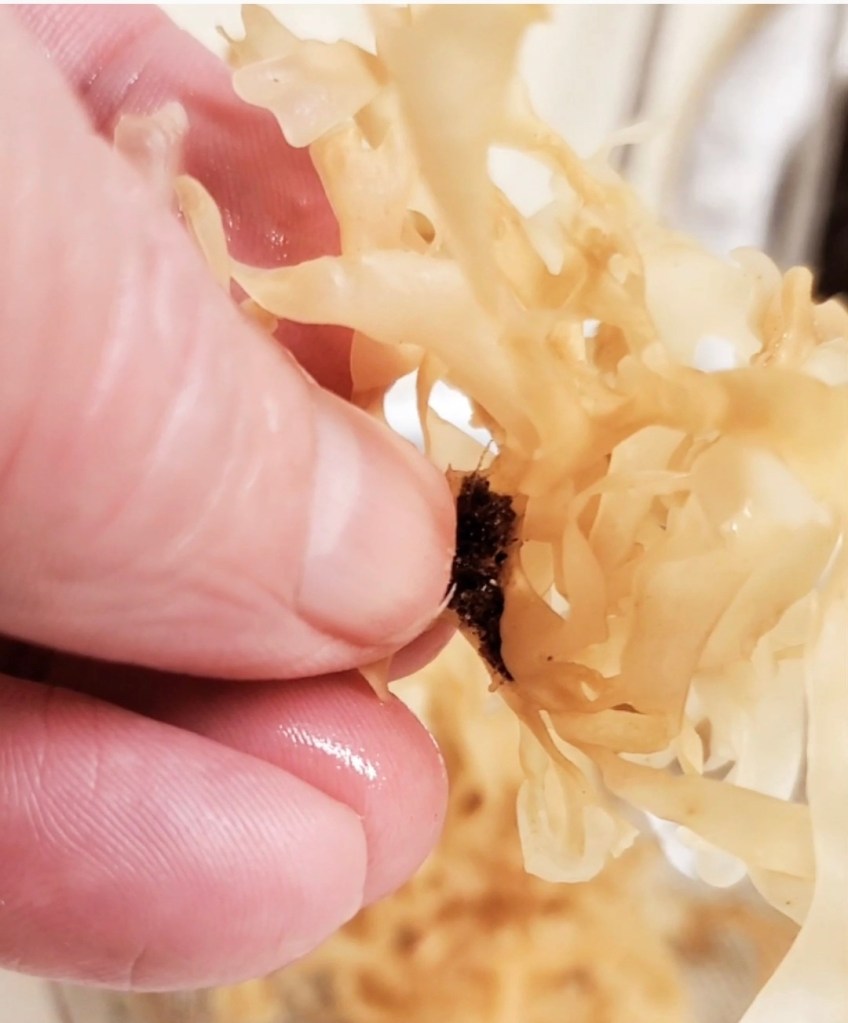
- Rinse your carrigeen and then rinse it again. It can be full of sandy bits.
- Place a pint of warm water in a saucepan with the carrigeen and then let it barely simmer for a half-hour. You are going to have to watch this and stir it.
- Peel and juice a lemon, while it’s boiling. A medium lemon yields about 3 tbsp of juice.
- Your carrigeen/water mixture will start to gel the way plantain seeds or flax seeds do. Turn the heat off and using a fine sieve strain the carrigeen from the liquid.
- Put this liquid in a clean saucepan with the lemon juice, the lemon peel, and the sugar.
- Simmer this for five minutes.
- Strain and bottle in an airtight bottle.
- Unlike our shelf-stable syrups, this needs to be refrigerated if you don’t want it to ferment
I am not going to pretend I grew up with this receipt. My people were landlocked. So this was an experiment for me. The author is correct that it is thin when it is mixed with a handful, I made it a second time with a cup and found that it gelled a little more.
I find receipts that take advantage of the mucoadhesive qualities of demulcents to be particularly clever, but I am not sure I would ever call this preparation syrup. This method is however exactly how my people used gelatin or plantain seeds to make drinks. Some of you might remember that they used to sell orange-flavored gelatin for drinking to help your nails grow. This “syrup” reminds me of that drink. Marshmallow decoction can also be made this way.
Isn’t Carrageenan Bad for You?
Irish Moss as you may have already guessed is the source of the food emulsifier carrageenan. The story of the demonization of carrageenan is pretty common. One researcher noticed an odd correlation between breast cancer and carrageenan and published two papers on the subject. These two papers were picked up by the alt health grapevine and blasted all over the internet.
These papers were considered when European Commission Scientific Committee for Food (ECSCF) revisited the topic in 2002. The ECSCF’s final report states that these correlations could be made with any food or chemical which has increased in prevalence during the 20th century. I have no doubt the researcher in question was unaware of the extensive use of Irish Moss in the 19th century, as it further invalidates this conclusion. It was a classic case of “correlation does not equal causation”, and no new data has come to light since then to support the opinion.
References.
O Cuinn, Tadhg. ‘An Irish Materia Medica’. Translated by Färber, Beatrix, 1415. Corpus of Electronic Texts. https://celt.ucc.ie/published/G600005/.
.
 Domestic Medicine
You must be logged in to post a comment.