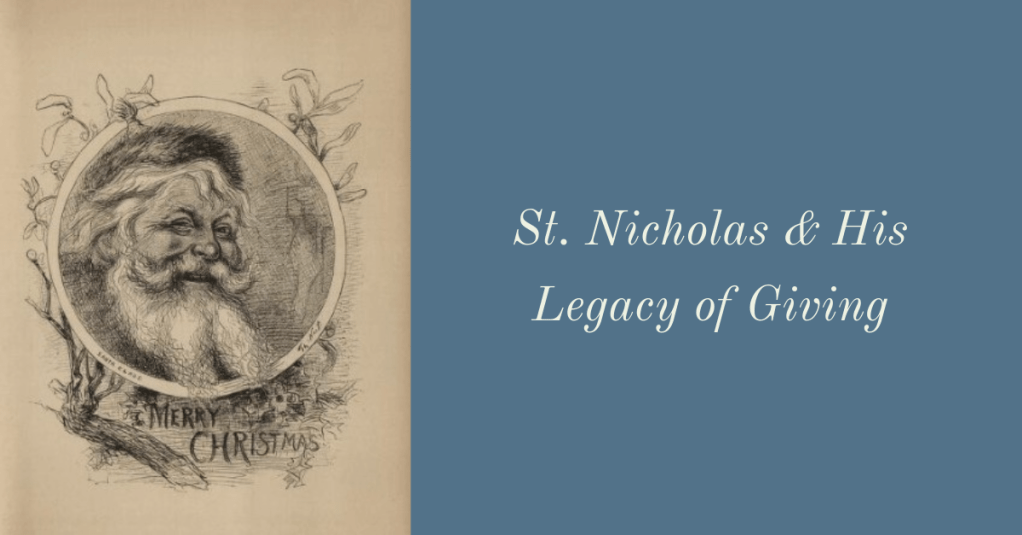
December 6th is St. Nicholas Day. According to his official biography, St Nicholas was born during the third century in the village of Patara in Asia Minor which is the peninsula that includes most of modern-day Turkey. His parents perished in an epidemic after their death he devoted himself to God. He reportedly spent his entire inheritance on charitable endeavors. Bishop Nicholas was renowned for helping the poor, especially children. This is a story told in his hagiography that exemplifies the manner of his charitable acts:
There was a certain man among those who were recently famous and well-born, and he was a neighbor, his home being next to Nicholas’. Owing to the plotting and envy of Satan, who always has a grudge against those who prefer to live a life in accord with God, this man was squeezed by great poverty and lack of resources. He had gone from being well-off to extreme indigence. He had three daughters who were both shapely and very attractive to the eye, and he was willing to station them in a brothel so that he might thereby acquire the necessities of life for himself and his household. For no man among the lordly or powerful deigned to marry them lawfully, and even among the lower-classes and those who owned the least bit of something there was no one well-minded enough to do this. And so the man looked away from his salvation and, as it were, fainted at the thought of prevailing upon God with persistence and prayer. By this logic he came to assent to situating his daughters in the abyss of such dishonor…
Michael the Archimandrite Bibliotheca Hagiographica Graeca 1348
Nicholas, wishing to use his own money to help the man, and to lead him with his daughters away from the shameful and dishonorable deed which had, in truth, already been decided for them – what does he do? He does not appear to him in person or speak about a gift or any other type of relief, thereby freeing him from shame while at the same time very carefully taking the trouble not to trumpet his own charity. After hurling a bag containing a large amount of gold into the house through the window at night, he quickly hastened home.
Legend has it that this bag of gold managed to land in a sock that had been hung to dry in the home and this is how the story of St. Nicholas leaving gifts in shoes or stockings was born. He died December 6, AD 343 in Myra and a healing liquid the ancients called manna was said to exude from his gravesite which is why you will occasionally hear of him being the patron saint of apothecaries. I am not going to go too in depth into his life because that’s not the point of this post, but I’ve found a fun write up about him if you are interested in reading more.
In 1446, over 1000 years after his death St Nicholas story was revived, undoubtedly with some medieval glossing as was their habit. He was canonized as the patron saint of children and December 6th became a Catholic feast day.
People all over Europe commemorated him by secretly leaving treats for children while giving St. Nicholas credit for delivering them. Markets began to crop up all over Europe where one could buy spiced cookies stamped with his likeness and other treats for gifting on the day.

The Reformation was a rough time for St. Nicholas in England due to the Puritans who wanted to cleanse the Anglican church of any catholic practices which resulted in bans on many church holidays. They were largely unenforceable, especially in rural areas. People continued to observe holidays quietly in their own homes until the restoration when Charles II reinstated public celebrations.
The Dutch were particularly fond of Sint Nicolaas or Sinterklaas as they called him. Even when laws were enacted after the Reformation outlawing the sale of images of St. Nicholas, bakers kept up the traditon of making his cookies.
The St. Nicholas tradition never really made a splash in the New World due to the Puritans stodginess, except in New York where there seemed to be people interested in exploring their Dutch heritage.
“Last Monday, the anniversary of St. Nicholas, otherwise called Santa Claus, was celebrated at Protestant Hall, at Mr. Waldron’s; where a great number of sons of the ancient saint the Sons of Saint Nicholas celebrated the day with great joy and festivity.”
Rivington’s Gazette (New York City), 23 December 1773.
In the early 1800s the New York historical society pushed to have St. Nicholas declared the patron saint of the state, in honor of their Dutch origins. The author Washington Irving jumped on this band wagon.
Irving is second perhaps only to Charles Dickens in popularizing Christmas during this era. His Sketchbook of Geoffrey Crayon, Gent. (1820) carried Victorian Christmas frivolity back to North America. Old Christmas was republished in 1886 and it’s a lovely snapshot. If you don’t have time to read it, you can listen while you do your holiday baking. Audiobook
Irving started the process of rebranding the St. Nicholas legend with references to an elf-like St. Nicholas whose guidance was integral to the founding of the State, in Knickerbocker’s History of New York.
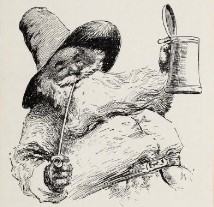
And when St. Nicholas had smoked his pipe, he twisted it in his hatband, and laying his finger beside his nose, gave the astonished Van Kortlandt a very significant look; then, mounting his wagon, he returned over the tree-tops and disappeared.
Washington Irving Knickerbocker’s History of New York (1809).
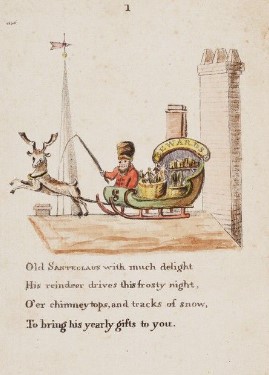
While Irving wrote about a horse pulling the wagon, in 1821 the 3rd part of the The Children’s Friend Series was poem about “Old Santeclaus” which depicted Santa’s sled being pulled through the sky by a reindeer.
Santa Claus continued his rise to stardom when a narrative poem called ‘A Visit from St. Nicholas’ was published anonymously by the New York paper The Troy Sentinel on December 23, 1823. This poem was later republished as “Twas the Night before Christmas” and Clement Moore claimed authorship although there is modern debate about the authorship of the poem.
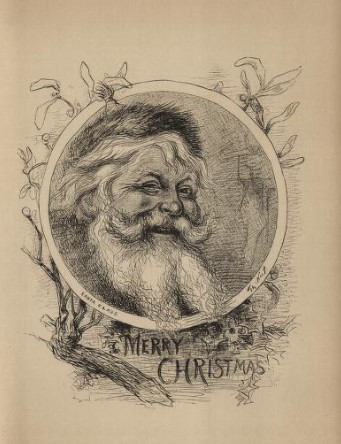
The secular nature of Santa Claus is often blamed on consumerism. But in reality, it was created when political cartoonist Thomas Nast started drawing pictures of Santa Claus for Harper’s Weekly during the Civil War. If Nast’s goal was to remind people of their shared culture and unify a war-torn nation, St. Nicholas or Santa Claus was a good place to start. Due to his wide popularity in Europe, he appealed to people from many backgrounds.
In 1890 Nast published a collection of his drawings titled Christmas Drawings for the Human Race.. He published the images saying, “The pictures are well called ” Drawings for the Human Race,” because they appeal to the sympathy of no particular religious denomination or political party, but to the universal delight in the happiest of holidays.”
In 1883, Nast teamed up with George Webster, illustrating Webster’s story “Santa Claus and His Works” and that is the first time we read about the North Pole and Santa being a toymaker.
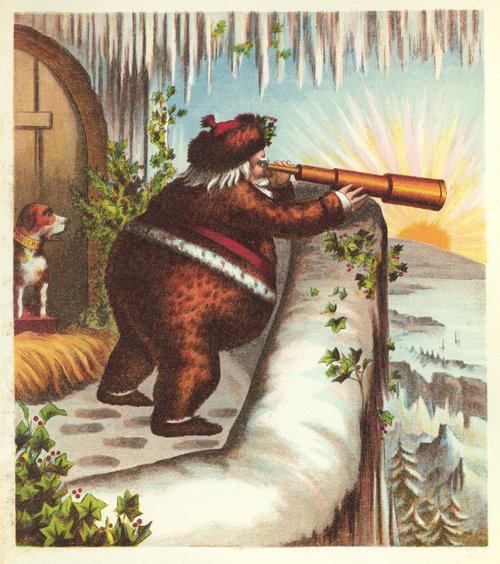
This image of Santa was further refined and slimmed down to his modern look in 1931 by illustrator Haddon Sundblum who worked for the Coca Cola company. This marketing campaign soared, and many European nations adopted Santy from the American lore.
I will be the first to admit that at first glance, it seems the culture of consumerism has since ruined the holiday. But has it really? I think it is a remarkable thing that for all these centuries people have carried on this tradition. As an icon, I believe Santa embodies the best of human kindness and charity teaching children the value of giving selflessly for no other reason than to bring joy to our fellow human beings. Given the longevity of the Nicholas traditions, it seems I am not the only person who feels this way.
For those of you who were looking for a more in-depth study of the Saint himself, here is his translated hagiography.
.
 Domestic Medicine
Thank you. It’s kind of off topic for my blog, but he does have a bit of a connection with apothecaries. I mostly wrote it because I have been seeing a lot of humbugs talking about Coca Cola inventing Santa and I wanted people to see he’s a little more meaningful than that.
LikeLiked by 1 person
Very interesting. Great pictures. Thank you.
LikeLike