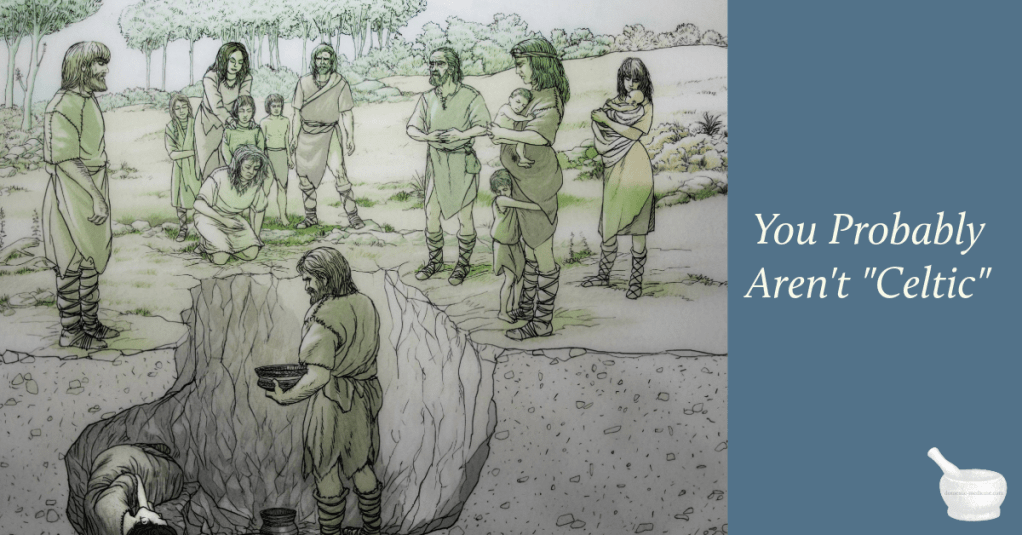
The other day on “the socials” I mentioned something about various Celtic Studies programs doubling down on the existence of the Celts because they have too much invested in to back down now, and I got a couple confused Facebook messages. One “proud Celt” got a little snippy with me.
So, I guess we are going to do this…
Several years ago, someone gave me the 2018 edition of Barry Cunliffe’s The Ancient Celts and then I found The Celts which is another good read on the subject by Alice Roberts. I went down a rabbit hole of my own choosing which resulted in me taking down my old website so that I could revise every post before I republished it on this blog.
Who I Thought the Gaels Were?
Before I get to that though, let’s talk about the term Gael as I understood it previous to reading the book and tearing down my site. ”Celtic” is a linguistic grouping that can be traced back antiquity, when Greeks referred to some of the tribes in Southern Gaul as Keltoi, while the Romans called them “the Gauls.”
This categorization is like using the term “Germanic” to encompass the range of languages derived from Old German. It has never made sense to me that we treat the Celts as a monolithic culture, when each group had its own unique customs, language, and social norms. We do not assume speakers of Germanic languages could easily communicate between cultures and we do not call them “the Germanics.”
One of my professors was from Scotland and this was her pet peeve. She would hammer on the fact that just because we know something about the Gauls does not mean it applied to the Gaels. One day I used the ‘C’ word around her. She gave me the stink-eye over her glasses while asking, “Which Celts? The Welsh, the Cornish, the Gallaeci that lived in Iberia, the Gauls that lived in France, the Bretons that lived in Brittany, the Boii tribe that lived in Bohemia and Bavaria, or perhaps you mean the oldest documented group of Celts that spoke Lepontic and lived in the Alps.” She then shook her head and said, “I think you mean the Gaels, dear.”
As a bit of background for people who do not know Irish mythology, for exceedingly long time the prevailing belief was that an invading Celtic culture who spoke a Goidelic form of Celtic came to Ireland and the British Isles sometime around 500 BCE and in Ireland at least wiped out the existing population. Many people still believe this. The theory is especially popular amongst racist asshats who like to go on about the Celtic Master Race.
Researchers have known since the mid-20th century that there is no archeological data to support the idea of a large-scale invasion and conquest. Some suggested the Gaels slowly moved into Ireland and spread their culture peacefully while assimilating some beliefs of the people they encountered. This made sense to me because it explained why aspects of earlier cultures like agricultural quarters persisted. So, I didn’t believe the invasion hypothesis, but I did believe that the Gaels existed.
After reading Cunliffe’s book I had to acknowledge that there is no evidence of any such migration in the Irish genetic history or in the archeological data. This idea of invading “Celts” is entirely 19th Century mythology.1 It is a yarn spun by Eugene O’Curry and picked up by P.W. Joyce and others. These are the same people who convinced the world that the kilt was an ancient Irish form of dress. I will let the clothes historian I buy patterns from explain that one to you.
So, Who Were the Gaels?
Hunter-gatherer groups probably always wandered about the islands a bit. To date there is no DNA evidence from the earliest Irish inhabitants – only a couple of bones from butchered animals. They likely explored during various glacial retreats and any trace of their existence was erased as glaciers advanced.
After the last glacial maximum (11,700 years ago) these nomadic bands seemed to settle down and began forming semi-permanent settlements. Cheddar Man belonged to these folk. Graeme Warren published a very informative book about the Irish Mesolithic and another about the Scottish Mesolithic. I am not going to expand on that much except to share I have read that up to 10% of the modern Irish genes may come from Western European hunter-gatherers especially if you are a biological woman, because ancient women seemed to prefer farmers to hunters2.
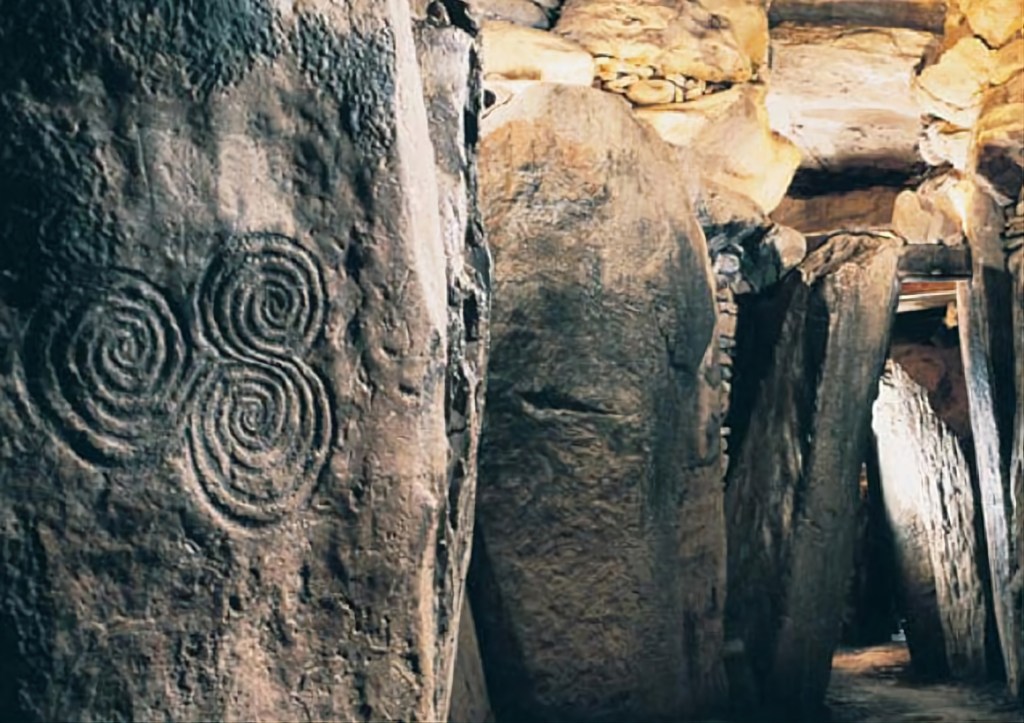
The neolithic farmers hunter-gatherer women preferred migrated to Britain and Ireland around six thousand years ago and were descended from Anatolians. They were the culture responsible for building amazing architectural works such Newgrange about 5200 years ago.3 This culture is still reflected in a small amount (around 5%) of the Irish genetic pool, however it is theorized that some sort of plague or illness decimated the population.4
This dip in population, about 4400 years ago, coincides with an incoming migration of pastoral people who were descended from the Yamnaya culture. Researchers call them the Bell-Beakers due to their pottery style. They were pastoralists who domesticated horses and engaged in equine and ruminant dairying.5 This explains the high occurrence of lactase persistence in Northwestern Europe.
They established an active and prosperous culture during the Late Bronze Age and were known for their distinctive pottery and metallurgy – working with copper and gold. They created the dolmens and had the unique practice of burying people in the fetal position as is recreated in the title picture. To our knowledge they did not have a written language and so their traditions, like those of many other Bronze Age cultures, would have been passed down via oral narrative and song.

The modern Irish get a good deal of their DNA from the Bell Beakers. It is hard to pinpoint exactly how much because there is some variation between studies. I’ve seen it said that they have determined from genome analysis that between 60-75% of Irish DNA is due to their Beaker heritage. This is also true of other northwestern European cultures. The modern Irish are most genetically like the people who lived in Wales and Scotland before the Saxon incursion because they share the Beakers as ancestors.6 This culture eventually adopted a Celtic language and is the culture we call the Gaels.
Small amounts of DNA were acquired later via Norse, Norman, and Saxon interaction. That’s it there is nothing indicating that Celtic tribes came anywhere near Ireland in the Irish genome and no blathering on about it is going to change that.
How Did Celtic Languages Spread?
Irish and Scottish Gaelic are Celtic languages, so what is that about? One theory is that a form of proto-Celtic emerged on the Atlantic coast including parts of Iberia. Due to Iberia’s huge role as a trading center in the ancient world, the language became what anthropologists call the lingua franca which means it’s the primary diplomatic/trade language of an area. Many believe the Celtic language spread from there to various other cultures. It is called the “Celtic from the West” hypothesis and was proposed by John T. Koch, Cunliffe and others.
If someone struggles with this concept, I point out that “westernization” is a thing and not every person who speaks English as their daily language is English. I have talked about the trade connection between Iberia and Ireland before, so this makes complete sense to me. We have documentation of Irish trade families establishing homes in Iberia by the 13th century, but that has probably been going on since their very first contact. This connection explains why we have Irish brewers learning about distillation before continental Europeans and Irish physicians using manuscripts translated at the Toledo school.7
That may be as far as Celticization went in Ireland. Hallstatt style art never made it to Ireland and very few examples of actual La Tène style ornamentation have been found in Ireland. Motifs we associate with Celtic art the curves, swirls and repeating patterns can be seen in the Newgrange tri-spiral and repeating patterns of Bell Beaker pottery. Metallurgy previously attributed to the La Tène Celts during this period was most likely the handiwork of the Bronze Age Irish who adopted new technology via trade influence.
There’s nothing saying a few craftsmen didn’t come looking for work and trade opportunities. I’ve seen some people make a case for calling the Bell Beaker who were “Celticized” at least to the point of speaking a Celtic language, the Gaels and that seems reasonable to me, as long as we still give them credit for their unique culture and art.
The Celtic from the West theory also supports the position of Irish archeologists like Terry O’Hagan who teaches that Irish druids are a monastic invention.7 If the Celts never made it to Ireland, then the Gallic Druid priesthood didn’t either. Assuming of course that the organization actually existed the way he described it and wasn’t just a bit of fancy on Caeser’s part.
Medieval monastic stories are believed to be an early attempt at nation building on the part of the church that were written “as part of a campaign to assert the joint authority of the Uí Néill kings of Tara.”8 They were written in direct response to the works of authors like Geoffrey of Monmouth who were attempting to do the same in England.
It’s worth pointing out that medieval writings don’t make any claims of Celtic heritage, they just talked about magicians as draoitheach. Ronald Hutton explains that this could be because druidecht is just a word for magic in the Celtic language family and that druí refers to all those who dabbled in magic in the stories whether they were perceived as the hero or that antagonist. 9 Every society has magicians, which doesn’t make them Druids.™
The “Celtic” pride theory was written at a time when we didn’t understand the ancient world and scholars considered Ireland to be an isolated island that no one interacted with because the Romans didn’t even conquer them. This is anything but true as evidenced by archeological finds, the Bronze Age Irish were engaged in robust trade and cultural exchanges with the Romans and the Iberians. Even the gold they used came from Cornwall.
I applaud Cunliffe for doing a tricky thing. The new data negates much of what he taught for decades, and he’s been having to go around and set the record straight. I am feeling a little of this, although I only have to live with being embarrassed about a few articles I wrote ten or fifteen years ago.
Honestly, all of this does not change a lot for me. Regardless of the questionable accuracy of their origin stories, many customs misattributed as being “Celtic” are still part of Irish or Scottish culture.
They are traditions my great-grandparents (Irish and Scottish) passed down to my grandparents because they were homesick. They are part of our heritage, regardless of their source. There’s nothing wrong about getting your Gaelic on, even if it’s not prehistorically accurate because it connects us to them.
I can see how friends of mine who are neopagans might struggle with this a little more than I do, as well as people who are hung up on the idea of being “a Celt” whatever that means to them. But as I remind people all the time, we need to be able to look at new data and shake off long-held beliefs, so here we are. I just appreciate that my brain is still capable of remodeling and has not become old and rigid.
More Reading:
Hey, Irish Americans: Your “Celtic” tattoo isn’t Celtic — because that whole idea was made up
Under The Spell of the Druids
References:
- Barra, Caoimhín De. The Coming of the Celts, AD 1860: Celtic Nationalism in Ireland and Wales. University of Notre Dame Press, 2018. ↩︎
- Balaresque, Patricia L., Georgina R. Bowden, Susan M. Adams, Ho-Lee Leung, Turi E. King, Zoë H. Rosser, Jane Goodwin, et al. ‘A Predominantly Neolithic Origin for European Paternal Lineages,’ 1 January 2010. https://doi.org/10.1371/journal.pbio.1000285′]. ↩︎
- Cassidy, Lara M., Ros Ó Maoldúin, Thomas Kador, Ann Lynch, Carleton Jones, Peter C. Woodman, Eileen Murphy, et al. ‘A Dynastic Elite in Monumental Neolithic Society.’ Nature 582, no. 7812 (June 2020): 384–88. https://doi.org/10.1038/s41586-020-2378-6. ↩︎
- Cassidy, Lara M., Rui Martiniano, Eileen M. Murphy, Matthew D. Teasdale, James Mallory, Barrie Hartwell, and Daniel G. Bradley. ‘Neolithic and Bronze Age Migration to Ireland and Establishment of the Insular Atlantic Genome.’ Proceedings of the National Academy of Sciences 113, no. 2 (2016): 368–73. ↩︎
- Wilkin S, Ventresca Miller A, Fernandes R, et al. Dairying enabled Early Bronze Age Yamnaya steppe expansions. Nature. 2021;598(7882):629-633. doi:10.1038/s41586-021-03798-4 ↩︎
- Olalde, Iñigo, Selina Brace, Morten E. Allentoft, Ian Armit, Kristian Kristiansen, Nadin Rohland, Swapan Mallick, et al. ‘The Beaker Phenomenon and The Genomic Transformation of Northwest Europe,’ 9 May 2017. https://doi.org/10.1101/135962. ↩︎
- ‘Avicenna Fragment’, ca 1600. Meamram Páipéar Ríomhaire. https://www.isos.dias.ie/master.html?https://www.isos.dias.ie/libraries/PRIVATE/Avicenna_Fragment/english/index.html?ref=https://www.isos.dias.ie/libraries/PRIVATE/english/private_menu.html?ref=. ↩︎
- O’Hagan, Terry. ‘Pagans and Paganism in the Writings of (St) Patrick [Part 1]’. Vox Hiberionacum (blog), 17 March 2019. https://voxhib.com/2019/03/17/pagans-and-paganism1/. ↩︎
- Wadden, P., and Patrick Wadden. ‘Theories of National Identity in Early Medieval Ireland’. Http://purl.org/dc/dcmitype/Text, Oxford University, UK, 2011. https://ora.ox.ac.uk/objects/uuid:49c662b9-4e14-41b3-972e-ed8475f324c5. ↩︎
- Hutton, Ronald. ‘Under the Spell of the Druids | History Today. ‘History Today, 2019. https://www.historytoday.com/miscellanies/under-spell-druids. ↩︎
 Domestic Medicine
One thought on “You Probably Aren’t “Celtic””
Comments are closed.