
As I have mentioned before, these quarter days served to organize agricultural and household tasks and I am far more interested in that aspect of the day I observe these traditional holidays to connect to my ancestral folkways and to help me stay organized in the many tasks I accomplish in my life.
In passing down this commonsense tradition I learned growing up and learning more about the way my ancestors lived, I am honoring all that is past, present, and future. This is what drives me to attempt to reclaim some measure of authenticity in the depiction of our cultural folkways. So, rather than just burying my head in the sand for the next week as people spread nonsense about Brighid, I’ve decided to push back a bit with my own ideas.
During the Celtic Revival, which in my estimation spans from Standish O’ Grady (1878) to W.B. Yeats (1939) in Ireland1, a lot of ancient history was revived and revised for nationalistic reasons and it’s best to read all of it as creative nonfiction. An Irish archeology professor I interact with on Twitter calls it the leprechaunization of Ireland.
My people who immigrated here before that time missed out on all of that and so I got a little more balanced version of the story. When I was growing up in the diaspora, before the days of the Internet, Imbolc was not something I heard about. St. Brighid’s Day belonged to the saint, and the following day belonged to her friend Mary.
I thought it would be interesting if I chose to ignore almost everything written after the last of my people immigrated (mid-1800s) and try to determine who Brighid was to them and what her day may have been in their minds. Remember though that my maternal grandparents were born in 1906 so this does not skip as many generations for me as it might for you.
That’s going to be a theme in my research this year. If it wasn’t written before 1860, I am probably not going to mention it much other than an occasional visit to the Schools’ Collection which seems to house a lot more of that balance that I remember from my youth.
The folk customs pertaining to St Mary’s Day (Candlemas, Lá Fhéile Muire na gCoinnea ‘feast day of Mary of the Candles) often get mixed up with those of Lá Fhéile Bríde. To make sure that I don’t do that, I will be covering them in two different posts.
Despite what a lot of creative nonfiction writers out there would have you think, we really don’t know much at all about the ancient observance of Imbolc. If you look through medieval and early modern manuscripts, you will not find it mentioned. The Irish observed the same quarter days as the English for most of documented history. Even the Wikipedia page about the quarter days acknowledges Imbolc hasn’t been celebrated since before the 5th Century.
Imbolc is equidistant between the winter solstice and the spring equinox, but modern folk tradition in Ireland holds that February 1st was the first day of “spring” by the Celts. That has always confused me because the continental celts did not divide their year into four seasons. There was the cold half of the year (gaimred) associated with the feminine and the warm half of the year (samrad) associated with the masculine.
So, it made sense to me the first time I read that custom may have been assimilated – possibly dating back to the Neolithic. Some passage mounds such as the Mound of Hostages and the Cairns of Slieve na Caillaigh are aligned with the sunrise on this morning. The Neolithic inhabitants of Ireland, as you may recall were farmers with Anatolian ancestry who settled all over Europe. This might explain why we find Brighid in Ireland, Brigantia in Britain, and Santbregit in Old Welsh.
In the Wooing of Emer it is written “Oi-melc, then, is the time in which the sheep come out and are milked.” Oi-melc translates literally to “sheep milking” which makes sense when you consider the fact that this is the time the ewe’s milk would begin flowing as they prepared to give birth. This is said to be the origin of the term Imbolc.
Kuno Meyer translated the following passage concerning the ancient quarter days which leads some scholars to believe that purification rites were associated with this quarter day. This is all we know about a feast day that was celebrated before there was any written documentation.
Fromad cach bíd iar n-urd,
issed dlegair i n-Imbulc,
díunnach laime is coissi is cinn,
is amlaid sin atberim.Tasting every food in order,
Bodleian Library MS. Rawl. B. 502
This is what behoves at Candlemas1,
Washing of hand and foot and head,
It is thus I say.
I want to be clear that there was nothing in my search perimeters linking the sisters Brigit with Imbolc, or spring like we do these days. This following excerpt from Cormac’s glossary was written 244 years after the hymn about St. Bridget, I mention below. None of this can truly be viewed as primary source material.
“Brigit i.e. a poetess, daughter of the Dagda. This is Brigit the female sage, or woman of wisdom, i.e. Brigit the goddess whom poets adored, because very great and very famous was her protecting care. It is therefore they call her goddess of poets by this name. Whose sisters were Brigit the female physician [woman of leechcraft,] Brigit the female smith [woman of smithwork]; from whose names with all Irishmen a goddess was called Brigit2.
Brighid the poetess is the only sister identified by Seathrún Céitinn (Geoffrey Keating)3 as one of the Tuatha Dé Danann. She is also mentioned simply as the Goddess presiding over poetry in Volume 4 of the Collectanea de rebus hibernicis.
We need to have a talk about the word poet here. Every time you see the word pertaining to Irish mythology it has probably been translated from the word filídh. Poet is a woefully inadequate translation. The filídh were a type of service magician knowledgeable in interpreting the meaning or substance of words and portents. They were often called upon to interpret the laws. I want you to keep that in mind as we progress.
Her father was definitely the Dagda. Some say that her mother was Danu the mother goddess of Tuatha Dé who was a river goddess. I have not found that within my search perimeters. If that is true, her parentage would reinforce her connection to the British river goddess Brigantia. But again, I’ve never found it in anything written prior to 1850.
Brighid was married to Bres who was the son of the King of the Fomorians but fostered by the Tuatha Dé. Her son Ruadán was killed during the Second Battle of Moytura during which she went to the battlefeield to caoine (lament) his death by wailing and crying. This was the first time this was heard in Ireland. This keening tradition is quite an important aspect of Irish culture, and I am often suprised how few people mention this story.
That’s all we know about this goddess, insomuch as we can trust that our monastic spin-doctors relayed anything correctly. (I wouldn’t bet the farm on it.) Anything more you read is nonsense neopagan rebranding that began in the 19th century with Carmichael, Frazier, and their ilk, and has continued since.

There are three quasi-mythical Brighids mentioned in the Ulster cycle. The Senchas Már is a law tract based upon the judgments of famous judge and filídh, Sencha MacAilella. The honorable judge had a lot of powerful women in his life. Brigh Briugu was the poet’s mother. Brigh Brethach was his wife and the mother of Brigh Ambue his daughter.
Brigh Ambue was married to Celtchoir Mac Uthichair who we read about in The Tain. She may have been an advisor to Queen Mugan, the wife of Conchobor Mac Nessa. She seemed to be responsible for keeping her dad on his toes when making determinations on cases involving women, which earned her the name Brigh “of the Judgments. ”
This is all we know about these quasi-historical characters, but people who are always looking for triple goddesses will see a triple goddess. What I see here is an inherited honorific, which may have carried over into Christian times. I am not the first to suggest that Brigh might have a title rather than a name.4 One meaning of bríg in Old Irish was strength or authority,5 so it is possible that it was some sort of title of respect.
Christian missionaries began poking about the islands and eventually began the practice of conversion through assimilation. This isn’t conjecture. Pope Gregory I specifically told them to assimilate pagan traditions, as a means of winning over the locals. Mellitus was a missionary who joined St. Augustine of Canterbury on his mission to convert the British Isles, three or four years after St. Augustine arrived in Britain, so around 601.CE
In this letter the pope wrote to him we can also see that feast days were faire-like events that involved community feasts immediately before and after the conversion. So that gives us a little clue what Imbolc may have been like.
“Tell Augustine that he should be no means destroy the temples of the gods but rather the idols within those temples. Let him, after he has purified them with holy water, place altars and relics of the saints in them. For, if those temples are well built, they should be converted from the worship of demons to the service of the true God. Thus, seeing that their places of worship are not destroyed, the people will banish error from their hearts and come to places familiar and dear to them in acknowledgement and worship of the true God.
Further, since it has been their custom to slaughter oxen in sacrifice, they should receive some solemnity in exchange. Let them therefore, on the day of the dedication of their churches, or on the feast of the martyrs whose relics are preserved in them, build themselves huts around their one-time temples and celebrate the occasion with religious feasting.
Gregory the Great: Epistola 76, PL 77: 1215-1216.
They will sacrifice and eat the animals not any more as an offering to the devil, but for the glory of God to whom, as the giver of all things, they will give thanks for having been satiated. Thus, if they are not deprived of all exterior joys, they will more easily taste the interior ones. For surely it is impossible to efface all at once everything from their strong minds, just as, when one wishes to reach the top of a mountain, he must climb by stages and step by step, not by leaps and bounds.”
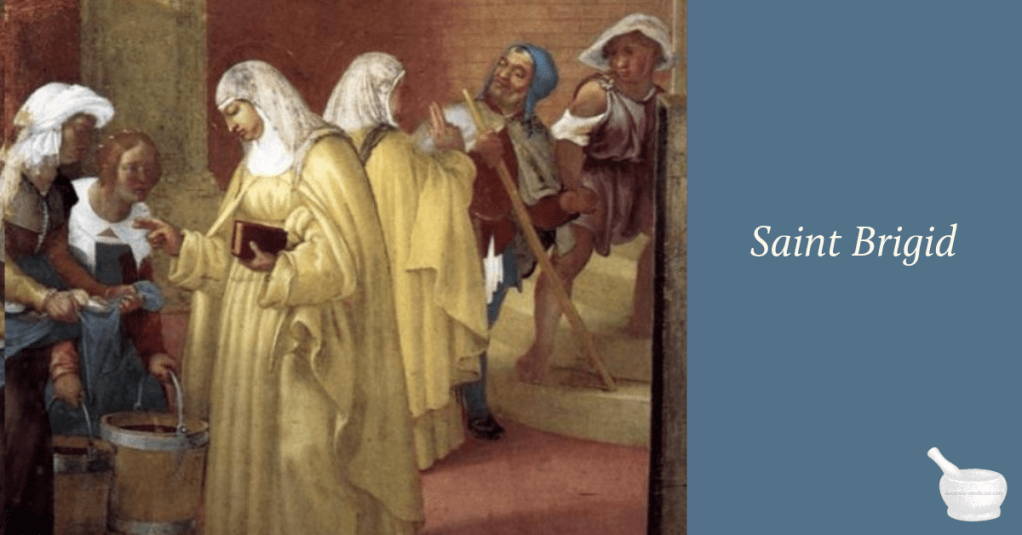
St. Brigid is one of the legendary figures who emerged during this time of stages and steps. According to Catholic lore, Brigid was the illegitimate daughter of an Irish filídh who sold her mother so he wouldn’t be found out, but she inherited his abilities. She is said to have been educated by St. Patrick, until eventually founding her own monastic community in Kildare in 480 C. Most historians believe that Kildare was one of the religious temples reinvented by Christian missionaries per Pope Gregory’s directive.
Saint Brigid traveled the Irish countryside performing various miracles including curing illnesses and turning water into ale. The oldest written reference to her is an Old Irish hymn written by St Ultan of Ardbraccan who died in died c. 6576.
Brigit bé bithmaith
breó orda óiblech
donfe don bithlaith
in grian tind toidlech
Brigit ever good woman
A sparkling golden flame
may she lead us to the eternal realm
the shining bright sun
Ronsoera Brigit
sech drungu demna
roroena reunn
cathu cach thedma
Save us Brigit
from hordes of demons
may she win for us
battles of every hardship
Dorobdo innunn
ar colla císu
in chroeb co mblathaib
in mathair Ísu.
Destroy within us
the sins of our flesh
the branch with flowers
The mother of Jesus
Some say the introductory paragraph indicates that Brigid was some sort of sun goddess, but there’s no other documentation of that other than the association with fire, though. That last line refers to the Irish belief that Jesus was fostered by Brigit as any noble child would have been placed in fosterage during this part of the medieval era.
In the History of Ireland by Seathrún Céitinn (Geoffrey Keating) we are told that there were fifteen St Brighid’s in Ireland including Brighid, daughter of Dubhthach.7 I’ve seen some conjecture that this is because at Kildare as each St. Brighid passed; another was picked to take her place. He wrote that one of Brighid’s miracles was maintaining a fire at Kildare that burned without creating ash, which would make it impossible to bank so I am not sure why this was a miracle, but I digress.
The church of St Brigid at Kildare (Cill Dara) was favored by the kings of Laigin (Leinster). Brighid was named as their patron saint in the Lebhar Na G-ceart. This leads some researchers to theorize that Brighid was a tribal goddess specific to people in Leinster.
William Drummond wrote that Brighid meant “fire keeper” and that the Breoghidh were noble women tasked with keeping a fire burning at Killdare and performing divinations there until Henry de Loundres, the archbishop of Dublin in 1220, ordered an end to the pagan superstition. 8 If this is true, their role as filídh, persisted a lot longer than many scholars believe and it may support the idea that Brighid was a title.
What About the Cáilleac?
I have yet to see a “primary” source written about Cáilleac Bhéirre in which she is directly associated with Imbolc or Brighid, so I don’t think she bears mentioning here, but since the Gather blog has decided to post rubbish, I will mention her.
Stories in in the Schools’ collection most often describe her as an old woman who brought three lives to this world. “Thug sí trí shaol go dtí an saol seo.”9 Creative “nonfiction” authors took a lot of liberties with her during the Celtic Revival. Don’t do that. When we reinvent her as a “goddess” I think we overlook a crucial aspect of her story which is the place “old women” held historically.
Although it is frequently used when referring to supernatural old women, the word cáilleac/cailleach does not automatically refer to a magic user. The word is from Old Irish meaning “veiled woman.” It has been used to refer to nuns because they wear headcoverings due to biblical law stating that a women who “prayeth or prophesieth with her head uncovered dishonoureth her head.”10
I mention this because if you read the stories about Saint Bridget, there’s a specific moment when a veil is placed on her head that is more significant, if you know that the action signifies she is a prophetess, which by the way the bible has no problem with.
I’ve also seen cailleach and biddy used in Schools’ Collection to describe old beggar women As Greedy as Cailleach an Tae. I think the term might be tied up in this history, but not in the way other people have written.

While we do not know much about Imbolc, we know a great deal about customs practiced by early Christians who celebrated Lá Fhéile Bríde. Irish folklorist Seán Ó Súilleabháin wrote, “Every manifestation of the cult of the saint (or of the deity she replaced) is closely bound up in some way with food-production” and that butter, cheese, and milk were favored foods of this feast day.
Common sense dictates that it would be safer to eat up the stores of milk, in the form of cheese, because fresh milk was becoming available. Since most of us grew up with refrigeration, it is odd to think of milk as a seasonal item, isn’t it? We were lucky to be able to get milk from Grandma’s dairy herd, when our milk cow was taking her two month rest every year.
Farmers watched the portents to see if it was time to begin preparing the fields for planting. Sighting a hedgehog or an adder would be an encouraging sign. Villagers could expect that soon the rough seas of winter would begin to abate, and the tides would wash in loads of seaweed to be gathered, cut, and spread on their cropland.
There is as you might expect by now, a history of young people going from home-to-home asking for money or some sort of gift. 11 Note the similarity in this story to the name given to Brighid’s fire tenders.
“Boys and girls would go from house to house with rags on them. That night they used to have a musical instrument and they would play it, and they would get money from the man of the house. They were called Brighideóga and that is the name they are now given as well.”12
Maighread Breathnach National Folklore Collection, UCD 1938
Unlike some historians I doubt how ancient these practices were. We can see from Pope Gregory’s letter than the older practice was a communal faire type gathering where everyone ate and celebrated together outside a temple or holy place.
To me it seems more likely that this practice popped up sometime during the medieval period when all of the mumming/wassailling traditions emerged. As the nobility took their feasts into their great halls the poor were shut out, but not the clergy. Those not lucky enough to get an invite were forced to go round the evening before the feast trying to scrounge up food, drink or coin in order to have their celebrations.

There are healing traditions associated with the feast day which could date back to the days when one of the sisters’ Brighid was a goddess who presided over medicine and healers. Or maybe they go back to the days when monastic communities provided most “professional” health care that happened outside the home in medieval times. Who is to say?
I couldn’t find much about them in my search perimeters, but I have personal knowledge of a couple practices being used in my family13, so I feel comfortable passing them along with what I believe is the practical undercurrent of the tradition.
One was that a piece of silk ribbon or a strip of linen was left outdoors on St. Bridget’s Eve – usually on the windowsill or over a bush. The saint was said to have blessed the ribbon as she traveled the Irish countryside and historians write about the ribbons mystical healing powers. February is a good time to take stock of your first aid supplies. I just did that today.
Based on my experience I am going to offer the conjecture that the ribbon itself was a practical item used for various first aid applications. Linen strips can tied tightly to stop bleeding or soaked in rose vinegar and wrapped around a feverish person’s feet. They can be used to hold a plaister over a wound or on someone’s sore throat. They can be tied around the head to apply pressure as a headache cure. Using counterpressure to relieve a headache is a pretty common practice in traditional medicine. There is even an old clinical trial that supports its usefulness.
The Bratog Bríde (Bridget’s Mantle)15 has sometimes been written about as a linen garment that was left out to be blessed by the saint to be used for the purposes of ensuring a safe childbirth. Most people who pass this along share it as some odd superstition about the healing powers of the cloth. I believe that’s because they were people who had never helped deliver a baby. Fellow doulas and midwives out there know exactly what I am talking about.
Women have used scarfs like that in cultures all over the world to help move injured people and assist laboring women. The Rebozo trend seems to have brought that practice full circle. Here is a primary source account of an Irish woman using a mantle as a child carrier. I was excited to have stumbled across this one.
There was an Irish Woman, wife to a Common Souldier, who, though big with child, accompanied her Husband in the Camp; and whereas the Army daily was in motion, marching from place to place; it hapned, that by reason of a sudden flood after a hasty rain, a small Brook began to swell so high, that it hindred the Armies marching for one hour:
In which time of the Armies halting, the womans pains of child-bearing came upon her; insomuch, that she withdrawing her self to the next thicket of shrubs (without the help of any Midwife, or any other preparation of Baby-clouts) there, all alone, brings forth Twins; … both which she brought down to the River presently, and there washed both her self, and them; which done, she wraps them up (not swadled at all) in a course Irish mantle, and carries them at her back, marching with the Army the same day barefoot & barelegged (as she was) twelve miles, and that without the least prejudice to her health, or to the lives of her children.
James Wolveridge Speculum matricis hybernicum 1669
If these items were blessed by a priest or a saint, all the better. That practice persisted for centuries. There is a rite for blessing the linens of the sick in my 1964 copy of the Rituale Romanum.
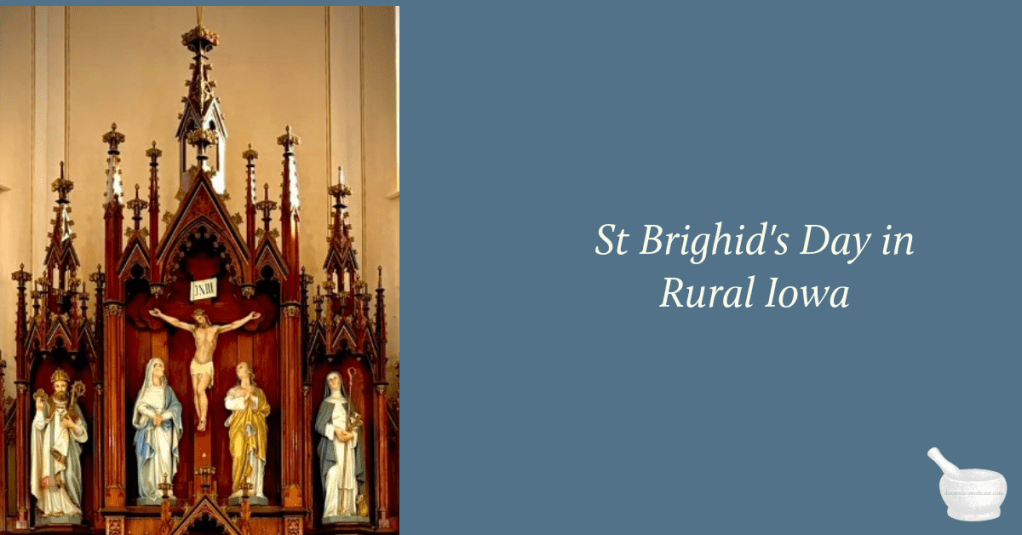
The day was really not a big deal in our area. An agricultural festival that doesn’t jive with your seasons doesn’t hang on for long, and the 1st of February is not remotely close to spring here. I grew up not far from where the Presentation Order from Mooncoin first immigrated to the US and established themselves. I recall the nuns always had some sort of community education event, usually on the weekend though. I know that older family members went to mass, but they did that a lot. I recall that they taught how to make the crosses in catechism classes that week because we would be making them during school recess.
That’s not to say we didn’t do the things. I remember my grandmother showing me how they would weave unsheathed grain into crosses and hang them to save the seeds, but that happened at threshing time which was an outdated practice by the time I was born. The only time I ever picked grain by hand was that year that the combine broke at harvest time and there was no money to fix it.
The coming of spring was still divined by the portents , they just happen later in the year. So farmers watch to see if the groundhogs or hibernating snakes have left their dens, although here in Iowa we were usually watching for rattlesnakes. Then the farmers get to work preparing their fields to be sown. Being landlocked there were no ocean tides washing in seaweed for spreading on the cropland, but there were steaming piles of manure.
I spent a very long time trying to find something that talked about a rural family might celebrate St. Bridget’s day around the time my people started immigrating . It sounds like it was pretty similar to a weekend barn dance. I found that comforting.

My guess here is that the “madder” is a spelling of the term mazer which would be interesting because this mirrors the 12th night wassailing custom.
I believe people take the Irish mythological cycle out of context. The Irish mythological cycles do not depict deities in the classical sense. The Irish venerated their ancestors, and the cycles are stories passed down about the great deeds and valor of those who have gone before. They were magical but they weren’t written about as gods in the sense that say the Egyptions wrote about their extremely interventionist gods.
Royal families traced their lineage back to these heroes to support their claim to power. Their adventures were recorded by monks who understood God in the context of a magical being who demanded worship and imposed commandments on people and they tried to reconcile these two things. Tuatha Dé Danann couldn’t be real people because humans are not magical, only gods are. Then these stories were intrepreted by people who wanted to tuck all beliefs into neat motifs or catagorizations.
I think the legendary Brighids of Ireland represent something more tangible than some amorphous diety. Brìgh was also a term that had to do with understanding the meaning of words or sayings15. In O’Brien’s Irish-English dictionary published in 1768 he defines brìgh as”the meaning, interpretation or substance of a thing.” 16
It is at least worth considering given the many times the name emerges as an an honorific that it meant something more at one time. Perhaps it was given to various ritual healing specialists responsible for divination, interpreting the meaning of portents and reminding their community of the meaning of pisreóga and the laws of man.
We see evidence of this below when a Brighid is referrred to as a Poetess. We see evidence of this when historians write of a procession of St. Brighids. We see evidence of this in Biddy Early’s name. I think this speaks to a past when women were recruited and trained to be wise and powerful players in their community, alongside men. You don’t have to be a mythical goddess to wield that kind of power, but I suppose some people would like you to think so.
I think it’s a lot more interesting to ponder that aspect of Brigid than it is to spend a lot of time reading Llewellynized nonsense.
References:
- If it has ever actually stopped? ↩︎
- Meyer translated Imbulc to Candlemas. I don’t agree with that. They are not the same feast day in the liturgical calendar and there is a convoluted story as to their proximity which I will cover in my Candlemas post. ↩︎
- Mac Cuilennáin, Cormac. Sanas Chormaic. Edited by O’Donovan, John. 1868 Translation. Calcutta, India: Irish Archeological and Celtic Society., 900. ↩︎
- Céitinn, Seathrún. Foras Feasa Ar Éireann. Translated by Comyn, Edward and Dinneen, Patrick. Classics Project, 1632. ↩︎
- Koch, John T., and Antone Minard. The Celts: History, Life, and Culture. Vol. 1. 2 vols. Bloomsbury Publishing USA, 2012. ↩︎
- eDIL – Irish Language Dictionary. ‘Bríg’. Accessed 12 January 2020. https://dil.ie/search?q=Br%C3%ADg&search_in=headword. ↩︎
- See also Brocthan’s Hymn in the Irish Liber hymnal ↩︎
- The other 14: Brighid, daughter of Dioma; Brighid, daughter of Mianach; Brighid, daughter of Moman; Brighid, daughter of Eanna; Brighid, daughter of Colla; Brighid, daughter of Eachtar Ard; Brighid of Inis Brighde; Brighid, daughter of Damhar; Brighid of Seanbhoth; Brighid, daughter of Fiadhnat; Brighid, daughter of Aodh; Brighid, daughter of Luinge. ↩︎
- Drummond, William Hamilton. Bruce’s Invasion of Ireland: A Poem. Hodges and MʻArthur, 1826. It was eventually rekindled until Henry VII closed all Catholic facilities, and then rekindled again in 1993. ↩︎
- Cailleach Bhéarach · Gort Na Díogha · The Schools’ Collection’. The Schools’ Collection, Volume 0016, Page 160. National Folklore Collection, UCD. https://www.duchas.ie/en/cbes/4613671/4607054/4623982. ↩︎
- 1 Corinthians 11:5 ↩︎
- Súilleabháin, Seán Ó. Irish Folk Custom and Belief. Published for the Cultural Relations Committee of Ireland at the Three Candles, 1967. ↩︎
- Breathnach, Maighread. ‘Oíche Bhríde’. Claddagh East, Co. Galway, Ireland, 4 February 1938. The Schools’ Collection, Volume 0018, Page 264. National Folklore Collection, UCD. https://www.duchas.ie/en/cbes/4613682/4608142/4623298. My translation. ↩︎
- I just mean they used the healing practices here, not the ritual that went along with it. I have worked with a rebozo as a doula and still use a soft silk ribbon for my migraines. ↩︎
- Súilleabháin, Seán Ó. Irish Folk Custom and Belief ↩︎
- eDIL – Irish Language Dictionary. ‘Bríg’. Accessed 12 January 2020. https://dil.ie/search?q=Br%C3%ADg&search_in=headword. ↩︎
- O’Brien, John. Focalóir Gaoidhilge-Sax-Bhéarla: Or, An Irish-English Dictionary. N. F. Valleyre, 1768. ↩︎
 Domestic Medicine
You must be logged in to post a comment.