
In the 15th century the term “cordiall” meant something that was soothing to the heart or spirit. The term was frequently used for medicines, but there were even devotional books named The Soul’s Cordiall.
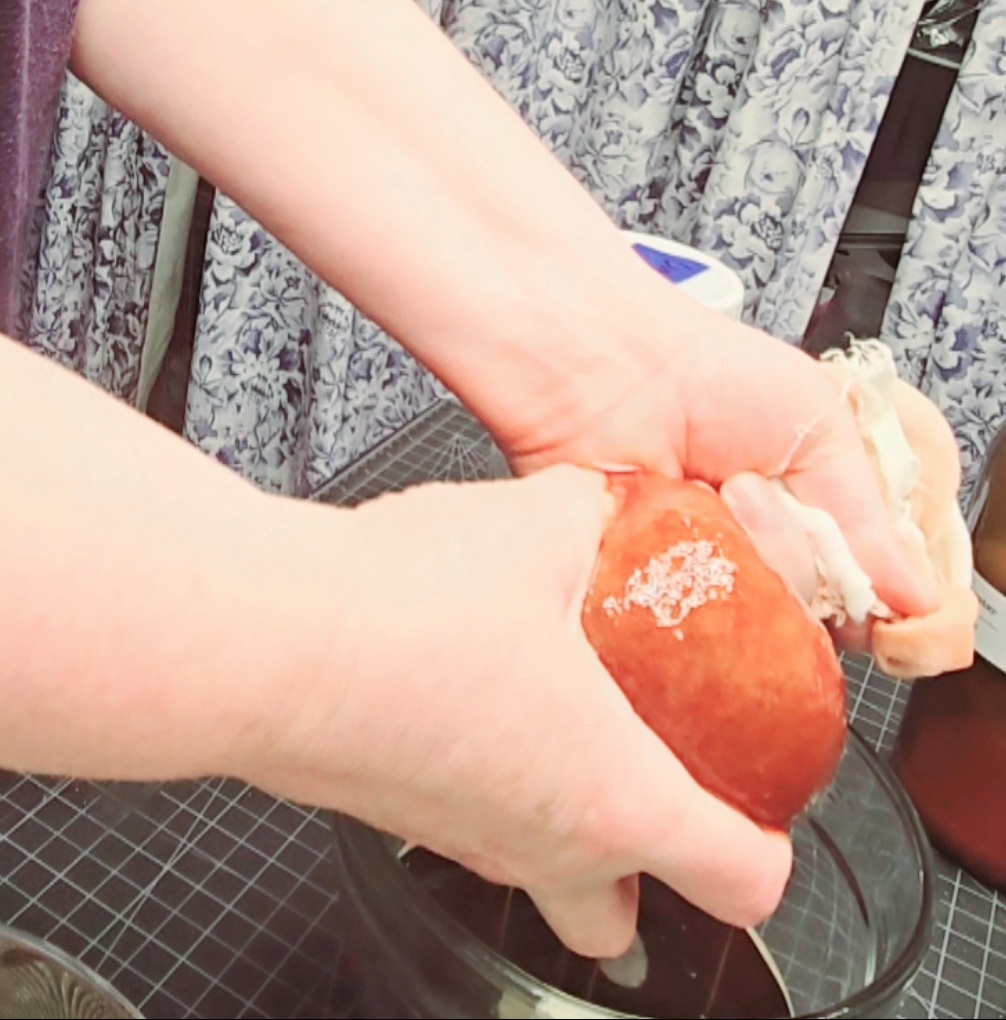
I think most of us could use a bit of soothing right now, so this is the perfect time to talk about cordial preparations which include the cinnamon water that I was squeezing out the other day. If for some reason you just want to make it without learning about it, you can jump to the receipt.
The physycke doctor Andre Boorde assured his readers that “All maner of cordyalles and restoratiues, & al Swete or dulcet (sweet and soothing) thinges doth comfort the hert, and so doth maces and gynger ; rere egges, and poched egges not harde, theyr yolkes be a cordiall.”1 So maybe I need to learn to love dippy eggs?
Culpeper lists the five cordial flowers as Roses, Violets, Borrage, Buglosse, Rosemary, or Bawm-flowers. 2 Students of modern herbalism will recognize this list as plants thought to be beneficial to the nervous system. Something as simple as a preserved nutmeg (fresh nutmeg that has been confited with syrup) was also considered a cordial.
The name cordial speaks to the purpose of the preparation not the type of the preparation. This is why we have those lovely cordials that ooze cherry filling when you bite into the chocolate shell. The word may also refer to a liqueur or a syrup. Making them pleasant tasting seems to have been considered part of the soothing nature of the preparation.
Cordials were meant for soothing an overactive nervous system. Humoral practitioners believed the heart regulated our emotional state. You sometimes saw the word used in reference to other body systems like “a cordial for the stomach” which seems to mean that they were meant sooth stomach upsets caused by nervous conditions.
Cordials were often suggested for people who experienced brain fog, light-headedness, dizziness, and fainting. Due to their association with the heart cordials were were sometimes recommended for” heart qualms.” A very simple cordial might be made quickly by mixing things they would have already had around the home.
3 drops of cinnamon essential oil
15 mL syrup of carnation flowers
15 mL cinnamon water (see receipt below)
Mix these three ingredients together and give them to the party to sip on when they are feeling light-headed or faint.3
Cordial Waters
One of the most common medieval medicinal preparation methods was to macerate plant material in wine or an unrectified spirit and then distill it again. (Then liquor simply meant liquid.) This is how the medicinals of monastic tradition such as cardamaro, meletti, absinthe, génépi, nocino, and of course, chartreuse, were made. They were collectively referred to as amari in Italy or generally just called waters.
Reading through medical receipts you will see these preparations far more frequently than you see anything resembling modern tinctures. You might wonder why they would bother to distill a preparation like this rather than just using it.
According to humoral medicine alcohol still had some amount of phlegm that needed to be rectified via distillation to make the preparation healthier. That theory was abandoned which allowed tinctures to gain in popularity. It’s not a terrible idea. Multiple distillations improve the mouth feel of a spirit. This is why Irish whiskey is smoother than a Scotch, because it is distilled three times rather than only twice.
A cordial water is a distillation that is compounded with with a syrup or sugar. They might call for equal amounts of hydrosol and alcohol during the maceration stage. After maceration and distillation the drinks were sweetened as sugar was considered by most to be warming in the first degree.
It also diluted the preparation. Since this might become a concern for some people, I want to share this with you from the pharmaceutical compounding text I used in college.
“A minimum of 15% alcohol is required to preserve the product from microbial growth if no other preservative agents are present. Industrial pharmacists usually regard 15% alcohol as adequate for the preservation of products with a pH of 5, while 18% has been considered adequate for neutral or slightly alkaline preparations.” 4
If this doesn’t reassure you then feel free to keep your preparations in the refrigerator. The following example is a very nice way to preserve black cherries without any added sugars.
An Excellent Cordiall water for Dizziness & Swimming in the head.
Adapted from a receipt by Lady Sedley
Ingredients
4 lbs fresh black cherries
½ cup lemon balm
½ cup rosemary tops
½ ounce cinnamon
½ ounce nutmeg
2 quarts dry sack sherry or brandy
Directions
- Stone the cherries, chop the herbs, and grind the spices.
- Put all the ingredients in a container with an airtight lid. If the brandy is too much alcohol for you then you could use wine like I do.
- Let it sit for at least 24 hours.
- Strain the liquid through butter muslin
Lady Sedley’s directions say to distill this in balneo (bain marie method) which means that she used glass distillation equipment. Do what you like with that. Since we are using brandy that is likely to have been distilled a few times, it will be smooth enough without distillation, but not quite as potent. It can be sweetened with sugar or a cordial syrup to your liking but I find the juice from the cherries to be plenty of sweet.
Cinnamon Water
I am going to be honest and say that the reason cinnamon water peaked my curiosity is that Culpeper recommends a method for making a cinnamon water by infusion saying that it was used more frequently for “heart-qualms, and faintings” than Mathiolus’ method and he found it to be equally effective.
As a historian I find this significant because it represents the beginning of the tincture era when practitioners began to realize that maybe they didn’t need to rectify the phleghm from these infusions. As a long-covid sufferer, I was willing to give just about anything that might possibly get my nervous system under control a go.
The most typical way of making cinnamon water is to make the following spirit and it is generally attributed to Pietro Andrea Mattioli whom Culpeper called Mathiolus.
CHAP. XXVII. To make Cinnamon waters.
TAke a pound of fine Cinnamon, beate it and put it to infuse the space of twenty foure houres in a glasse vessell, with foure pints of good Rose water, and halfe a pint of good white wine upon the hot cinders or in some hot place being well stopped, then still it in a Limbecke or Balneo Mariae, and keepe the water in a strong glasse well stopt.5
Some physicians would recommend sweetening it with sugar while others would not. Culpeper, as usual pandered to the trends and infused the solution with musk and ambergris.
Cinnamon Water made by Infusion.
Take of Cinnamon bruised, four ounces, Spirit of Wine [brandy], two pints, infuse them together 4. daies, in a large glasse close stopped with cork and a bladder, shaking the glasse twice a day.
Dissolve half a pound of white sugar Candy, in a quart of Rose-water, then mix both these liquors together, then put into them four grains of musk, and half a scruple of Amber∣greese tied up in a fine rag and hung to the top of the glasse.6
I have been experimenting with my version of this for over a year now. It is hard for me to pinpoint exactly how useful because it’s only a small part of a regimen, I developed for myself.
I can say that 5-10 mLs will pretty quickly halt one of the episodes where my heart starts racing because I have changed position suddenly. I don’t think it is a placebo-effect because other things like motherwort tincure have not been at all useful for my palpitations. It is not long-lasting though, so I will usually follow that up with a breathing exercise or something longer lasting like my hops-mugwort preparations.
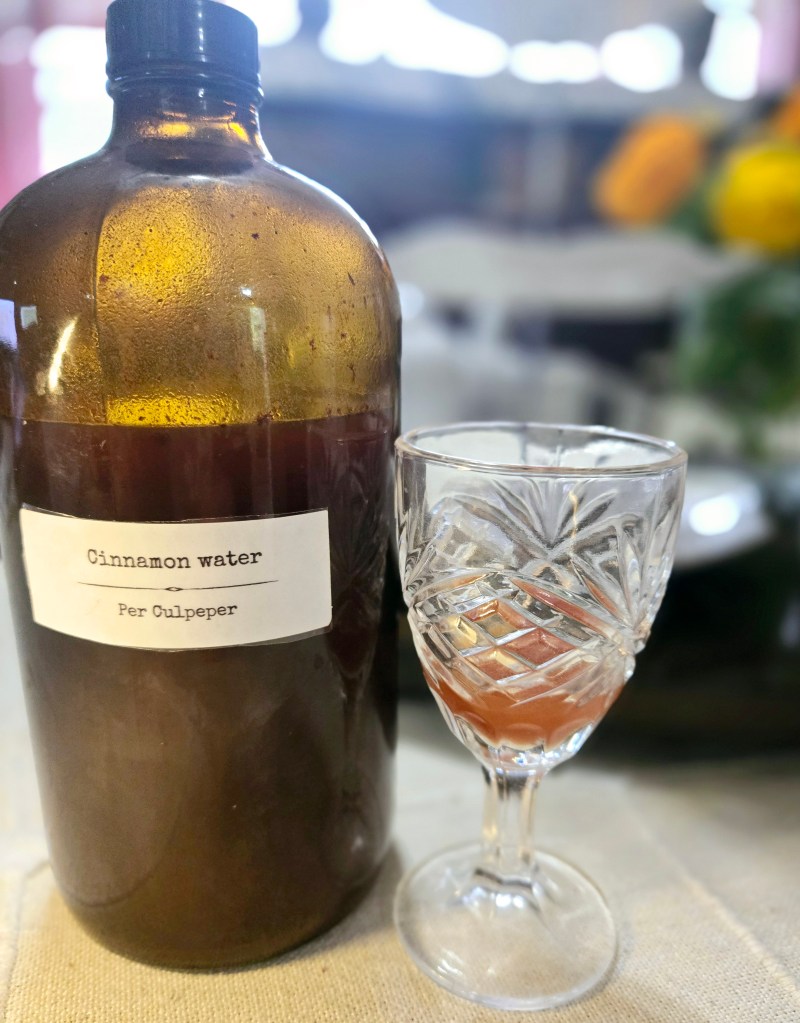
Cinnamon Water Cordial
Ingredients
2 ounces cinnamon chips
2 handfuls of rose petals (I prefer fresh. You can use dry)
1 pint white wine or brandy
1 pints rose-water
1/3 lb (130 grams) white sugar (optional)
Directions
- Coarsely grind the cinnamon chips and rose petals. Put them in a container that has an airtight lid.
- Pour the wine/brandy over this mixture and let it infuse for four days. It’s up to you what you use here. Using wine as a solvent means there will be less alcohol in your final preparation and that’s been my goal lately.
- Strain this through butter muslin, squeezing tightly to get as much liquid as possible.
- Put the strained liquid in the bottle you plan to store it it
- If you are going to use the sugar stir it into the rosewater and then pour it into the bottle. I find the cinnamon to be “sweet” enough and don’t use sugar at all so I just pour in the rosewater.
- Put the lid on the bottle, label it, and store it.
References
- Boorde, Andrew. The Fyrst Boke of the Introduction of Knowledge Made by Andrew Borde, of Physycke Doctor. A Compendyous Regyment; or, A Dyetary of Helth Made in Mountpyllier. Translated by Frederick James Furnivall. 1870 translation. London; England: Pub. for the Early English Text Society, by N.T. Trübner & Co., 1542. http://archive.org/details/fyrstbokeofintro00boorrich. ↩︎
- Culpeper, Nicholas. Pharmacopoeia Londinensis: A Physicall Directory, or, A Translation of the London Dispensatory Made by the Colledge of Physicians in London. London, England: Printed for Peter Cole and are to be sold at his shop, 1649. https://archive.org/details/b30336879_0001. ↩︎
- Kent, Elizabeth Grey. A Choice Manual of Rare and Select Secrets in Physick and Chyrurgery … 1st ed. London, England: Printed by G.D., and are to be sold by William Shears …, 1653. http://name.umdl.umich.edu/A47264.0001.001. ↩︎
- Shrewsbury, R. P. (2015). Applied Pharmaceutics in Contemporary Compounding (3rd ed.). Denver, CO: Morton Publishing Company. pp 120. ↩︎
 Domestic Medicine
Thank you. That’s helpful.
LikeLike
The cherry drink is delightful. As far as the rose water, I make my own in the summer but if I run out I buy it. I suspect that the pre-prepared water has rose essential oil added to it. The homemade has a fresher, lighter taste that I prefer.
LikeLiked by 1 person
Really very interesting. I like the sound of the cherry drink especially. Is the rose water your own pre-prepared water, or could one use proprietary rose water? The latter always seems overly strong.
LikeLike