
In my last post, I explained how early modern people acquired the fresh herbs essential for their domestic medicine. I discussed a class of merchants referred to as ‘old women’ or simplers.
These merchants specialized in gathering and selling herbs that domestic practitioners used to treat common ailments—wounds, digestive issues, and fevers—offering practical remedies which addressed the everyday health needs of their communities.
After sharing that post, someone asked me why I did not mention how the burning times impacted the profession. This question is rooted in a modern myth that drives me round the bend – that of midwives and healers meeting a fiery end at the hands of witch hunters.
Even though this is a myth that has been busted almost 40 years ago, it seems almost impossible to put to rest. In this post, I going to do my best to answer the question by tearing away at the myth that prompted it, even though better scholars than me have tried and failed.
Perhaps repetition is the key? So let’s just jump in here.
One contributing factor to the persistence of the midwives and healers myth is that people do not understand that how widely plant medicine was utilized. We have all been inundated with this idea that every village had one spooky hedgewitch peddling cures when the reality is that herbal remedies were part of the collective knowledge of a community, not an exclusive commodity. People who want to sell you things have taught you that.
Every person raising a family knew plant medicine. (I want to step away from the use of the word mother here because during a time when many women died in childbirth any family member might be caring for the ill. ) As long as plant use was focused on practical healing, it didn’t garner religious or supernatural suspicion, and was exempt from witchcraft accusations. I am not quite sure how people who know me still don’t know that… but it is what it is.
Others will argue that there is “no such thing as a witch” and therefore there is no way they could have actually been prosecuting witches. That is not entirely true. There were absolutely people who earned a living by working within a framework of magic and supernatural beliefs. There is widespread confusion about the difference between the folk practitioners who dealt in ritual magic, and the everyday practitioners of domestic medicine.
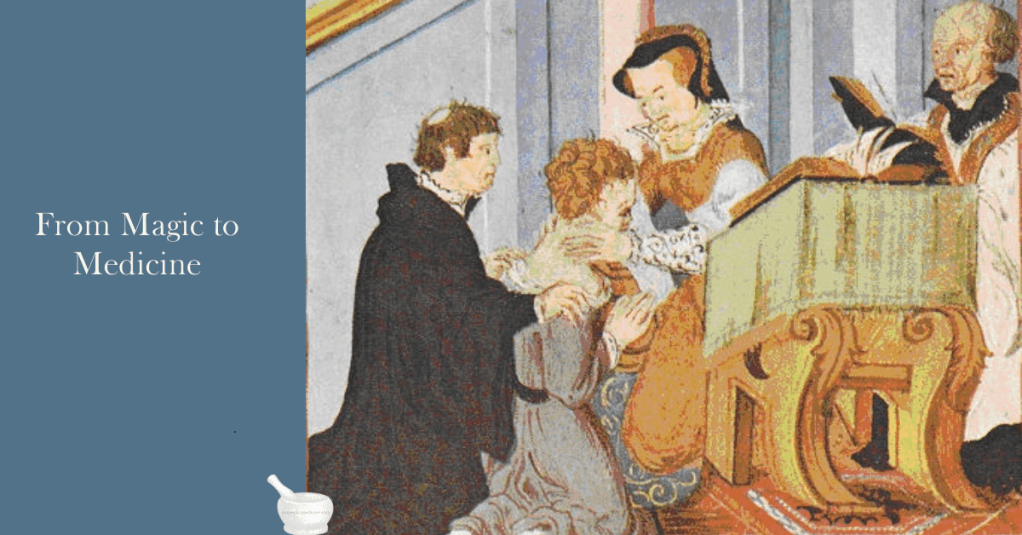
Part of this confusion is because in ancient societies most physicians were considered to be magical because illnesses were believed to be caused by supernatural forces. This belief was common and deeply embedded in many different cultures. Beings like Mesopotamian gidim, Anglo Saxon elves, and Scottish seely wights were believed to bring harm or illness if displeased. So of course a healer had to be magical in order to divine the cause of your illness might be and to repel or appease whatever spirit was causing it.
Early modern people, were not far away from the days of attributing illness to onfliers and elves, and using plants as magical wards to keep them away. The Catholic Latin – English dictionary published in 1483 advises people that “where thou dos it [mugwort] in houses na elves na na evyll thyinges may come therein.”1
In England and France, monarchs were thought to have a magical healing touch, granted by god. In Catholic homes people would often apply remedies along with a blessing or little prayer. Incense was still burnt to appease God.
In adopting humoral theory, however, professional medical practitioners changed this. They had moved away from attributing illness to supernatural causes, focusing instead on balancing the body’s internal humors. Even though this theory was mostly nonsense, it did create a new class of healer – the rational scientist.
Domestic medicine was informed by physicians and so it shifted also. Even though at times magical ritual persisted as an adjunct, domestic medicine became more grounded in empirical observations. Plants and minerals were used for their known qualitative and medicinal properties, aligning more closely with professional medical practices and leaving supernatural explanations behind.
Who Were Early Modern Wise Women?
When the terms ‘wise woman’ or ‘cunning woman’ were used as a title, the term was typically assigned to ritual healing specialists or what Ronald Hutton refers to as a “service magician.”2 They occupied a unique space in society, distinct from both the healers using domestic remedies and the more malevolent practitioners of magic (if you believe in such things).
Wise woman was just one of names used to describe these people. Others included cunning woman/man, bean feasa, cailleach luibh [herb hag], lucht piseog, fear piseog, blesser, conjurers, artificers, soothsayer, and magus. As you might surmise from the names, the role was not unique to one gender,
In early modern times, these specialists were perceived as “good” witches who counteracted maleficent magic. Their particular role was to step in when an event or illness was attributed to supernatural causes. As one account described it:
“The Good or white Witch (as they call him or her) whereby is meant, these Healers or Blessers (as some call them) who pretend to know who are bad Witches, and where they dwell; and how to heal blasting, for speaking.”3
These benevolent magicians provided a wide range of services, from counteracting spells to interpreting supernatural signs, often referred to as portents. They were sought after to locate lost items or to interpret weather patterns and dreams. In one early modern play, a character implores:
“For heavens sake, Madam, torture not your selfe With dreams, but let some Magus read them to you, Or else consult with some wise woman ’bout them.”4
A typical scenario involving one of these specialists is described in an early modern book warning people against consulting with them. Here, the healer was consulted when a patient’s lingering illness was suspected to be caused by a curse (forspoken):
“A man is sicke, his sicknesse doth linger vpon him, Some doe put into his head that he is bewitched, He is counselled to send vnto a cunning woman, She saith he is forspoken indéede, she prescribeth them what to vse, there must be some charme and sorcerie vsed. The partie findeth ease, & is a glad man, he taketh it that he hath made a good market.” 5
The methods used by these practitioners varied significantly. Some claimed to be able to “pull forth the thorn, pin or needle”6 believed to have been maliciously inserted into the afflicted, or an effigy of the afflicted. Others crafted protective amulets to ward off malevolent forces.7
Some consulted with fairies or spirits to cure illness, sometimes using plant-based substances, or entheogens, to enter altered states and communicate with these beings. An example would be Biddy Early, the famous Irish healer, who often drank from her buidéal draíochta (black bottle) to consult the Fae.
Another story describes a cunning woman who “cured” individuals using the following charm 8for which she was paid a loaf of bread and a penny:
“My Lofe in my lappe,
My Penny in my pursse,
Thou art neuer the better,
Nor I am neuer the wurse.”
These practitioners became targets of distrust, as even a seemingly good witch could be perceived as a threat.
“They are taken for cunning men and women, and for good people who follow Isaacs example in blessing men’s children and cattell: they are thought to doe no harme at all, but much good by helping strange mischaunces that befall men in their bodies, children, or goods. Thus would some excuse and defend these wizards and blessers, who are the wretched lives of the divell [devil]…”9
I want to interject here that some authors are overly dramatic about the use of the word cunning. In early modern English, ‘cunning’ simply meant wise and the terms were used interchangeably.
“I reckon these hearbs onely, because I teach my Countrey Housewife, not skilfull Artists, and it should be an endlesse labour, and would make the matter tedious to reckon vp, Land• beefe, Stocke-Iuly-flowers, Charvall, Valerian, Go-to bed at noon, Piony, Liconas, Tansie, Garden mints, Germander, Centaurie, and a thousand such Physicke Hearbs. Let her first grow cunning in this, and then she may enlarge her Garden as her skill and ability increaseth.”10
I use this quote frequently in presentations because it never fails to surprise at least some audience members that a protestant minister was telling women to learn about herbal medicine in 1617. You can rest assured that the good Reverend Lawson who wrote this book wasn’t encouraging everyone to turn to witchcraft. The term cunning woman is actually used in the bible.
Thus saith the LORD of hosts, Consider ye, and call for the mourning women, that they may come; and send for cunning women, that they may come:
And let them make haste, and take up a wailing for us, that our eyes may run down with tears, and our eyelids gush out with water.
I’m also fairly confident that God wasn’t suggesting people send for a bunch of witches to lament Judah and Jerusalem’s troubles. Or maybe he was? There is a lot more white magic in the Bible than most people realize, but I digress…
Catholic “Sorcery”
Catholic practices were too ritualistic for Protestant reformers who criticized the Catholic church for assimilating pagan practices. Gifford noted “Papists make no more of the Sacrament than of some magical sorcery.”11 (The term Papist was a derogatory label used primarily by Protestants in early modern England to refer to Roman Catholics.) Historian Ronald Hutton’s work points out that witchcraft accusations became a tool to root out practices Protestants associated with Catholic rituals or older folk traditions.
When people were accused of witchcraft, it was rarely because they were using herbs to heal. Some writers even made sure to clarify that not every “old woman” was a witch. 12
Those presiding over witch trials were supposed to differentiate between practices that aligned with Protestant views of healing and what they considered the supernatural or “diabolic” manipulation of nature.
Reformers saw any form of healing that involved blessings or invocations as suspect. So if you applied herbs and said a little prayer, as was the Catholic practice in many places at the time, then you were more likely to draw censure.Frequently the defining characteristics of “witchcraft” were the ritualistic aspects which included casting a spell with words.
Whether it be by Charms, Voices, Images, Characters, Stones, Plants, Metals, Herbs, &c. there must herewithal a special form of words be always used, either Divine, Diabolical, Insensible, or Papistical, whereupon all the vertue of the work is supposed to depend.13
I should point out here that like St. Augustine, Scot rejected the idea that witches had any real supernatural powers. He was definining what what constituted an accusations of witchcraft which in his opinion was based on superstition, ignorance, and fear rather than on any actual maleficium (harmful magic).
Conceits Unveiled
Of course there were also skeptics who dismissed the work of the wise women as trickery saying, “Supernatural Informations and Conjurings are meer Artifice and Cunning.”14 Playwrights of the time often portrayed people engaging these “magicians” as gullible and easily fooled by conceits.
‘Conceit’ refers to a trick, illusion, or scientific curiosity meant to astonish or entertain. Conceits were sometimes employed by artificers to exploit someone’s trust for gain. It later became called a confidence trick which is where we get the word con man. The term traces its roots to Latin ‘concipere‘ (to conceive or devise), relating to the crafting of an idea or plan.
Several authors tried to disclose to the public how these conceits were wrought. In Naturall and artificiall conclusions (1650), Thomas Hill uncovered a great number of such tricks including making a stone burn with using a flame and how “to make one that they shall not sleepe, or to sleepe when you please.”15
In Natural Magick (1658), John Baptista Porta wrote an exploration of seemingly “magical” phenomena that could be explained by science, including how to create a fire that burned in water and how to make invisible ink.16
Even if you don’t believe in ‘witchcraft’ it’s important to understand that some of these people presented themselves as working within a magical framework to make a living. Whether or not they were really magical is unimportant.

The Intersection of Domestic Medicine and Magic
Ritual healing specialists, though sometimes viewed with suspicion by Protestant reformers and skepticism by others, were still regarded as beneficial by many. They continued to be sought after for their perceived abilities. As James Mooney, an American ethnologist of Irish descent, observed in 1887:
“Every housekeeper is well acquainted with all of the virtues of the common herbs to which she never fails to resort in case of need—always accompanying the application with a prayer—and it is only when she exhausts her resources or is convinced that the illness is of a supernatural origin that she applies to the cailleach luibh.” 17
I often use this quote to illustrate the clear divide between those practicing domestic medicine and ritual healing specialists. Every household had someone who was knowledgeable about caring for the sick, preparing remedies from plants, minerals, and other locally available resources. This did not stop because of the witch mania.
My own family, for example, carried on these traditions through generations. This kind of practical domestic medicine became the lifeblood of communities, especially in rural areas where access to formal medical care was limited.
There is no history of the midwives in my family line being hassled by witch hunters or physicians, however I do have an ancestor who liked to sneak out to drink Sack and “cavort merrily” with married men and she got herself in a bit of trouble.
How Did the Midwives and Healers Myth Surface?
I am sure you are wondering how this all got started. The myth arose largely because romanticized historical narratives have blurred the lines between a wise woman and a practitioners of domestic medicine. This happened for a couple of reasons.
The rise of romanticism fueled a growing fascination with folklore and the supernatural. Authors with nationalistic motives also sought to elevate local folk traditions and pre-Christian practices in order to establish national identities and they pandered to a public wild for spooky stories.
Hutton points Jules Michelet’s work La Sorcière (1862) as an example of this.18 In it, he portrayed witches as wise women or healers who were persecuted by the Church and state. My beloved authors of the Celtic Revival were guilty of throwing in a little fancy as well. Unfortunately this is something I did not understand when I wrote a lot of articles ten years ago.
I am not the only scholar who relied too much on works from this era. Witches, Midwives, and Nurses (1973) used a few poor sources to support the premise that the persecution of witches was a way to suppress female autonomy, particularly in the realms of medicine and midwifery.
While this interpretation resonated with many, it was more ideological than historically accurate. In reality midwives continued to practice throughout the era. Some even assisted witch hunters by identifying “witchmarks” on victims of the witch hunts.
The truth is that most accused witches were neither midwives nor healers. Even Ehrenreich, the author of Witches, Midwives, and Nurses, has since acknowledged errors in her scholarship. Despite many scholars working to eradicate inaccuracies, these myths persist.
The roles of simplers and domestic healers are now hopelessly confused with that of service magicians in the modern “herstory” mythology. The fact that a simpler was more likely to harvest snails than a witch ever was, indicates how blurred the distinctions between the two roles have become over time.
Since these myths unfortunately continue to shape modern views on what it means to be “an herbalist,” it’s important to challenge these romanticized narratives and spend some time discussing historical realities.
Ultimately, while much of the popular imagination remains captivated by the myth, it is the legacy of simplers and domestic healers that truly speaks to me. These healers didn’t rely on magic or mysticism but instead used practical knowledge of plants and remedies to care for their communities, and families.
During the era of the witch trials, everyone used plant medicine in their homes. Making lavender tea does not make you “witchy.” It may however directly connect you to the practices of your ancestors.
I encourage you to dive deeper into the history. Explore the books in the reference section, which reveal how wise women and magicians navigated early modern society. I promise, their real practices were far more interesting than simply brewing a cup of tea.
More Reading:
Doctor, Healer, Midwife, Witch: How the Women’s Health Movement Created the Myth of the Midwife-Witch
Historians as Demonologist: The Myth of the Midwife-Witch
The truth about witches and witch-hunters by Scottish witchcraft expert Julian Goodare
Witchcraft: Eight Myths and Misconceptions by Oxford professor Diane Purkiss
Five Myths about the Salem witch trials by Stacy Schiff
‘The Myth of the Persecuted Female Healer’, written Jane Davidson and found in The Witchcraft Reader published by Routledge in 2019. affiliate link
The Witch: A History of Fear, from Ancient Times to the Present by Ronald Hutton. affiliate link
- Herrtage, Sidney John Hervon, ed. Catholicon Anglicum: An English-Latin Wordbook, Dated 1483: From the MS No. 168 in the Library of Lord Monson, Collated with the Additional MS. 15,562 British Museum. 1881 Translation. London, England: N. Trubner & Co., 1483. ↩︎
- Hutton, Ronald. The Witch A History of Fear, From Ancient Times to the Present, 2017. ↩︎
- Bell, John. The Tryal of Witchcraft: Or, Witchcraft Arraign’d and Condemn’d. Glasgow, Scotland, 1697. ↩︎
- Baron, Robert. Mirza a Tragedie. London, England: Printed for Humphrey Moseley, 1647. ↩︎
- Gifford, George. A Discourse of the Subtill Practises of Deuilles by Vvitches and Sorcerers. Imprinted at London: [By T. Orwin] for Toby Cooke, 1587. ↩︎
- Blagrave, Joseph. Blagraves Astrological Practice of Physick London, England: Printed by S.G. and B.G. for Obad. Blagrave, 1671. ↩︎
- A True Discouerie of Diuers Notable Villanies Practised by One Iudeth Phi∣lips. London, England: Printed at London by TT.C. and are to be solde by William Barley, 1595. ↩︎
- Clowes, William. A Prooued Practise for All Young Chirurgians, Concerning Burnings with Gunpowder, and Woundes. London, England: Printed by Thomas Orwyn, for Thomas Cadman, 1588. ↩︎
- Perkins, William. Commentarie Upon the 11. Chapter to the Hebrewes. Humfrey Lownes, 1608. ↩︎
- Lawson, William. The Country Housewife’s Garden. 1983 Reprint. London, England: Breslich Foss, 1617. 32 ↩︎
- Gifford, George. A Discourse of the Subtill Practises of Deuilles by Vvitches and Sorcerers. Imprinted at London: [By T. Orwin] for Toby Cooke, 1587. ↩︎ ↩︎
- Scot, Reginald. The Discovery of Witchcraft. London, England: Printed for Andrew Clark, 1665. ↩︎
- Ibid.. ↩︎
- Ravenscroft, Edward. Dame Dobson, or, The Cunning Woman a Comedy as It Is Acted at the Duke’s Theatre. London, England: Printed for Joseph Hindmarsh, 1684. ↩︎
- Hill, Thomas. Naturall and Artificiall Conclusions…London, England: Iane Bell, dwelling at the East end of Christs-Church, 1650. ↩︎
- Porta, John Baptista. Natural Magick. London: Thomas Young and Samuel Speed, 1658. ↩︎
- Mooney, James. The Medical Mythology of Ireland. Philadelphia, PA: MacCalla & Company, 1887. ↩︎
- Hutton, Ronald. The Witch A History of Fear, From Ancient Times to the Present, 2017 ↩︎
If you are enjoying this post, I would appreciate if you could support my work!


 Domestic Medicine
You must be logged in to post a comment.