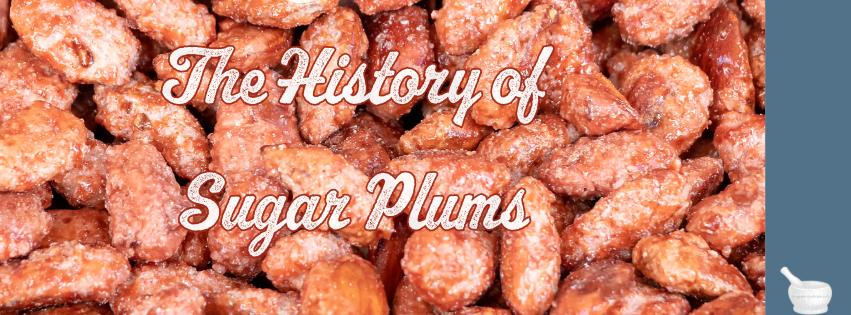
Last year I posted an instagram post about the history of sugar plums promising that I would dig a little deeper to learn more about it. The earliest rather vague reference I have found to sugar plums is in a Tudor era book called Knack to Know a Knave published in 1594 which says to the reader, “Come eat some plums, they be sugar.” 1
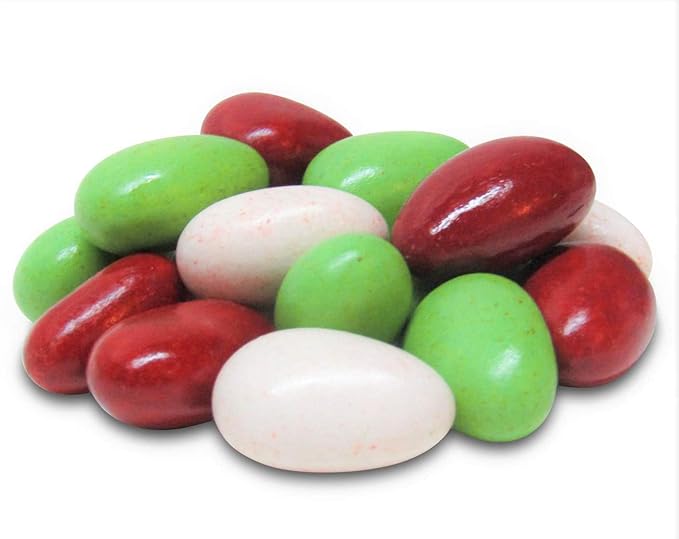
Nouvelle grammaire angloise (1600) defines the term simply as “des Dragées” 2 which are modernly known as Jordan almonds (pictured below) . Almost two centuries later Nathan Bailey’s dictionary confirms this calling sugar plums “almonds iced over with sugar.”3
In Hannah Glasse’s cookbook she refers to nonpareils as sugar plums and suggests decorating your fritters with them. These are the small round balls used for decorating cakes and cookies.
The Victorians seemed to apply the term to a broader array of candies. Jonathan Bouchier addressed the subject in Notes & Queries (1893) saying ” By sugar-plums I mean sugared almonds, bull-eyes, acidulated drops, barley sugar, peppermint lozenges, toffee, and, in short the whole lollipop tribe.”4
These typed of candies were made by a process called panning which is still used today for making modern candies like M&Ms or those coated chocolate eggs we buy at Easter time, as well as classics like Jordon almonds and nonpareil. If you really want to get adventurous you can buy yourself a panning attachment for your Kitchenaid and try this yourself.
I am more interested in the use of panning as a means of making medicinal sugar plums. There is a long history of coating seeds, particularly carminatives like caraway, anise and fennel, with sugar and serving them after meals to improve digestion.5 They were called comfits and Christopher Monk has written an excellent post about making them.
The Sugar Plums of St. Roch were made by panning juniper seeds and were said to be “good against the Plague” while another type of sugar-plum were made with orange or lemon slips (peels) and good for digestion. Pistachios peeled and coated with sugar were said to be a type of cordial.6
William Salmon suggested that medicinal sugar-plums should be taken in the morning fasting in some warm broth. posset drink, or mace ale.7
They seem to be one of the older methods of delivering medicinal agents that were slowly replaced by medicines made with alcohol such as tinctures, elixirs and balsams. In fact in 1685 one Timothy Byfield criticized sugar-plums as one of the old styles of medicine, that create surfeit and fowl the body and “of themselves create Disease.”8
The Mystery of the Purging Sugar Plums
If you do a research into eighteenth century books and periodicals you will find advertisements for a propritary medicine called “purging sugar plums” sold as early as 1705.9 Full page ads assure us that “Dr. Ryan’s Incomparable Worm-destroying Sugar Plums are Highly Necessary to be Kept in All Families.”10
In a pamphlet published in 1715 attributed to Paul Chamberlen we are told:
Purging SUGAR-PLUMS entirely without Mercury.
So often mentioned in the publick prints, and used now for several years in great numbers of families with such great success and liking, not to be distinguished by any mortal living from common SUGARPLUMS bought at the confectioners; only those at the confectioners are quite round, whereas these are made something flattish; But as for their colour, taste, smell, &c. ’tis impossible for any one that eats them, to distinguish ’em from a common SUGAR PLUM a lump of loaf sugar, or a bit of sugar-candy, having neither any nauseous, sickly, physical, squeamish or disagreeable taste, or leaving any such taste behind them in the mouth, but may be eaten with the same ease, pleasure, and unconcernedness, that a bit of sugar-candy, or a common sugar plum is…
They kill, destroy, and bring away all sorts of worms, with the slimy corrupted matter that breeds them; having brought away from several men, women, and children, great knots of such worms as these.
And on Christmas Eve, 1714, two of these plums brought away alive near half a pint of these sort of worms, from the child of Mr. Dixon, a taylor, in Feathers-Court in St. Martins-Lane, an account of which any one may see more at large in an advertisement in the evening post on Tuesday, Dec. 28, 1714
In A Complete History of Drugs (1748) we are told “There are Infinite Variety of Flowers, Seeds, Kernals, Plums and the like, which are, by the Confectioners, cover’d with Sugar and bear the name of Sugar-Plums.”11
The author tells us anise seeds, careway seeds, coriander seeds were most common but also mentions that in the “Northern Nations” the seeds of wormwood were used like anise seeds to make medicinal sugar plums. My guess is that these are our “worm destroying sugar plums” while sugar-plums containing a small amount of scammony as mentioned in Dictionaire Oeconomique,12 were the purgatives. They might also have been a combination of ingredients as that formula was a pretty closely guarded secret.
So you can see, sugar plums have a fascinating history that shows how food and medicine were once deeply connected. Medicinal sugarplums are just one example of how sugar helped the medicine go down. They were used to soothe digestion, combat worms, or even as gentle laxatives. By the end of the Victorian era, the term expanded to include all kinds of candies, losing its medicinal role but gaining widespread charm.
References
- Tudor Facsimile Texts: Knack to Know a Knave. 1911, 1594. ↩︎
- Miège, Guy. Nouvelle grammaire angloise. chez E. Laurenz, 1600. pp 244 ↩︎
- Bailey, Nathan, and Anton Ernst Klausing. A Compleat English Dictionary; Oder, Vollständiges Englisch-Deutsches Wörterbuch … Waysenhaus- und Frommannische Buchhandlung, 1783. ↩︎
- Notes and Queries. London [etc.] Oxford University Press [etc.], 1849. http://archive.org/details/s8notesqueries03londuoft. ↩︎
- Lindley, George. A Guide to the Orchard and Kitchen Garden: Or, An Account of the Most Valuable Fruits Cultivated in Great Britain: With Kalendars of the Work Required in the Orchard and Kitchen Garden During Every Month in the Year. Longman, Rees, Orme, Brown and Green, 1831. ↩︎
- Chomel, Noel. Dictionaire Oeconomique: OLately Printed at Paris … D. Midwinter, 1725. ↩︎
- SALMON (M.D.), William. Phylaxa Medicina: A Supplement to the London Dispensatory, and Doron: … Being a Cabinet of Choice Medicines Collected … for Vulgar Use. Second Edition, 1688. ↩︎
- Byfield, Timothy. Two Discourses: One of Consumptions, with Their Cure … The Other Contains Some Rules of Health. For Dorman Newman, 1685. ↩︎
- “Purging Sugar-Plums for Children, an English Proprietary Medication Advertised in 1705.” Pediatrics 70, no. 6 (December 1, 1982): 1000. https://doi.org/10.1542/peds.70.6.1000. ↩︎
- Schuyler, Hamilton. A History of St. Michael’s Church, Trenton: In the Diocese of New Jersey, from Its Foundation in the Year of Our Lord 1703 to 1926. Princeton University Press, 1926. ↩︎
- Pomet, Pierre, Joseph Pitton de Tournefort, Nicolas Lémery, John Hill, Samuel Birt, William Parker, Charles Hitch, Edward Wicksteed, and J. and J. Bonwicke. A Complete History of Drugs. London : Printed for J. and J. Bonwicke. 1748. http://archive.org/details/completehistoryo00pome. ↩︎
- Chomel, Noel. Dictionaire Oeconomique: OLately Printed at Paris … D. Midwinter, 1725 ↩︎
 Domestic Medicine
You must be logged in to post a comment.