I was tasked with providing primary source documentation concerning weights and measures. The project was initiated by people who want to be able to recreate the receipts they are working with. They are not transcribing just for the sake of writing something down.
One of the goals of this blog is that I want to set people up with enough knowledge to safely and accurately recreate receipts from manuscripts, so I thought I would share what I found here. I really wanted to just give you a list to make this easy for you but it’s just not possible. You have to read everything for context. You need to know the year that your manuscript was written so you know if a pound was 12 ounces or 16 ounces. You have to know where the recipe was written.
For those of us trying to recreate medical receipts, we may need to transcribe some terms differently. Pharmaceutical measurements were first defined during antiquity eventually morphing into what is known as the Apothecaries’ system. That’s a topic for a whole post someday. Today though I can give you a short cheat sheet of some terms you might come across and what they mean in metric terms.
Troy (15th century – 1824)
Grain: 64.798 milligram
Pennyweight: 24 grains (1.56 g.)
Ounce : 20 pennyweights (31.2 g.)
Pound: 12 ounces (373 gtams)
Avoirdupois (Modern Imperial)
Grain: 64.8 mg
Dram: 1.772 g
Ounce: 28.3 gr 1/16 lb
Pound: 453.6 g 16 ounces
Apothecaries
Grain: 64.8
Scruple: 20 grains (1.296 g)
Drachm: 60 grains (3.89 g)
Ounce: 480 grains (31.1g)
Pound: 5760 grains (373 g)
The 1824 Weight and Measures Act passed by the British Parliament marked the beginning of the Imperial Measures. This act replaced previously used measures referred to as the Queen Anne measures. It’s commonly believed that the USA uses Imperial measures, but we actually utilize units based on the earlier Queen Anne measures. This is why a British pint is 20 ounces and an American pint is 16 ounces.
Because most Americans are still using measuring cups to cook with (throw them away and buy a scale) they don’t understand the difference between mass and volume. In terms of dry ingredients, how much mass a measuring vessel holds depends on the ingredient. This was even true in early American cookery.
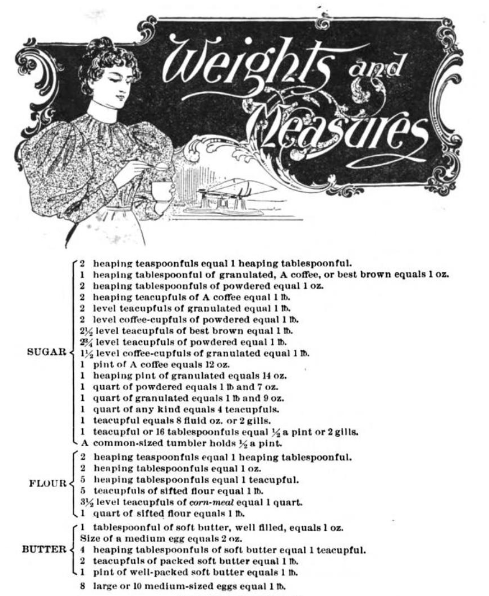
According to Estelle W. Wilcox of Buckeye Cookery fame (below)1 two teacups full of sugar weighs a pound while it takes four teacups of flour to make a pound. This is because flour is less dense than sugar. I understand why we eventually just started working with measuring cups because who wants to memorize all this?

One recreation problem we face is that modern measurements of mass are not quite the same though. There are about 3.25 cups of all-purpose flour in a modern pound. If you are working with bread flour it’s about 3.5. A modern pound of sugar is about 2.2 cups while a pound of powdered sugar is around 3.5 cups.
This doesn’t mean modern measuring cups are different. It probably has to do with different milling methods of drygoods. (If nothing else, I hope you glean from this post that weighing dry ingredients is far superior to using the Imperial measuring system, in terms of consisistency. The metric system is our friend.)
So as an example when using modern all purpose flour, if a recipe in Buckeye cookery calls for 1 teacupful, you would use approximately 0.8125 cups. This makes transcription for the purposes of recreation more tricky because maths are involved.
Liquid measurement is more consistent because that is done by volume. According to Buckeye Cookery when you are measuring liquid by volume 4 teacups equals one quart. Most modern transcriptionists revert to this because it’s easier, but it’s not accurate and the texture of your food is will reflect that.
The following discussion made me feel a little bit better knowing that I wasn’t the only person in history who had a hard time nailing down these terms.2 Reading through it though, you can see we come up against another hurdle. These were written at approximately the same time but medical measurement was different.

I am going to run through a few examples.
Wineglass
Cyathus vinarii is the Latin for wineglass full3 and you can see below where it fits in the Roman system of measurement. It was a pharmaceutical measurement for centuries. As you can see in the entry below it was smaller during ancient times. It probably increased as the size of wineglasses did. By the time A Universal Formulary was written it seems to be accepted as two ounces in medicine and cookery.

New York: Harper & Bros. Tables, pp. 1024–1030
Saucerful
The term saucerful had me baffled, until I realized that cookery and medicine didn’t always line up. Coming from a medical background I understood saucer to be the equivalent to the Roman acetabulum, 4and the idea of using one cup of some medicinal ingredients was pretty alarming.
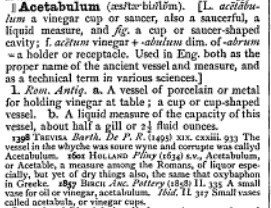
One-eighth of a pint would be a quarter cup by American standards but a British pint is 20 ounces and so one-eighth of that is 2.5 ounces, which for what it’s worth fits almost exactly in what I believe to be my oldest saucer. This entry refers to the vessel in the middle of the bottom row in this illustration.

When it comes to household use, I found a few sources that stated the saucerful to be equivalent to two gills. After 1824 that would be 10 ounces in Great Britain and 8 ounces in the US. It’s worth pointing out that a gill is only a liquid measurement.

I honestly can’t find a primary source that defines what a dry saucerful would have been in terms of household use. If you find one please drop me an email. I have seen it translated as a heaping cup but I am almost certain that is a applying the volume measure which can’t be applied to dry ingredients.
Teacup
I have always believed a teacup to be 4-6 ounces. I have seen that backed up in many primary sources aside from the Universal Formulary, so the 19th century lists list confused me. The New American Cookbook seems to be using the same size teacup as Buckeye. 5
In Just for Two, Amelie Langdon tells us that one teacupful of rice equals one-half pound which tracks, but she goes on to say that one teacupful of stemmed raisins or currants equals six ounces, and one teacupful of stale bread equals two ounces. 6 So we know that measuring things by mass continued into the 20th century. I played around with a couple of my teacups and they don’t match up to this. Most of them held around 3/4 cup of sugar, but again modern sugar is different.
So I am willing to genearalize that in medicinal receipts, a teacup is 4-6 oz and you have to look for context clues to determine what the author intends. In cookery receipts it might be used as a device to measure mass but how much it actually holds depends on what you are measuring. That is unfortunately where I have to leave this because there isn’t always a simple answer.
I do hope that some of this information helps you in your projects and if you are stumped on something, please feel free to message me at stephany@domestic-medicine.com. I love diving down rabbit holes.
- Estelle Woods Wilcox. Buckeye Cookery and Practical Housekeeping. Buckeye Publishing Company, 1877. http://archive.org/details/buckeyecookerya00wilcgoog. ↩︎
- Griffith, Robert Eglesfeld. A Universal Formulary: Containing the Methods of Preparing and Administering Officinal and Other Medicines. The Whole Adapted to Physicians and Pharmaceutists. Philadelphia, PA: Henry C. Lea, 1866. ↩︎
- ‘Cyath. Vin. | Encyclopedia.Com’. Accessed 1 June 2024. https://www.encyclopedia.com/humanities/dictionaries-thesauruses-pictures-and-press-releases/cyath-vin. ↩︎
- Murray, James Augustus Henry, Sir William Alexander Craigie, and Charles Talbut Onions. A New English Dictionary on Historical Principles: Founded Mainly on the Materials Collected by the Philological Society. Clarendon Press, 1888. ↩︎
- The New American Cook Book... Springfield, OH: Mast, Crowell & Kirkpatrick, 1897. ↩︎
- Langdon, Amelie. Just for Two: A Collection of Recipes Designed for Two Persons. Minneapolis, MN: Byron & Willard, 1903. ↩︎
 Domestic Medicine
You must be logged in to post a comment.