
If you are new to my blog and just here for the mushroom coffee content you can jump here. If you are an old friend and want to see what I have been up during my break from blogging, read on.
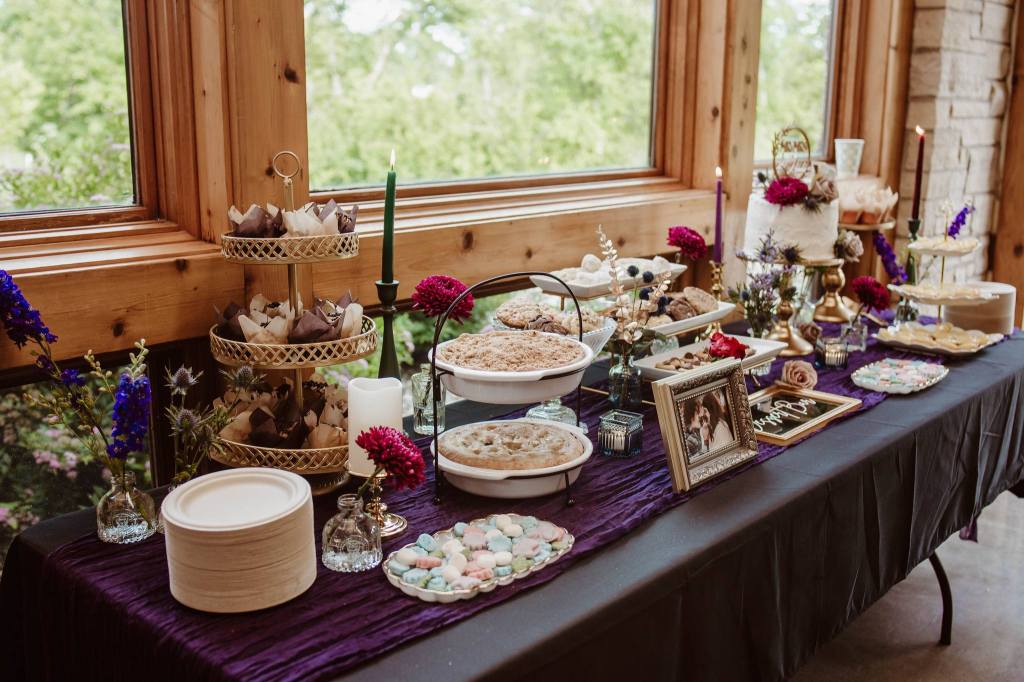
My oldest daughter decided to get married and as is tradition in my family, we handled the food. My husband and I handled the main meal. We made italian beef, pulled pork, mac & cheese, and funeral potatoes, pasta salad and a side salad for 165 people. My sisters and nieces were on the desserts and flowers. It was a lot of planning and work, but we did it!

During the downtime I got some feedback from people who were wondering if maybe I had stopped blogging altogether. That’s never going to happen, but I am going to make some tweaks to the blog. I think I was getting too bogged down in the history and forgetting that the focus of this blog is to mine historic sources for what is practical and useful when implemented in modern life.
Things are getting back to normal around here. I am still working on my own recovery from long covid and helping some long-time clients with that as well. I plan to post how I have worked some historic convalescent receipts into my regimen soon, with a focus on what I worked with instead of tincures due to needing to limit my alcohol consumption.
I decided now that I am feeling better to take some “me time” and volunteered as a historical interpreter with my local historical society. I have been giving tours of a local historic home , so I have been expanding my research into the 19th century.

I have decided with everything going on in my life, it would be a shame to only focus on the historical track. I am going to save some space for some more “modern” concepts which is what I will be ending with today because I promised some people on the socials I would talk about it.
My Take on Mushroom Coffee
I have been hearing from a lot of people asking me what I think of the mushroom coffees on the market, and you know questions always lead me down rabbit holes, so here’s what I found.
For my history people, yes there is a historical precedent of Europeans working with wild mushrooms, although they were more likely to be harvesting porcinis, chanterelles, and oyster mushrooms. I found a receipt for mushroom tea (1833) that establishes a functional precedent because it is suggested as a substitute for a restorative broth. It also establishes that the author knew a long cooking time was beneficial.
Wash any quantity of mushrooms according to the strength and quantity required, put them in a jug or teapot with a blace of mace; pour boiling water upon them, and set the jug on the hob two or three hours, and it will be ready for use. This is a good substitute for beef tea.1
For the people who want to know if the mushroom coffee is good for you, my answer is sort of. Of course mushrooms are beneficial 2 and withania (ashwagandha) has a proven track record as an adaptogen3. As someone who has recently cut way back on caffeine, I believe the biggest benefit of the beverage might be in reducing your daily caffeine intake.
On the other hand I am decidedly not about the additives that they put in most of the coffees. Why are some of them such weird sparkly colors? I don’t know about you, but I am not drinking something that looks like glitter. Also I like my coffee black. Once in a great while I will add some cream and nutmeg, but I never drink it sweet.
So I decided to make my own.
This is going to sound like a lot of work to you but it’s mostly passive preparation time. You chop the ingredients and put them in a crockpot with lots of water and wait while that simmers down. Then you spread them on the dehydrator trays and wait. It takes about ten minutes to chop things up and ten minutes to grind the flakes into powder.
Start by getting the ingredients you want to put in your powder around. I had been growing a lion’s mane mushroom for this project and also had chaga, reishi, and Withania somnifera around.
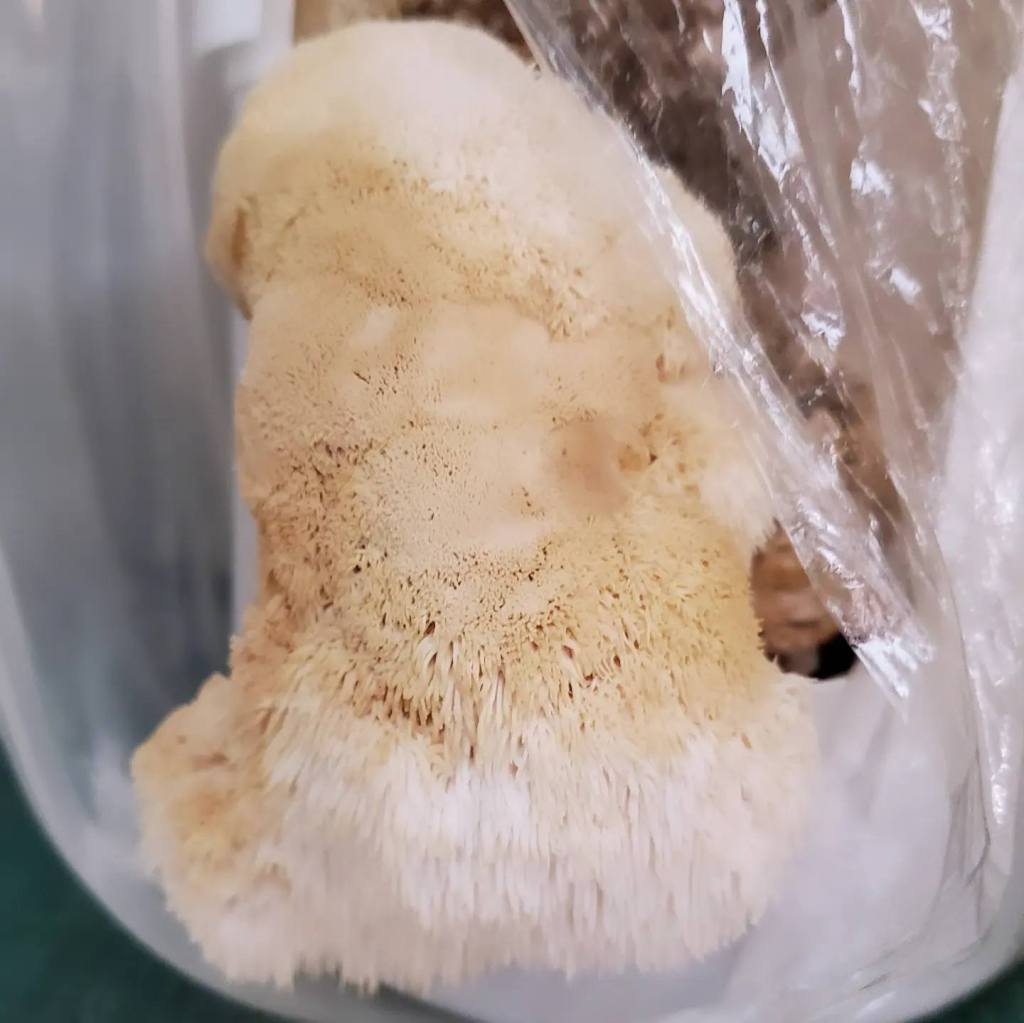
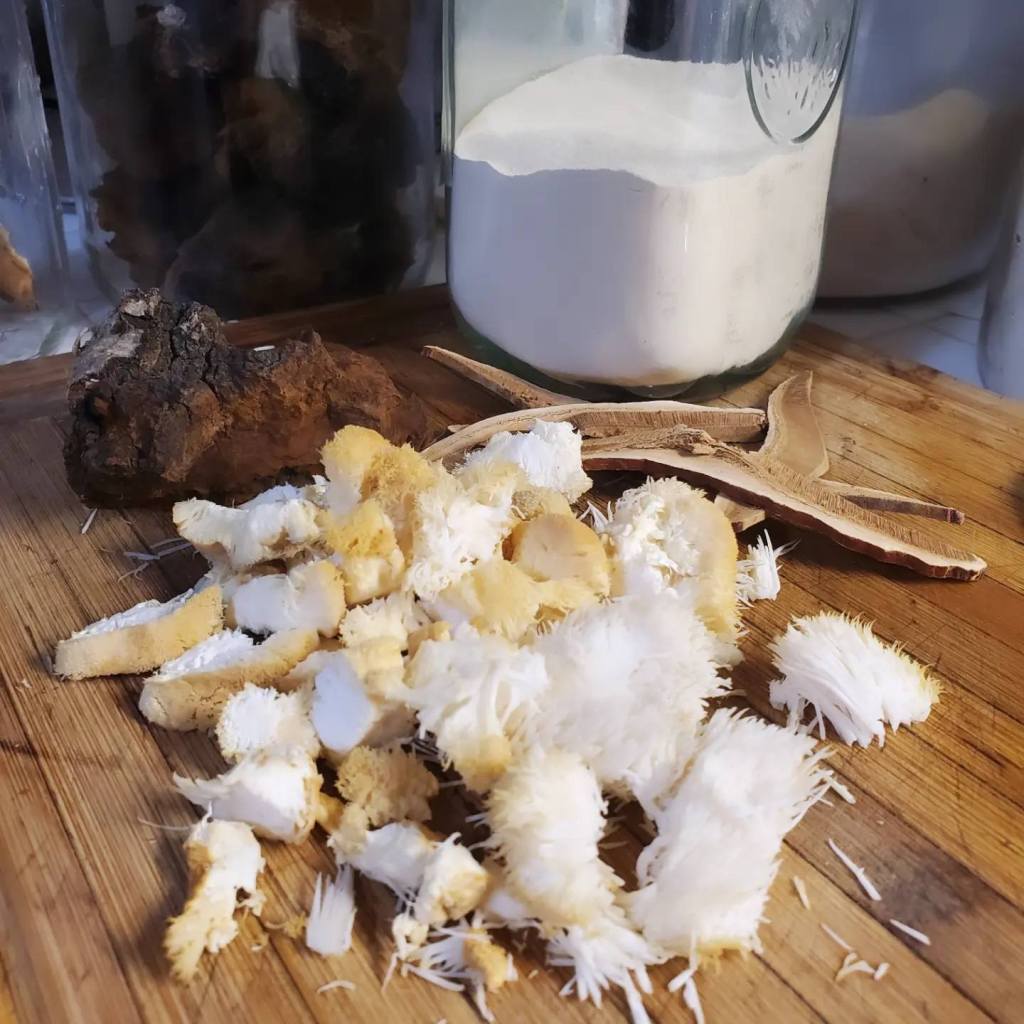
I was basically following process that I use to make any of my instant powders. You can use any mushrooms you want. Don’t feel like you have to use just “medicinal” mushrooms. In fact, if you are someone who should be avoiding oxalates you might want to omit the chaga.4 If you choose not to omit chaga, remember kidney stones form when there is too much oxalate and not enough water in the urine so keep yourself well-hydrated.
I started by weighing the following ratio of ingredients and making a decoction.
1 part fresh lion’s mane mushroom
1 part dried ground withania root
1/4 part powdered chaga
1/4 part powdered reishi
4x as much water as the “dry” ingredients
This all goes in my crockpot and I simmer them on high until it starts to thicken and then turn the crockpot down. I started with a lot of water, so it was taking a long time to cook down.
It would probably be a project best suited to the winter months and not a week when the temperature is in the mid 90s and the humidity is in the upper 80s. I thought about adding some arrowroot as a thickener but at the last minute I remembered about caffè d’orzo and added some hulled (not pearled) barley to soak up some of the liquid.
Data shows that boiling “improves the total glucans content by enhancing the β-glucans fraction”5 which I assume also holds true for the β-glucans in the barley. We don’t have to worry about polyphenols leaching away into the cooking liquid because we never strain the water off.
It also helps if you give the decoction a good whir with an immersion blender, occasionally. Once I had a spreadable slurry, I put it on the fruit leather trays of my dehydrator. You don’t have to worry about the visible bits in the slurry because you will be powdering this in the end.

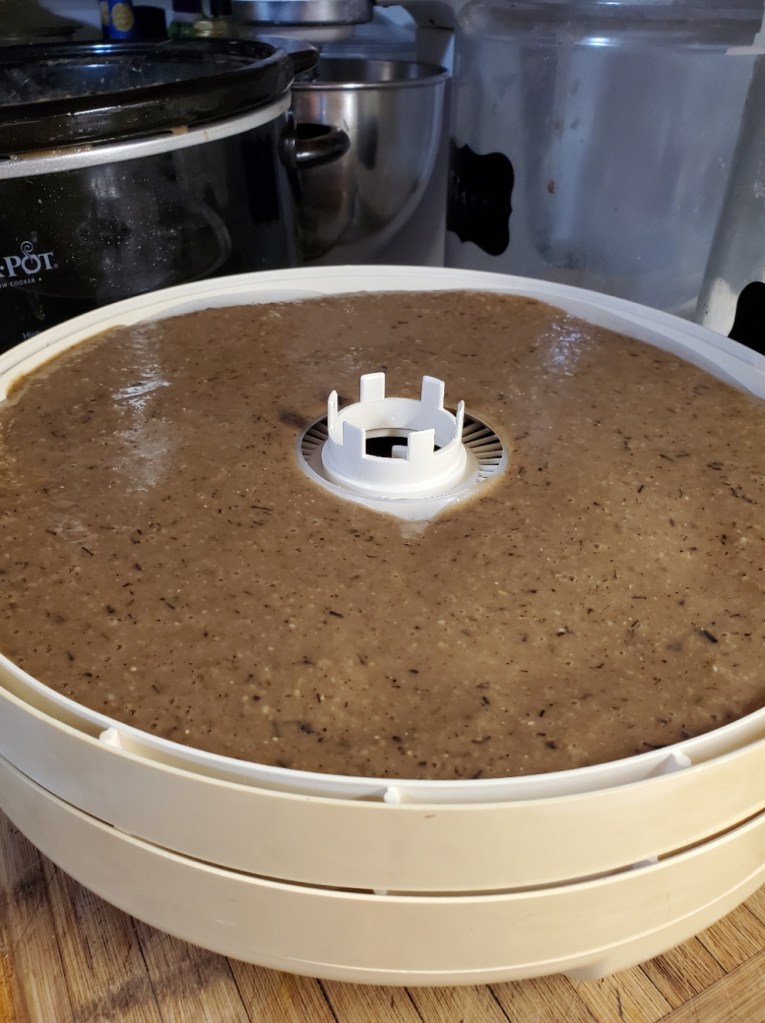
It’s really important that if you are using grains like barley, you dehydrate the mixture at a temperature higher than 140 degrees. I used the jerky setting on my dehydrator which is about 155 degrees. This is to prevent Bacillus cereus from growing in the slurry during the prolonged dehydration time. While I doubt any bacteria would survive being dessicated in the dehydration process, I am a safety girl.
Once the slurry is dry and brittle as pictured below, you will be able to grind it into a powder that could be mixed with some instant coffee to approximate the mushroom coffees on the market.
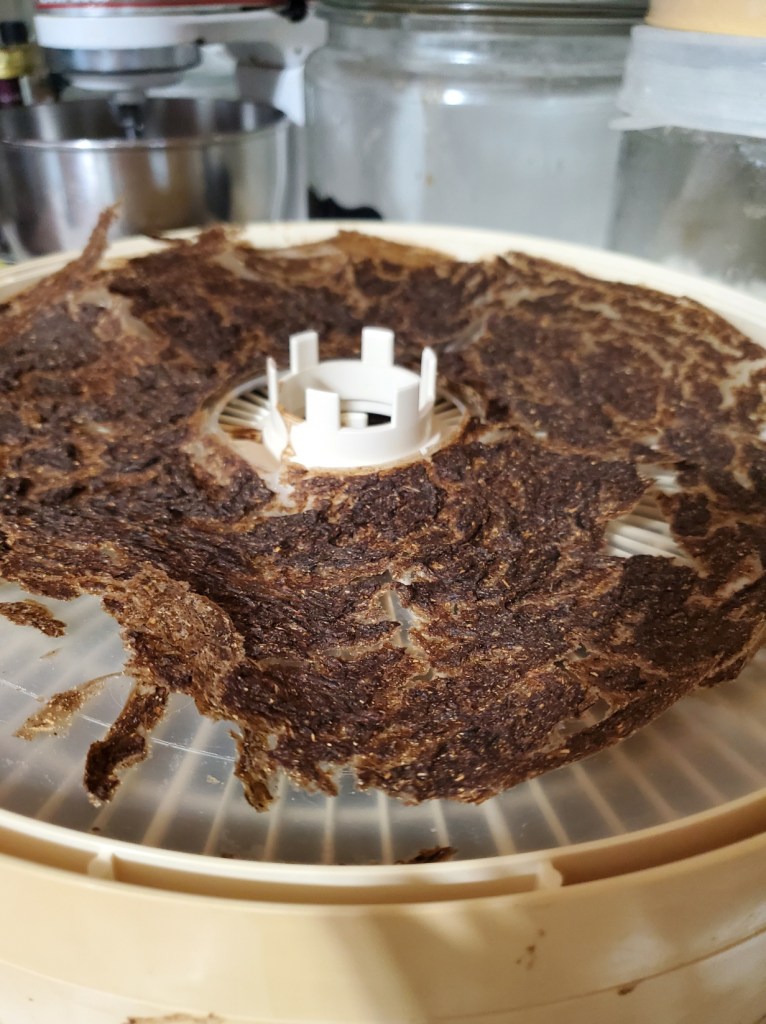
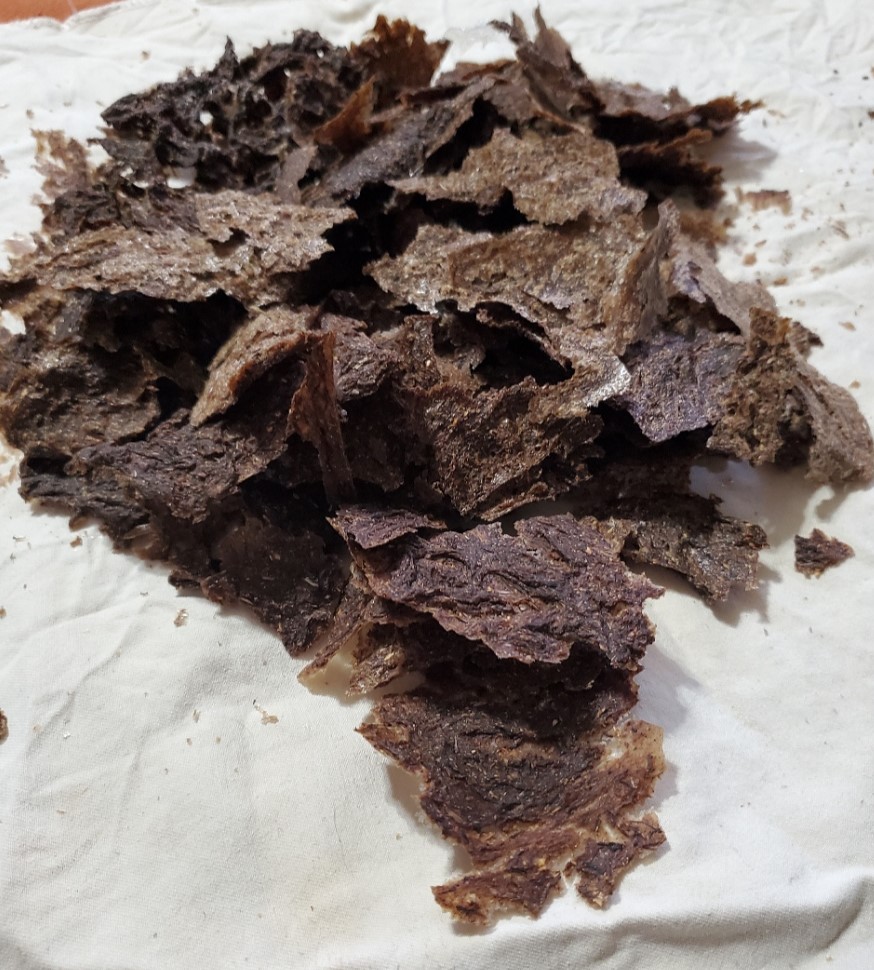
This is where I go off the rails a bit. After giving up caffeinated coffee, I found a local roaster who makes a decaf that makes me very happy. I have no intention of ever giving up my pour over coffee. So what I chose to do was to grind the flakes a little less finely so I could put a scoop of the mushroom powder in the bottom of my pour over filter before adding the coffee.


It tastes exactly like I like my coffee to taste. Smooth, dark, and nutty. The flavor profile is similar enough that I can barely taste mushroom powder, however I do notice the “spicy” aftertaste that I recognize as the withania.
It will be awhile before I can report back as to whether or not I think it’s useful, but long-time readers know that I generally feel that increasing the variety of phytochemicals in your diet is a good thing.

I could add the powder to my coffee and just be done with it but I am going to play around with it for awhile. Thinking about making some mushroom cocoa this way as well. Or maybe mixing some into my warm milk and nutmeg at bedtime. I will report those results of those experiments on the social media.
References
- Vegetable Cookery; with an Introduction, Recommending Abstinence from Animal Food and Intoxicating Liquors. By a Lady. The Fourth Edition, 1833. ↩︎
- Venturella, Giuseppe, Valeria Ferraro, Fortunato Cirlincione, and Maria Letizia Gargano. ‘Medicinal Mushrooms: Bioactive Compounds, Use, and Clinical Trials’. International Journal of Molecular Sciences 22, no. 2 (10 January 2021): 634. https://doi.org/10.3390/ijms22020634. ↩︎
- Cheah, Kae Ling, Mohd Noor Norhayati, Lili Husniati Yaacob, and Razlina Abdul Rahman. ‘Effect of Ashwagandha (Withania Somnifera) Extract on Sleep: A Systematic Review and Meta-Analysis’. PloS One 16, no. 9 (2021): e0257843. https://doi.org/10.1371/journal.pone.0257843. ↩︎
- Kikuchi, Yuko, Koichi Seta, Yayoi Ogawa, Tatsuya Takayama, Masao Nagata, Takashi Taguchi, and Kensei Yahata. ‘Chaga Mushroom-Induced Oxalate Nephropathy’. Clinical Nephrology 81, no. 6 (June 2014): 440–44. https://doi.org/10.5414/CN107655. ↩︎
- Plataforma SINC. ‘Nutritional Properties of Mushroom…’ ScienceDaily, 2017. https://www.sciencedaily.com/releases/2017/05/170519083817.htm. ↩︎
 Domestic Medicine
You must be logged in to post a comment.