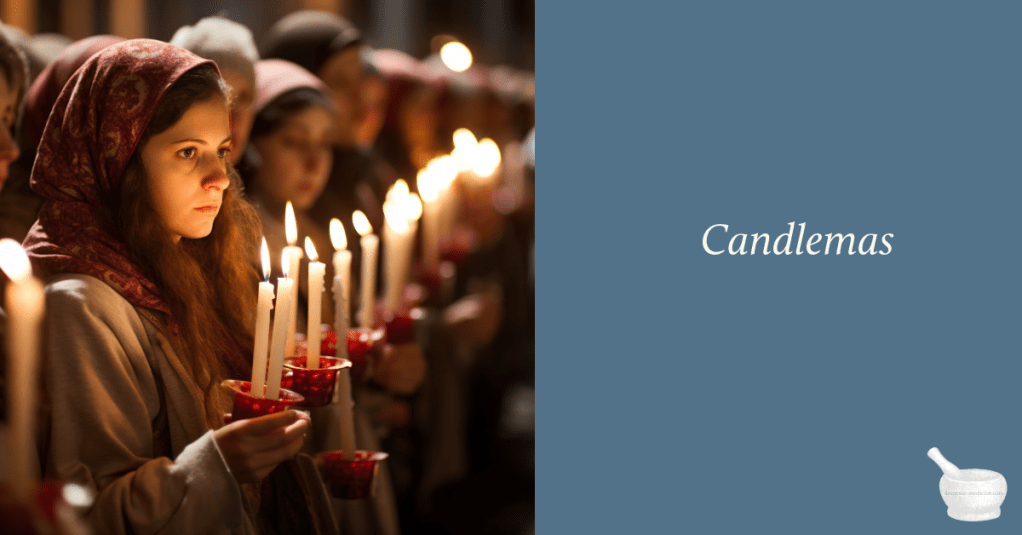
Candlemas was traditionally celebrated on the 2nd of February. Other names you will see used for this day include The Purification of the Virgin Mary, Lá Fhéile Muire na gCoinnea (feast day of Mary of the Candles), Gŵyl Fair y Canhwyllau (Mary’s Festival of the Candles) and Wives’ Feast Day.1
Candlemas is a Catholic holiday celebrated widely across Europe. The Anglicans also recognize the day. It is the concluding day of the Christmas–Epiphany season on the liturgical calendar in commemoration of the day that Mary presented her offerings at the temple 40 days after the birth of Baby Jesus. It is the final festival of lights during the dark of the winter.2
The mass is often a celebration of the Virgin Mother, and the liturgy is to be followed by a procession carrying lighted taper candles. Bede wrote that in his time people would parade through the streets.
Under the old Law, the Time of Purification was forty Days, which was to Women then, what the Month is to Women now. And as during that Time, the Friends and Relations of the Women, pay them Visits, and do them Abundance of Honour; so this Time seems to have been calculated, to do Honour to the Virgin ́s Lying-in.
John Brand Observations on popular antiquities 1777
I don’t know about you but if they wanted to call me impure and tell me I had to stay home from church for thirty or forty days after giving birth to be pampered, I wouldn’t be arguing with anyone. I think a very practical midwife invented this practice
Baronius wrote that Galasius established Candlemas as a substitute for the pagan festival of dies Februatus (Lupercalia) which was picked up by Puritans as a battle cry. Almost every one of them condemned the practice as popery. I think it was rather clever of them. If you want to supplant a festival predicated on sex, fire and blood sacrifices, going in the extreme opposite direction of virginial purity seems like a good call. That is a hotly debated topic and I really don’t care much about sorting out what is Roman and what is Christian. My ancestors are a good syncretic mix, and so am I.
Candlemas is mentioned often as a benchmark day in the Anglo-Saxon Chronicles, beginning in 1014 CE. This just means that you see it a lot in medieval texts as a reference point. In Northern England and Scotland it was one of the quarter days that I introduced you to in the post on Michaelmas. This means rents were due and other financial and legal matters were addressed, so when you dive down the rabbit hole, expect to see the terms of a lot of contracts between landholders and tenants.
Candlemas did not usurp Lá Fhéile Bríde. In Scottish regions especially they celebrated both festivals. For example, in 1692 the Edinburgh area quarter faires were distributed so that there were St. Brides faires at Abernethie, Forres in Murray land, and at the Town of Inverness on the first and Candlemass faires in Bamff, Dunkel, Dingwall and Dowglas on the 2nd. 2 There is a convoluted explanation of Brighid’s association with Mary to account for the proximity of the festivals. Here is one of the more common versions of it.
The first of February is “St. Bridgid’s Day,” and the second, or next day, is Candlemas Day, or the Purification of our Blessed Lady. The (folklore) reason that St. Brighid’s Day precedes the festival of the Mother of God is as follows: St. Bridget (“The Mary of Erin,” as she is sometimes called) and the Blessed Virgin Mary being sisters’ children, were first cousins and whdn the forty days allowed after childbirth for purification in the Temple had come, St. Brigid hit on the following plan to divert the attention of the sightseers who might come to stare at Our Lady. This she effected by getting a wooden frame, like unto a farm harrow ; placed on her head, having previous placed a lighted candle in each hole or socket intended for the teeth of the harrow; and thus equipped, she walked alone along the streets of Jerusalem to the Teampull (temple). It is needless to add that the entire attention of the sightseers was attracted to the unusual spectacle of a beautiful young layd walking along the street with a harrow of lighted candles on her head, and that that Mother of God escaped, as she wished, the rude gazing at by a crowd. Hence St. Brigid’s Day precedes Our Lady’s (Candlemas) Day in Ireland ever since.
Journal of the Cork Historical and Archaeological Society 1895
You may also find references to the idea that Baby Jesus was fostered by his godmother Brighid. Fosterage was a part of medieval social structure in which noble children were sent to another family to be raised until adulthood. This practice separated parent from their heirs, so that an ambush didn’t end a line.
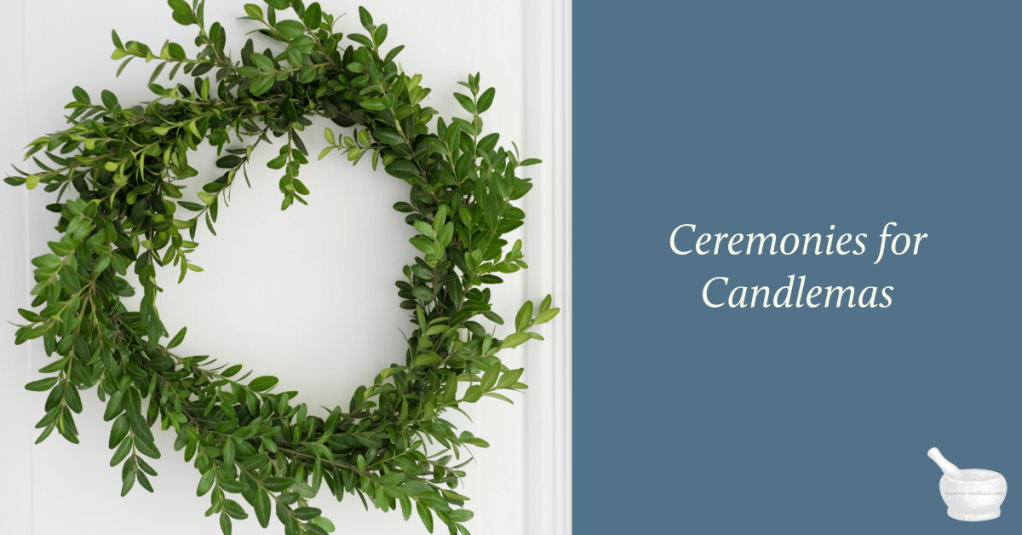
In some places Candlemas, rather than Twelfth Night, was the time that all the holiday greenery was removed from the home as it was the last day of the Christmas season. It is still true in some places. There seemed to be a yearlong flow of green plants coming into the homes and spent plants going out that is explained by Robert Herrick4 in the poem below.
Ceremonies for Candlemasse Eve.
DOwn with the Rosemary and Bayes,
Down with the Misleto;
In stead of Holly, now up-raise
The greener Box (for show.)
The Holly hitherto did sway;
Let Box now domineere;
Untill the dancing Easter-day,
Or Easters Eve appeare.
Then youthfull Box which now hath grace,
Your houses to renew;
Grown old, surrender must his place,
Unto the crisped Yew.
When Yew is out, then Birch comes in,
And many Flowers beside;
Both of a fresh, and fragrant kinne
To honour Whitsontide.
Green Rushes then, and sweetest Bents,
With cooler Oken boughs;
Come in for comely ornaments,
To re-adorn the house.
Thus times do shift; each thing his turne do’s hold;
New things succeed, as former things grow old.
Herrick also wrote that you burned down all of the Christmas brand (Yule log) except for enough to kindle next year’s fire on Christmas Eve. In some areas the holly was burned in Candlemas Eve fires. In other places this happen on 12th night. I leave some winter up until now to burn in a fire.
People often wonder what sort of foods are associated with the day? 17th century author Hannah Woolley gives us a suggested menu plan for a wealthy family. It’s quite the affair but Lent is approaching, and it can’t hurt to get a few good feasts before another period of deprivation.
As I have mentioned before, these quarter days served to organize agricultural and household tasks and I am far more interested in that aspect of the day. Candlemas was often the deadline on contracts that cottage workers had signed on to during the winter to make lace or spin wool for a merchant. So it was time to finish that up and get ready for the planting season.
The most obvious task to be tackled is candlemaking. You must have candles made if you want to take them to be blessed. It should be pointed out that they were not blessing all of the candles just those used as prayer candles.
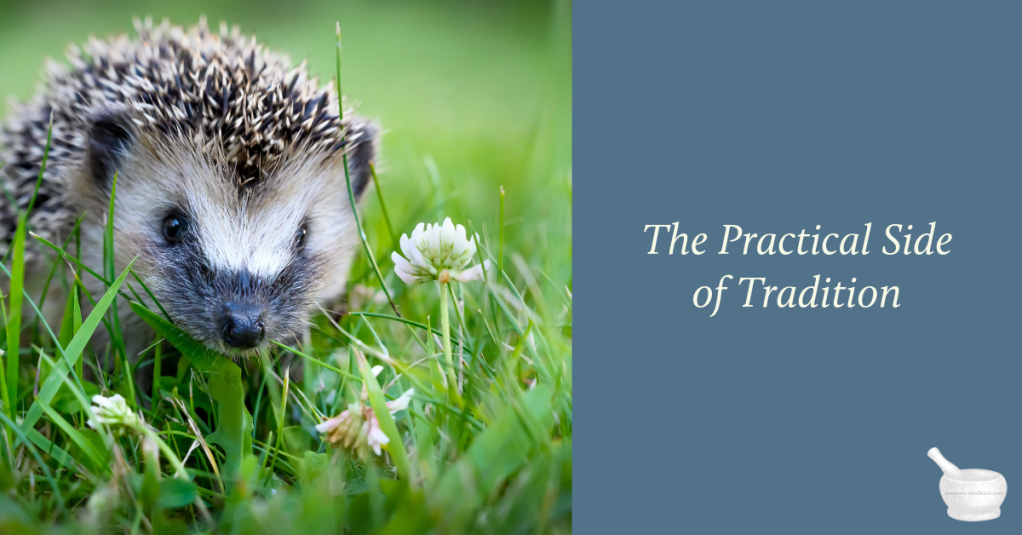
Everyone was looking for some sort of creature to emerge from hibernation as a sign that it was time to start the field work. In Ireland they watched for hedgehogs or adders. In England it was badgers. In Germany it was hedgehogs or bears. In the colonies it was, and still is, groundhogs.
Candlemas was the time to the move cattle away from the fields you plan on ploughing and sowing soon. The English and I suppose the Irish at this time, actually had a pretty interesting rotation system designed to protect the land that I thought I would share for any farmers who might be reading. It’s quite clever actually because the animals spread your fertilizer for you.
Whether the grounds be several and enclosed, or universal and common: whether they be Woods, Parkes, or Pastures, or Heathes, Mores, Downes, or other wilde and unlimited places, and these grounds shall be divided into thrée parts,
The first and most fruitfullest lying lowest, lying néerest to the river or some running stream, you shall preserve for meddow, and not suffer any beast to bite upon the same from Candlemasse, until the hay be taken from the ground.
The second part, you shall graze or eat from Candlemasse till Lammas, which would be that which lieth most plain and bleak, and most subject to all weather.
And the third part, which is the warmest and safest, you shall graze from all-Hollantide [Allhallows] till Candlemasse, and betwixt Lammas and all-Hollantide you shall eat up your eddish or after crop of your meddowes.
Gervase Markham
I have a list of my own practical tasks that I work on during Lady Saint week. For the most part I observe the days with some traditional folk practicality and I hope my list inspires you to make one of your own.
- I have a bit of soft spot in my heart for any ritual that involves fire, so I will start a fire to burn some winter greenery.
- I take stock of my situation by making an inventory of the gardening closet, freezer, pantry, and my herbal medicines, which is simply good quarter day accounting.
- I will make sure the first aid supplies are stocked and ready to go for when I inevitably injure myself in the garden.
- I will finish that pile of mending that is calling my name and do a round of deep cleaning I don’t have time for during the gardening season.
- I will plan my garden and wintersow some greens in the deck containers. I definitely need to order some seeds. Check out Botanical Interests New Varieties for 2024
References
- Brand, John, and Henry Ellis. Observations on the Popular Antiquities of Great Britain: Chiefly Illustrating the Origin of Our Vulgar and Provincial Customs, Ceremonies, and Superstitions. Bohn, 1777. ↩︎
- Nativity, Epiphany, and Meeting of Simeon ↩︎
- Paterson, James. Edinburgh’s True Almanack… 2003rd-01 (EEBO-TCP Phase 1). ed. Edinburgh, Scotland: Printed by John Reid to be sold at his printing-house, 1692. http://name.umdl.umich.edu/A24482.0001.001. ↩︎
- Herrick, Robert. Hesperides, or, The Works Both Humane & Divine of Robert Herrick, Esq. 2003rd-01 (EEBO-TCP Phase 1). ed. London, England: Printed for John Williams and Francis Eglesfield, 1648. http://name.umdl.umich.edu/A43441.0001.001. ↩︎
 Domestic Medicine
You must be logged in to post a comment.