This is going to be one of those posts in which my lived experience ran smack dab into what “they” say on the interwebz and so I felt compelled to do one of my deep dives.
Suet is defined in the OED as “Fat found in an animal, esp. that surrounding the kidneys; spec. the solid white fat surrounding the kidneys of cattle, sheep, and other ruminants, used esp. in the production of tallow and (now often as a processed commodity) in cookery.”1 It is a common ingredient in mincemeat and traditional Christmas puddings.
I had always used the word in the context of those first five words. I am trying to figure out when the specific definition became a thing. I do know that some people make a great issue of suet being that special kidney suet. I have even heard people say that you can only make tallow from this fat. That’s not true at all.
Let’s first apply some common sense to the situation. It has been a while since I helped my family butcher a cow, but if memory serves a 1500-pound animal will have about 30 pounds of what they call KPH fat. That’s the fat around the kidney, pelvic area and the heart. I am not sure what percentage of that is kidney fat but it’s not a lot. I am going to guesstimate it at about 7lbs per cow.
Is it realistic to believe that every time a medieval or early modern cookbook mentions using suet, the were talking about kidney fat? I really don’t believe so. Hopefully those of you who studied the animal husbandry practices of the time can back me up. But I don’t believe they butchered enough cattle in the UK to keep up.
Also how does this make sense in terms of what we know about the frugality of our medieval and early modern cooks? Do you really see them throwing away mountains of perfectly good food? There is a sort of rigidity in re-enactment that doesn’t hold up to scrutiny. Cooks have always been innovative, working with what they had and what they could afford. I can tell you that when my mom taught me how to butcher a cow and render suet into tallow 40ish years ago, that is how she did things.
So, let’s look at some primary sources to see if we can figure this out?
In A Book of Cookery (1591) we find the author calling pig fat suet as well as suet from cattle and sheep. There’s nothing saying it is kidney fat but there’s nothing saying it isn’t either. My guess is that what he’s referring to is unrendered fat as opposed to fat that has been rendered as he also uses the term lard in many receipts.
To make puddings of a Swine. Take the blood of the Swine, and swing it, then put therto minced onions largely with Salt, and the Suet of the Hog minced. Then take the guts clean washed, and stuffe them with the aforesaid stuffe: and so seeth them, then broile them upon the coles, and serve them foorth.
What is more useful is that in Murrels two books of cookerie and carving (1641) the author used the term Kidney-suet a couple of times and Beef-suet many times. Now we know they were two different commodities. You can see similar usage of the two terms in The English and French Cook (1674) and The Family Dictonary or Household Companion(1695). You even see Oxe-suet specified occasionally.
Looking through the books above you will also read that you can substitute marrow or butter for beef suet in some receipts. In Robert May’s cookbook he suggests using beef suet or lard in one receipt. Later you see cookbooks suggesting butter as a substitute.
We have endeavoured throughout this book to give chiefly directions about those dishes which will replace meat. For instance, the vast majority of pies and puddings will remain the same, and need no detailed treatment here. Butter supplies the place of suet or lard, and any ordinary, cookery-book will be found sufficient for the purpose….
CASSELL’S VEGETARIAN COOKERY 1895
Mrs Beetons recipe for suet crust tells you to remove the shreds of meat and skin from the suet2. KPH fat does not have either. So clearly, she was not working with it, which makes sense to me because those cookbooks are very frugal. This was the best find of my deep dive and I am going to put it up here for you in its entirety because of the excellent advice it offers on working with beef suet.
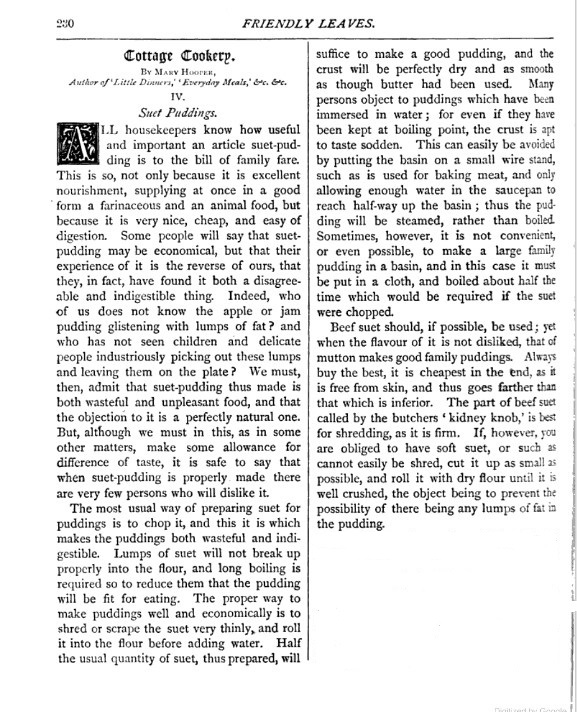
So, it seems as though my initial suspicion was correct. Beef suet and kidney knob were used interchangeably, and people used the best quality they could get their hands on. I discussed this with my local butcher. He says every year he gets a couple of bakers who come in and insist on the kidney knob, which he charges them more for, just because they make him do extra work. The rest of us get a mix of whatever he has on hand.
I hope you find an old-timer like my butcher because he charges me $1 per pound which makes rendering suet into tallow for soap and ointments very economical for me. The tallow my locker sells is also made by rendering by both kidney suet and muscle suet. So, I have experience working with both types of tallow. Both make perfectly serviceable ointments and soaps.
I personally would not want to use tallow made just from kidney fat for topicals. It’s cakey and can make your finished products a little drying in a manner similar to the way some people say coconut oil is drying. Honestly, I prefer using mostly lard for ointments, but adding some tallow to thicken it in the manner others add beeswax.
I don’t run around the Internet disagreeing with people who say otherwise, and I am not writing this to be argumentative. I am writing this because I really want you to try these receipts when I post them, and I don’t want you to feel like you have to spend a lot of money on “kidney suet” to do so. It’s okay to experiment. I like to tell students that I have never come across a receipt I didn’t tweak a little.
When it comes to the mincemeat recipe I have already shared, the key to success is in the mincing and shredding. Freeze your beef suet, shred it, and then mince it after you shred it.
“The fault of Euphemia is that she will not, simply will not, chop the suet sufficiently small.”
E. M. Forster A Room With a View 1908
As long as you are using raw fat that has not been rendered in the receipt, your results will turn out fine. I promise. I’ve been doing it since I started learning to bake 45 years ago.
- “Suet, N., Sense 1.b.” Oxford English Dictionary, Oxford UP, December 2023, https://doi.org/10.1093/OED/9031395838. ↩︎
- Beeton, Isabella. Mrs. Beeton’s Cookery Book: And Household Guide. Ward, Lock, & Company, 1898. p. 131. ↩︎
 Domestic Medicine
You must be logged in to post a comment.