Adapted from an article originally posted in Natural Herbal Living Magazine April 2016
When I first discovered “the herbal community” in the early 2000’s, I was really surprised by how infrequently I saw mustard mentioned. It has such a long history of domestic use. It is hands down my favorite warming, anti- inflammatory with perhaps the exception of horseradish which it pairs well with.
Sinapis alba (white or yellow mustard) and Sinapis arvensis (wild mustard) plants are native to the Mediterranean. The spread of these plants followed the Roman legions as they spread across Europe. While brown mustard (Brassica juncea) is native to China, S. alba seems to have been introduced in China sometime in the 10th century.1 Yellow mustard’s broad popularity is often attributed to the fact that it naturalizes easily and was less expensive than the trade-route variety.2
The cultivation of mustard is an ancient practice. Archeologists have identified mustard seeds at a Neolithic settlement site known as Çatalhöyük, in Turkey dating back to 7000 B.C.E.3 The seeds have also been identified at prehistoric sites in Greece, where the technology to extract mustard oil from the seeds has been around since the Bronze Age.4 The ancient Hebrews considered the seeds a symbol of profound faith, and mustard oil was used in their anointing rituals. 5
Historical texts often confused brown and white mustard.6 To make sorting it all out even more challenging, the species name Sinapis only applies to white/yellow mustard and wild mustard. While most people assume historical entries refer to S. alba, this is by no means certain. Monica Green who translated the Trotula , will go no further than to specify that the species being referred to in its entries is Sinapis.
Wild mustard has its place in history as well. For example, Greeks add seeds of S. arvensis to the brine used in preserving pears. Researchers believe this “enhanced the growth of lactic acid bacteria and contributed to the rapid decline of undesirable bacteria, such as Enterobacteriaceae.”7

Wild mustard goes by the name charlock or praiseach bhuí (pronounced prassha bwee) in Ireland. It was such a popular potherb that it lent the name praiseach to any broth or porridge. In fact, charlock along with nettles and a seaweed called carrageen were the three main subsistence foods of the poor during the Great Famine.8
This seem to be fairly common, as using the green as a potherb occurs in the ethnobotanical research done in many other countries including Poland, Turkey, and Southern Italy.9 Today, the greens are grown in gardens, although now mustard green seed packets generally contain Brassica juncea.
In Scotland, charlock was called scaldricks or sgealag in Gàidhlig. The Scottish also viewed the plant as a subsistence food and sometimes turned to grinding the seeds into a rough flour when they had run out of other grains for making a bread called, “reuthie bread.”10

Sinapsis alba seeds contains a glycoside called sinalbin and an enzyme known as myrosinase. In the same way that allinase “activates” garlic compounds, myrosinase hydrolyzes as it is crushed breaks down the sinalbin. This process forms the pungent heat producing compounds we know mustard for-including allyl isothiocyanate.11
These compounds will quickly become inert within about ten minutes if something isn’t done to keep this from happening. An acid such as vinegar or verjuice can be added to the preparation to preserve this pungent, sharp quality which is the reason for including vinegar in mustard. (Verjuice is the juice from unripe grapes.)
The Greeks were making mustard before 2000 B.C.E. The Romans called white mustard sinapi and wild mustard irio. They were wild for culinary preparations of mustard but also used it in the preservation of vegetables and meat. The Roman Apicius recommended, “To keep cooked sides of pork or beef or tenderloins place them in a pickle of mustard, vinegar salt and honey, covering meat entirely and when ready to use you will be surprised.”12
Persian cooks used the seeds to make sauces and seasonings, particularly in a paste known as Sinâb that they suggested serving with fatty foods.13 This use is supported by modern research, which shows that mustard has a hypolipidemic effect.14
Roman armies brought the seeds with them to Europe and the plant was soon naturalized. It became very popular as a condiment due to being cheaper than other spices that had to be imported. Moustarde is an old French word first documented in the 13th century.15 The condiment we now refer to as mustard came by its name because it was made by mixing the crushed seeds with unfermented grape juice which was known as must.”16 In medieval Europe, you would often find a mustardarius who was specifically in charge of the growing and preparation of mustard for a noble household.17 In the mid-14th century, the very first commercial mustard company was founded near Dijon. So yes, Dijon mustard is over 600 years old.
Shakespeare mentions Tewkesbury mustard in Henry IV, saying, “his wit as thick as Tewkesbury mustard.” This preparation was known to be made with brown mustard and not very similar to the modern condiment: “To make the Tewkesbury mustard balls, the seed of the Brassica nigra was pounded in a mortar, sifted, moistened with an infusion of horse-radish, and again pounded.”18 I’ve made them and served them with roast beef and ham.
Up to this point, no one had figured out a way to dry mustard seeds adequately for grinding into a powder. Credit for pioneering that process goes to one Mrs. Clements of Durham, England in 1720.19 In the mid-1800s, Coleman’s of Norwich started marketing yellow mustard powder in tins20 which partly explains why mustard plasters seem to be a partucularly UK-ish phenomenon.

The earliest documentation of using mustard medicinally is found in Egyptian manuscripts. Archeologists have found a great deal of mustard seeds in Egyptian excavations dating to around 2600 BCE.21
It is of note that while today, the Chinese call white mustard seed bái jiè zĭ, the seed seems likely to have been incorporated into the Chinese materia after being introduced from the west, as there are no references to white mustard in manuscripts written previous to that time.
Some historians insist that the mustard seeds mentioned in Ayurvedic texts were referring to Brassica juncea (Brown mustard) and not the Sinapis species. This is not entirely clear, though, because the system of measurement outlined in the Manava Dharmashastra mentions both white and black mustard saying, “one peppercorn (likya); this equals one black mustard seed, and three of the latter are equal to one white mustard seed.”22
The ancient Greeks credited the god Asclepius with discovering the medicinal properties of mustard seeds and using them as an aphrodisiac. The Roman naturalist Pliny recommended mustard for alopecia (patchy bald spots) and other diseases of the head such as losing hair and “defects in the eyebrow as well as for gout.”23 It seems perhaps he valued it for its ability to promote circulation to an area when applied externally.
Dioscorides did distinguish between the many varieties of mustard. Sinepi (white mustard) he said was used to, “draw out anything from deep within to the outside of the body,” specifically recommended it for, “hard swollen tonsils,” and, “old, hard, rough skin of the arteries.”24 S. arvensis was called erusimon which he attributes to its Egyptian name erethmu saying that “in general it thins and warms.” 25
Galen mentions that mustard taken internally helps to cut phlegm. Avicenna wrote that the mustard along with garlic and nasturtium were known to, “increase the amount of bile made, or excite a flow of bile,” but he urged that mustard not be included in, “the regimen of a wet-nurse,” because it would, “cause the blood to undergo decomposition.” 26
The physicians who compiled the Trotula during the 13th century mention using white or wild mustard in fomentations (hot compresses) of mustard for pain and swelling of the womb not related to childbearing, and as one of the many ingredients in their unguentum aureum, or “golden unguent,” which was an external preparation said to address all, “acute, cold gouts,” as well as, “dropsical conditions”28 (an archaic term for edema).

It is in the UK where mustard truly took hold as a folk medicinal. Many credit this to a Mrs. Beaton for first using grated turnip mixed with mustard and horseradish as a poultice for chilblains.29 Like most home remedies, this jumped across the pond. Mustard was used extensively in domestic medicine and by medical professionals in the US well into the twentieth century. 30
Traditional Mustard Poultice for Pneumonia – For this purpose sometimes they would just wet the mustard powder enough to spread it on some brown paper and slap it on the chest. It is thought that dilation of the capillaries in the lungs may encourage expectoration of mucous that may be not be moving.
To make a traditional poultice, peel two turnips or potatoes and grate them into bowl. Mix in 1/4 cup mustard powder. This mixture will only hold its capacity to produce heat for perhaps ten-to-fifteen minutes.
Pain – Traditionally mustard was used as a counterirritant which is a substance that is applied topically to warm the skin and relieve internal pain. If a mom was really in a hurry she would just mix a tablespoon of mustard with four tablespoons of flour. I keep mustard powder and rice flour in my first aid kit for this purpose.
Some families used mustard plaster for back pain which they called lumbago, but those were often mixed with linseed or flax seed. Here’s a detailed explanation of how to make one from the Schools Collection.
Have ready a piece of flannel the size required, and a basin and board knife for mixing. Put the knife into the baisin and pour over boiling water to heat hem. Empty the water and pour in sufficient boiling water for the poultice.
Add enough linseed meal and one part of mustard to seven or eight of meal to make the poultice of right consistincy and beat until it no longer adheres to the basin. If too wet it will scald and if too dry it will not be sufficiently hot.
Turn the mixture on to the flannell and spread quickly with the knife is about three quarters of an inch in thickness cover with muslin and turn the edges of the flannell over to make to poultice neat cover with cotton wool and bandanges if necessary to keep it in position Brown paper or muslin many be used instead of flannell.The Schools’ Collection, Volume 0865, Page 367
Irish Rheumatism Remedy – Grate 4 oz of horseradish root and put this and 1 tablespoon of brown mustard seeds in 1 cup of rum. Shake well and leave till the next day. Take a teaspoon of the mixture twice a day until all is used up.
Gout – When applied as a poultice or used in a footbath mustard’s action helps to promote circulation to the feet. The heat dilates capillaries and stimulates peripheral blood circulation in a manner similar to alkaloids in cayenne.
Headaches- A mustard footbath may also help to relieve headaches and tension in the neck and shoulders by drawing blood flow away from the head.
Ringworm – Mustard and sorrel leaves were boiled up together and made into an ointment and applied to ringworm.
Note: Not all mustard seeds have the same kick. I’ve been buying my mustard from Frontier and I think it’s a little weak, so I’ve been grinding some brown mustard seeds and adding them to the yellow mustard to bump up the heat a little. It doesn’t take much. I use ¼ cup brown mustard powder per pound bag of the yellow mustard.
Mustard with Ale
Hildegard of Bingen wrote of synape, “this herb is harmful to eat because its strength is weak and unstable,” although she went on to mention that this effect could be tempered by mixing it with wine: “Its harmfulness is removed through the warmth of the wine,” or alternatively, “if the person does not have wine, let them pour cold vinegar over it.”27
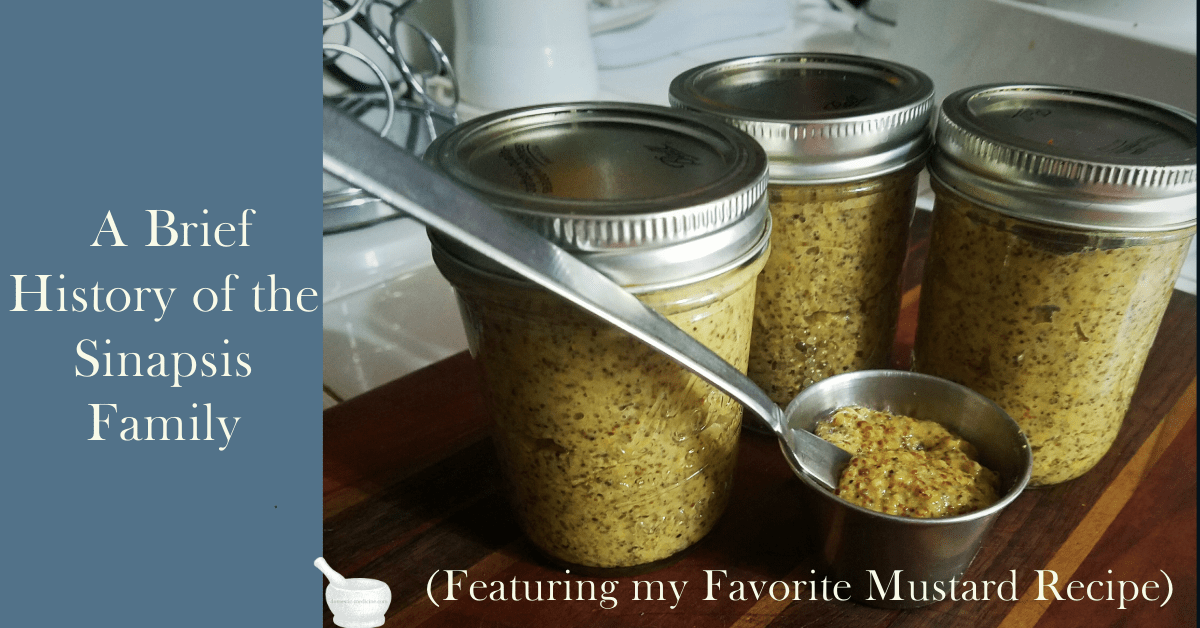
Clearly, we can see in these directions the origins of modern mustard preparations, so I thought I would end with my favorite mustard recipe. This is my favorite mustard to make when we have a lot of ale on hand. In the Le Viandier de Taillevent there is an ale mustard recipe that I use for the basic process.
“Soak the mustard seed overnight in good ale, grind it in a mill, and then moisten it little by little with ale. If you have any spices left over from Hippocras or sauces, grind them with it.”
Another receipt I have found that really intrigues me is this recipe for stewed mutton from the Boke of Kokery.
Stewed Mutton̄. Take faire Mutton̄ that hatℏ ben̄ roste, or elles Capons, or suche oþer flessℏ, and mynce it faire; put hit into a possenet, or elles bitwen̄ ij. siluer disshes; caste thereto faire parcely, And oynons smaƚƚ mynced; then̄ caste there-to wyn̄, and a lituƚƚ vynegre or vergeous, pouder of peper, Canel, salt and saffron̄, and lete it stue on þe faire coles, And þen̄ serue hit forthe; if he have no wyn̄e ne vynegre, take Ale, Mustard, and A quantite of vergeous, and do þis in þe stede of vyne or vinegre.
If you look at those ingredients, they sure sound like mustard, so I used the directions from the first receipt and the ingredients from the second to make my ale mustard.

1 cup brown mustard seeds
1 cup yellow mustard seed
½ cup white wine vinegar (red, or verjuice – whatever you have around)
1 small onion minced or 1/2 cup cooked cranberries
2 tsp black pepper
2 tsp salt
1 tsp cinnamon
pinch of saffron threads
- Put the mustard seeds in a glass bowl. You can use any mixture of yellow and brown seeds you like.
- Add one bottle of ale and the vinegar to the mustard seeds, cover the bowl and let it sit overnight. Because the first recipe says to let it sit on the fire coals you could do this in a crockpot, but I generally don’t.
- Strain the mustard seeds but keep any liquid. Chop the onion or cranberries, finely. Add it to the mustard seeds along with the other spices.
- I use my immersion blender to grind the mixture but you can also just put this in a food processor.
- Slowly pour the liquid you kept back into the seeds while blending them. Keep adding ale until the mustard is a nice consistency which can mean anything to anyone. In our house my eldest son is the judge of when it had been pounded enough. Put the mustard in sterilized jars and keep them in the fridge.
References
1 Kiple, K. F. (2000). The Cambridge world history of food. Cambridge, England: Cambridge University Press. pp. 1820.
2 Davidson, A. (2006). The Oxford Companion to Food (2nd ed.). Oxford, England: Oxford University Press.
3 Bogaard, A., Charles, M., Twiss, K. C., Fairbairn, A., Yalman, N., Filipović, D., … Henecke, J. (2009). Private pantries and celebrated surplus: storing and sharing food at Neolithic Çatalhöyük, Central Anatolia. Antiquity, 83(321), 649–668.
4 Valamoti, Soultana Marie. (2009). Plant food ingredients and “recipes” from Prehistoric Greece: the archaeobotanical evidence. In Plants and culture: seeds of the cultural heritage of Europe (pp. 25–38). Bari, Italy: Edipuglia.
5 Andrews, Tamra.(2000) Nectar and Ambrosia: An Encyclopedia of Food in World Mythology. Santa Barbara, CA:ABC-CLIO. pp. 156.
6 Duke, James A. 2007. Duke’s Handbook of Medicinal Plants of the Bible. CRC Press. pp. 67.
7 Papatsaroucha, Eleni, Sofia Pavlidou, Magdalini Hatzikamari, Athina Lazaridou, Sandra Torriani, Dimitris Gerasopoulos, and Evanthia Litopoulou Tzanetaki. 2012. “Preservation of Pears in Water in the Presence of Sinapis Arvensis Seeds: A Greek Tradition.” International Journal of Food Microbiology 159 (3): 254–62.
8 Mac Coiter, Niall. (2008). Irish Wild Plants: Myths, Legends and Folklore. County Cork, Ireland: The Collins Press.
9. Łuczaj, Łukasz J. 2010. “Plant Identification Credibility in Ethnobotany: A Closer Look at Polish Ethnographic
Studies.” Journal of Ethnobiology and Ethnomedicine 6 (36).
10 Dorson, Richard M. 1982. Folklore and Folklife: An Introduction. Chicago, IL:University of Chicago Press. pp. 334.
11 Nastruzzi, C., Cortesi, R., Esposito, E., Menegatti, E., Leoni, O., Iori, R., & Palmieri, S. (1996). In Vitro Cytotoxic Activity of Some Glucosinolate-Derived Products Generated by Myrosinase Hydrolysis. Journal of Agricultural and Food Chemistry, 44(4), 1014–1021.
12 Apicius. (2009). Cookery and Dining in Imperial Rome. (F. Starr & J. D. Vehling, Trans.). Retrieved from
http://www.gutenberg.org/ebooks/29728
13 Martinelli, Candida, trans. 2012. Anonymous Andalusian Cookbook. http://italophiles.com/al_andalus.htm.
14 Sengupta, Avery, and Mahua Ghosh. 2011. “Hypolipidemic Effect of Mustard Oil Enriched with Medium Chain Fatty Acid and Polyunsaturated Fatty Acid.” Nutrition 27 (11–12): 1183–93.
15 Dalby, Andrew.(2000) Dangerous Tastes: The Story of Spices. Berkeley, CA: UCLA Press. pp. 133.
16 Ayto, John. (2002) An A-Z of Food & Drink. Oxford, England: Oxford University Press. pp. 221.
17 Davidson, A. (2006). The Oxford Companion to Food (2nd ed.). Oxford, England: Oxford University Press. pp 524-525.
19 Dallas, Eneas. (1877). Kettner’s Book of the Table: A Manual of Cookery, Practical, Theoretical London, England: Dulau and CO.
20 Ayto, John. (2002) An A-Z of Food & Drink. Oxford, England: Oxford University Press. pp. 221.
21 Wenke, R. J., Buck, P. E., Hamroush, H. A., Kobusiewicz, M., Kroeper, K., & Redding, R. W. (1988). Kom el- Hisn: Excavation of an Old Kingdom Settlement in the Egyptian Delta. Journal of the American Research Center in Egypt, 25, 5–34.
22 Achaya, K.T., (1998) A Historical Dictionary of Indian Food. Delhi, India:Oxford University Press. pp 168-169.
23 Pliny, The Elder. (1856). The Natural History of Pliny. (Bostock, John & Riley, H., Trans.) (Vol. V). London,
England: Henry G. Bohn, York Street.
24 Dioscorides. (60AD). De materia medica. – five books in one volume: A new English translation. (Osbaldeston, T,
Trans.). Johannesburg: IBIDIS Press. pp. 311.
25 Ibid. pp 316.
26 Gruner, Oaker Cameron. 1973[reprint]. Avicenna’s Canon of Medicine. New York, NY: AMS Press.
27 Bingen, H. V. (2001) Hildegard’s Healing Plants: From Her Medieval Classic Physica. (B. W. Hozeski, Trans.). Boston: Beacon Press. pp. 87.
28 Green, M. H. (Trans.) (2010). The Trotula: An English Translation of the Medieval Compendium of Women’s Medicine. Philadelphia, PA: University of Pennsylvania Press.
29 Hatfield, G. (2004). Encyclopedia of Folk Medicine: Old World and New World Traditions. Santa Barbara, CA: ABC-CLIO. pp 73.
30 Schukar, Madeline. (1934). Mustard Packs In the Treatment of Pneumonia. : AJN The American Journal of Nursing. American Journal of Nursing, 34(2), 110–112.
 Domestic Medicine
You must be logged in to post a comment.