It has been pointed out to me that I use the term lady experimenter quite a bit. People who know me and have seen my own still room complete with fancy microscope and distillation equipment are sure to understand why I love the concept. In the interest of providing some context, I thought I should introduce you to them.
Documentation of the practice of domestic medicine might not have become so common in Britain and Ireland were it not for the Reformation. Between the years of 1536 and 1541 Henry VIII began the legal procedures which led to the dissolution of monasteries, priories, convents, and friaries in Britain and Ireland. Members of these religious communities had been very much involved in the growing of herbs and the production of herbal preparations, as well as providing charitable care for the poor. When they were banished to continental Europe, healthcare was undoubtedly less accessible for many.
It was the responsibility of the female head of the family to manage the household accounts frugally and efficiently. This meant among other things that she was to keep expenses down. As engaging the services of a physician was extravagantly expensive, one way to do this was to copy down their formulas sometimes with attribution to be used in the future. “Old women” who took their colebaskets into the city to peddle plants and ointments shared receipts with their customers as well.
Women of means took on a role as keepers of this knowledge. The medicinal formulas they collected were shared throughout their communities by word of mouth and were recorded in handwritten journals often referred to as receipt books which we will talk about more in another post. It was very trendy in the late 1500s and 1600s for women to share these receipts and for people to commend them on the contents of their medicinal closets.
“She was very Charitable to the Poor where ever she lived, according to that Estate * wherewith God had entrusted her. She was ready to relieve such as were Objects of Charity, with Meat, or Drink, and to lend them Mony, and to minister some Phisical things (whereof her Closet was never empty) according as their necessities required.
The Life and Death of Mrs. Katherine Clark who Died, Anno Domini 1675.
Lynette Hunter first used the term lady experimenter to describe the wealthy women who were taught the Art of Physick and medicinal preparation as part of their role in managing care for their family members and those in service to their household.[1]
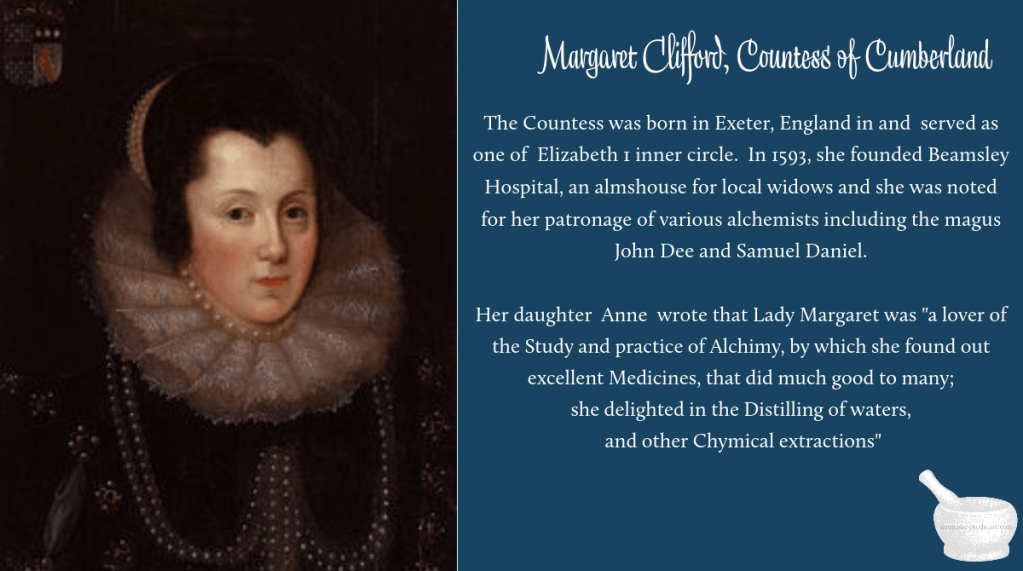
Lest we feel too sorry for these women, keep in mind they were part of the upper class and had scads of people to do the labor, in their service. Those who chose to do the work themselves Like Grace Mildemay and Margaret Clifford, definitely had people to clean up after them.
By the Regency period, very wealthy households might have two still maids who were assigned exclusively to the still room. According to the chirurgeon Hannah Woolley, governesses were also expected to have some knowledge of physick in order to adequately care for their charges. She learned much about the Art of Physick while working as a governess in the household of Ann, Lady Maynard.
I am not proposing this as a new practice. Late medieval cookbooks often contained medicinal receipts and there are a few examples of this sort of instruction occurring prior to this time. Le Menagier de Paris is one example. It was written in 1393 by a French man instructing his young wife on how to direct her staff on such matters.[2] I am just suggesting that women were being encouraged to step up their game during this era due to the dissolution. Culpeper concluded the dedication of his translation of the Pharmacopoeia Londinensis to them by saying,
“And last of al, not the least of all my respects kind Gentlewomen to you (who freely bestow your pains brains and cost, to your poor wounded and diseased neighbours) must not be for gotten, I humbly salute you with many thanks…”
Nicholas Culpeper, Pharmacopoeia Londinensis 1649
Home production of preparations made with homegrown plants has always been a cornerstone of domestic medicine. In the early modern period, this meant that gardeners were often well-versed in the medicinal uses of plants.[3] One of the most popular publications of the year 1617 was a short book by William Lawson called The Country Housewife’s Garden. Lawson concluded his chapter on growing plants to be used as medicine by saying,
“I reckon these hearbs onely, because I teach my Countrey Housewife, not skilfull Artists, and it should be an endlesse labour, and would make the matter tedious to reckon vp, Land• beefe, Stocke-Iuly-flowers, Charvall, Valerian, Go-to bed at noon, Piony, Liconas, Tansie, Garden mints, Germander, Centaurie, and a thousand such Physicke Hearbs. Let her first grow cunning in this, and then she may enlarge her Garden as her skill and ability increaseth. And to helpe her the more, I haue set her downe these obseruations.”[4]
When the Reverend Lawson entreated all women to grow cunning in their knowledge of medicinal plants and preparation, this was not unusual advice. It was a duty that members of the clergy placed on women as commonly as other household labor. Not everyone excelled at it certainly, but it was included in an idealized list of skills a woman should bring to the marriage contract as a useful domestic companion to her husband, or “helpmate” as they were sometimes called. [5]
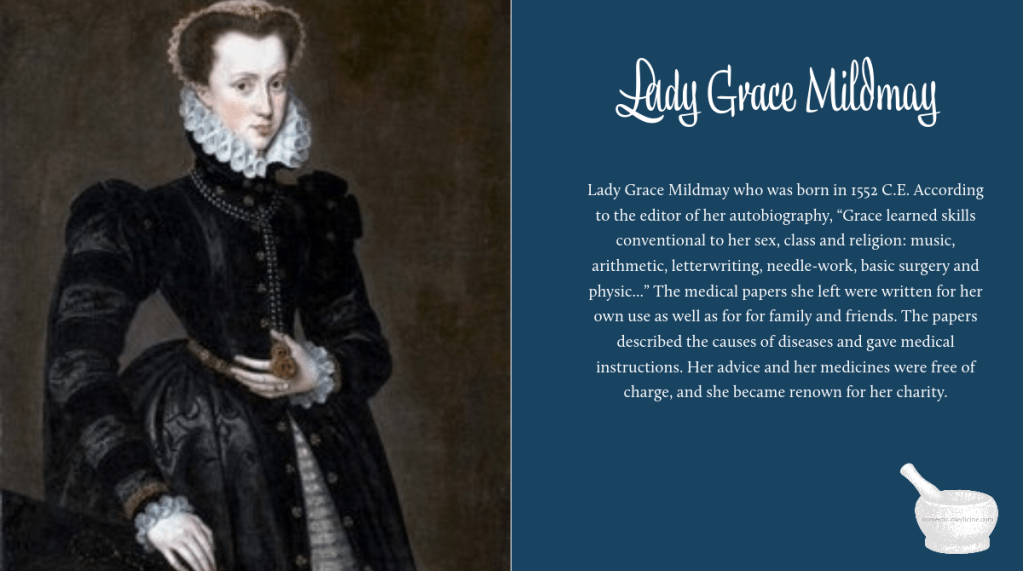
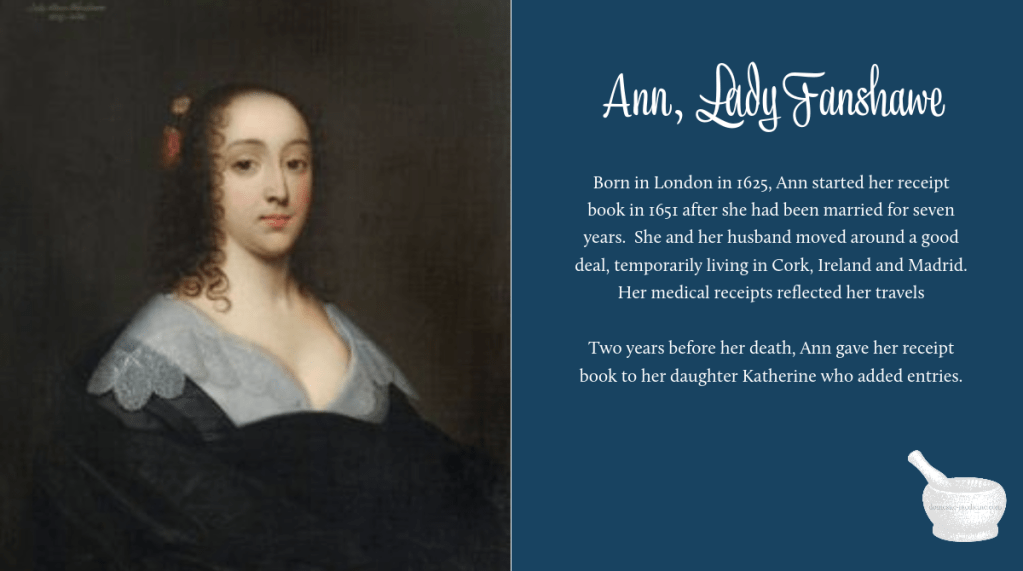
Among Lady Mildmay’s contemporaries were Lady Margaret Hoby, Lady Anne Halkett, Lady Ann Fanshawe, Lady Sedley, Lady Margaret Clifford, and many others. Our lady experimenters documented their receipts and preparation methods in handwritten books along with other household receipts which they then passed along in their family to be added to by subsequent generations. Of course, you never hear these names mentioned at herbal conferences unless you have been to one of my classes.
This brings me to a final point. There has been a lot of sensationalized history written about the ritual healing specialist of a village. While they certainly existed their role in healthcare has been mispresented. as they were consulted only when all other avenues had failed. They were not involved in every day community care. A typical situation in which a person might consult one of these practitioners is described below.
A man is sicke, his sicknesse doth linger vpon him, Some doe put into his head that he is bewitched, He is counselled to send vnto a cunning woman, She saith he is forspoken indéede, she prescribeth them what to vse, there must be some charme and sorcerie vsed. The partie findeth ease, & is a glad man, he taketh it that he hath made a good market.
George Gifford A Discourse of the Subtill Practises of Deuilles by Vvitches and Sorcerers. 1587
In most households, someone was knowledgeable about caring for the ill and convalescing. Very frequently the first “expert” the community turned to when they were in over their head was one of our lady experimenters in hopes of receiving the type of charitable support I tend to think of as mutual aid, that had been offered at religious institutions prior to the dissolution.
You may need to step back and process this because it runs counter to a lot of fanciful nonsense that has been passed along incorrectly. This website is dedicated to all the domestic medicine practitioners whose wisdom and skills have been ignored for far too long.
References
[1] Hunter, Lynette. ‘Women and Domestic Medicine: Lady Experimenters 1570-1620’. In Women, Science and Medicine 1500-1700, edited by Hunter, Lynette and Hutton, Sarah. Gloucestershire. England: Sutton Publishing, 1997.
[2] Montigny, Guy (presumed). Le Ménagier de Paris. Translated by Hinson, Janet, 1393. http://www.daviddfriedman.com/Medieval/Cookbooks/Menagier/Menagier.html.
[3] Hill, Thomas. The Gardener’s Labyrinth. Translated by Mabey, Richard. Oxford, England: Oxford University Press, 1577. It should be noted that Hill was not a gardener. He was just a bored noble interested in publishing. He had earlier published an English translation of Conrad Gesner’s Jewel of Health and an anatomy book.
[4] Lawson, William. The Country Housewife’s Garden. 1983 Reprint. London, England: Breslich & Foss, 1617. 32.
[5] Mildmay, Lady Grace. ‘The Autobiography of Grace, Lady Mildmay’. Edited by Martin, Randall. Renaissance and Reformation / Renaissance et Réforme 18, no. 1 (1620): 33–81. and Hellwarth, Jennifer Wynne. ‘Be unto Me as a Precious Ointment: Lady Grace Mildmay, Sixteenth-Century Female Practitioner’. Dynamis: Acta Hispanica Ad Medicinae Scientiarumque. Historiam Illustrandam 19 (1999): 095–117.
[6] Gifford, George. A Discourse of the Subtill Practises of Deuilles by Vvitches and Sorcerers. Imprinted at London: [By T. Orwin] for Toby Cooke, 1587.
 Domestic Medicine
You must be logged in to post a comment.