Allhollowtide is one name for the triduum 1 which includes Hallow e’en, The Feast of All Saints, and All Soul’s Day. Its root words are Middle English halwen2 “to reverence as holy” and tide (season). Hallows was an older name given to persons who had been sanctified as holy, or saints. Hallow’ een is the vigil of All Hallow’s Day.
The Catholic church had a tremendous influence on folk practice. An old Irish adage tells us bhí an creideamh ina chuid de dhlúth agus d’inneach na beatha which means “faith was woven into the warp and weft of life.” This is in part because the church, much like the Borg, assimilated and rebranded everything in its path following a doctrine of syncretism that began with Gregory I and continued for centuries.
The first “all-saints” was celebrated on what would have been the final day of the Roman festival Lemuralia on the 13th of May, 610CE by Pope Boniface IV. During that ceremony he consecrated the Pantheon for Christian uses in the name of the Virgin Mary and all known martyrs. Subsequently All Saints celebrations pulled in aspects of the Roman celebration.
Lemuralia was a festival during which Romans held rituals meant to release the spirits of ancestors who had not received proper death rites, from their earthly purgatory to pass on to the afterlife. The ritual included fava beans due to the belief that spirits of the dead were drawn to them, so that’s why we see beans pop up in various cultures’ customs.
200 years later Pope Gregory III started observing the holy day on November 1st and extended it to “All Saints” and not just martyrs. Both St. Bede (d735) and Alcuin (d804) acknowledged this date, so we know it was adopted by the Anglo Saxons. In 835 CE, Pope Gregory the IV exerted his influence over Emperor Louis the Pious compelling him to declare to the Gauls and Germany that the feast of the All Saints would be celebrated on the Kalends of November (November 1st)3 It is believed this was meant to supplant the Gaulish Trinouxtion Samonii and German celebrations that persisted and centered around venerating the dead. Ireland and Britain were never part of the Holy Roman Empire, so there is no reason to believe this had anything to do with co-opting the practices of insular Celts.
What about Samhain
There is so much nonsense on the internet about “the Celts” and Samhain that I fight the urge to boycott social media during October so that my brain does not actually implode. I wanted for a moment to step back and talk about who the “Celts” were and what we know about the ancient holiday Samhain, for anyone who might be interested in a less appropriative and more balanced presentation.
We know that as early as 7000 BCE the inhabitants of Ireland had begun to form semi-permanent settlements building sturdy huts with internal hearths. There is a body of archeological data that indicates that they began farming in Ireland during the Neolithic period (3900-1700 BCE) but that perhaps there was an extended pastoral phase which centered on tending livestock.
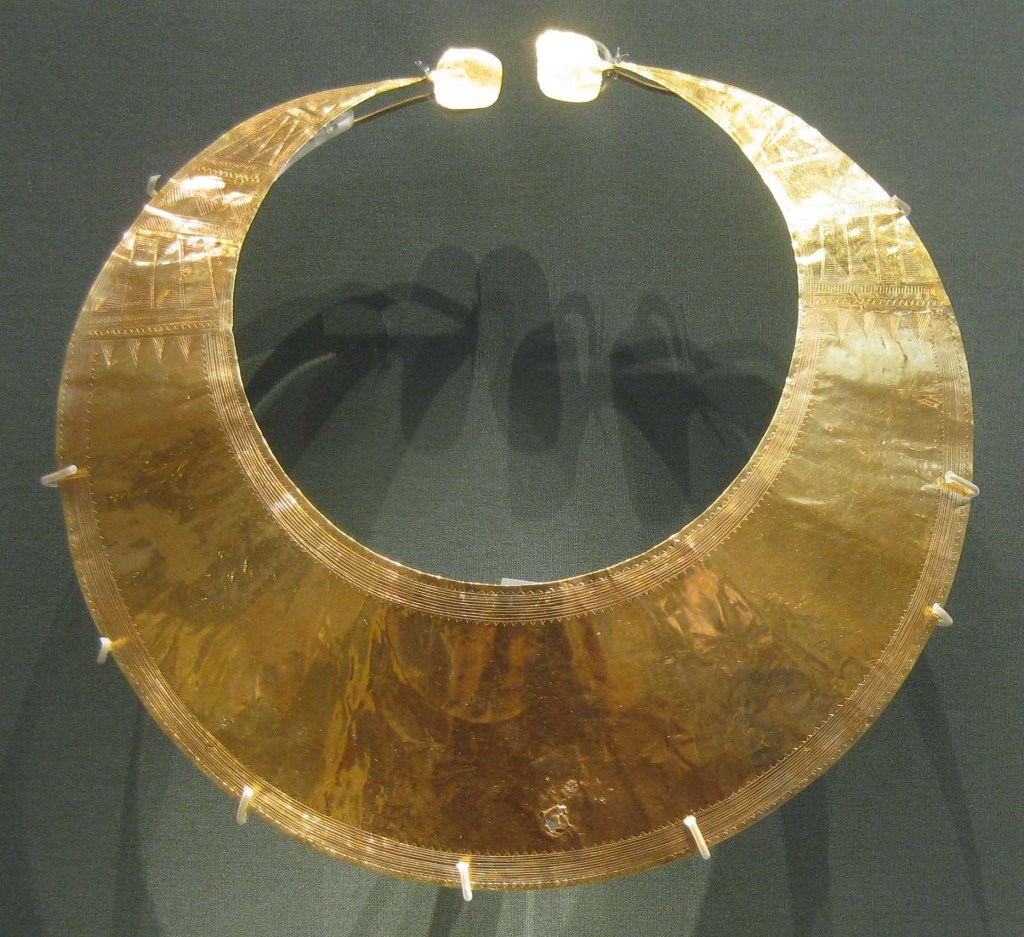
The Irish were trading their goldwork with other cultures millennia before any Celt set foot in Ireland.
The prosperous Bronze Age culture was known for trading their goldwork and building amazing architectural works such those at Newgrange and Knowth. There was a trade route between Ireland and Britain which was established as early as 3500BCE4. The gold used by Bronze Age artisans was obtained via trade with Cornwall, known for their advanced mining technology. There is no reason to believe that the Irish were insulated from other European cultures. This pre-Celtic Bronze Age genome is the predominant genome in modern Irish people.5
The “Celtic” identity of the Gaels is rooted in the idea of a strong Celtic incursion that displaced indigenous populations in both Ireland and Britain. This invasion hypothesis has largely been replaced with what you will sometimes see called a diffusion hypothesis. It is more likely that Celtic language and cultural practices merged with those of the indigenous inhabitants of Ireland to create the unique culture of the Irish Gaels. Regional differences are likely due to the assimilation of local customs.
The Celtic-speaking Hallstatt culture emerged in Ireland around 600 BC. There is no convincing archaeological evidence of a large-scale migration or invasion of Celts into Ireland or Britain. It is likely that various Celtic groups came first for trade and perhaps as small groups of immigrants pushed along by the Romans. Their language was the lingua franca of the time and so it spread throughout the British Isles. The Celtic speaking population of the British Isle are often called the insular Celts.
We know truly little about how the Celts, insular or continental, lived their lives. In fact, it’s hard to pull apart what might be “Celtic” versus what beliefs they picked up due to having been subjugated by the Roman empire for centuries. For example, there are very few depictions of deities in pre-Roman Celtic art, leading some researchers to believe that the various Celtic pantheons were simply the Roman pantheon rebranded to align with local languages and customs.
It is generally accepted that Celts observed a light half and a dark half of the year, and it is believed they celebrated the transition from the light half of the year to the dark half, as year’s end. We see validation of that in several Celtic cultures. The Gauls had Trinouxtion Samonii (Three Days at the End of Summer). In Old Irish tales, they mention holding feasts and bonfires marking na samna 6or summer’s end. The Welsh holiday Calan Gaeaf marked the beginning of their year on November 1st.
There’s also a recurring theme in the Irish mythological cycle of menacing otherworldly beings come to make trouble for people on Samhain. The Fomorian tribute was due on Samhain, which is interesting when you think about the quarter days being the days the rents came due. The Dagda sealing the deal with the Morrígan every year on Samhain makes me think of that too. Then we have the second battle of Magh Tuireadh, Medb’s and Macha’s attack on Ulster and the story of the fire-breathing monster Aillén mac Midgna burning Tara to the ground for twenty consecutive years on Samhain.
The documentation of the summer’s end celebration we have is from Old Irish manuscripts that were translated and glossed over by monks, beginning in the 12th century. Kuno Meyer’s translation of one of these (MS Rawlinson B 5 12 -16th Century) gives us some clues as to how summer’s end was celebrated in pre-Christian times.7
Carna, cuirm, cnoimes, cadla, Meat, ale, nut-mast, tripe
it e ada na samna, These are the dues of summer’s end.
tendar ar cnuc co n-grinde, A bonfire on a hill, pleasantly
blathach, brechtan urimme Buttermilk, a roll of fresh butter.
If you are the type to research this sort of thing, you might note that Kuno’s translation is a less fanciful translation than you might read from others. Other translations mention that the last line is the offerings suited to the day, but that is not the literal meaning of the words. 8
We do know that into the early modern era, summer’s end was when Irish farm families would bring cattle home from the summer grazing pastures known as buailes (booleys) where the women and children had been living with the animals since May.9 This was also a time when the herd would be culled of weak animals unlikely to live through the winter. It makes sense their return would be celebrated with a feast.
Christian Roy writes that insular and continental Celts alike would leave barec an anaon (bread of the souls) out for the dead at summer’s end.10 If true, this may be something they picked up during interaction with the Romans. Parentalia was a festival during which the Romans would offer sacrifices at the graves of their ancestors including flower-garlands and wine-soaked bread. Or it may be that both practices were assimilated from an earlier culture. Who knows?
The Gaels celebrated quarterly festivals based on the agricultural calendar rather than the two-season lunar calendar of the continental Celts, which could be due to assimilating local customs. That means we don’t know for sure that their other practices line up with what the Romans said about the Gauls. These holidays were observed prior to the 6th century CE. Samhain is not mentioned as a current practice in any medieval or early modern manuscript, although many customs undoubtedly persisted in folk practice.
The idea of celebrating Oíche Shamhna resurfaced during the Celtic “Revival” that occurred in Ireland and Britain during the late 18th and 19th-century, when “Celticism” was invented. During this time “non-English identities faced potential cultural oblivion through assimilation and submergence into a common Britishness.” 11 Irish romantic nationalists created a shared national identity based on common beliefs and practices, some of which were undoubtedly invented at the time, which helped them re-emerge from English colonization. The Scottish too were revitalized when the English became obsessed with Scottish customs due to Queen Victoria’s interest in the Highlands.
This fascination with Celtic practices was spurred on by the Romantic movement which focused on engagement with the natural world and simple folk beliefs and superstitions. Authors of the Celtic Revival acknowledge that they were writing about “the customs of the good old times, when it was difficult to say how much of our religion was Christian and how much Pagan”,12 but they sure opted for Pagan, a lot. The reality is that customs written about out as being “Celtic” were a mishmash of practices from the various cultures I mentioned above. In labeling them “Celtic” they erased the contribution of other cultures to the mix.
Aside from some translations you cannot use the works of Celtic Revival, as a reference for any historical events. Even Lady Gregory admitted that she took some liberties with her translation of The Tain. Perhaps they can be viewed as a snapshot of life at that time, somewhat grounded in the oral narrative and folk practices of Irish and Scottish folklife, but some Irish scholars scoffed at the more fanciful tales.
Customs of The All Hallowtide Triduum
All Hallow’s Eve, Hallowe’en
Hallowe’en is the vigil of All Hallow’s Day. A vigil is the name for people observing a period of wakefulness for ritual purposes. The word is derived from the Italian term vigilia and translates roughly to eve. The oldest observation of this vigil may have involved bell ringers walking amongst the community and keeping people awake to offer prayers to the saints. Seems likely to me that the bell ringers might also have been there to dissuade any pagan revelry. It seems that eventually the church gave this up and community festivals remained the norm.
In medieval Irish monastic manuscripts, otherworldy mischief is most notable on the eves of Lá Bealtaine and Oíche Shamhna. Irish pisreóga about the night seem to line up with this. Those who go out on this night are warned that they might encounter the fae in a variety of activities including fishing in lakes, singing, and dancing in the hills, or stealing children and leaving changelings in exchange.
The Fae were not the only otherworldly visitors. Ghosts were said to be able to wander more freely in the mortal world this night. “Jack O Lantern” was a spirit whose goal was to lure people to their doom in the bogs. One thing I remain somewhat confused about is when witches became associated with Halloween? Samhain certainly would not have been associated with witches as the Gaels didn’t even have a word for witch13. Maybe I missed an episode of Charmed that explained it?
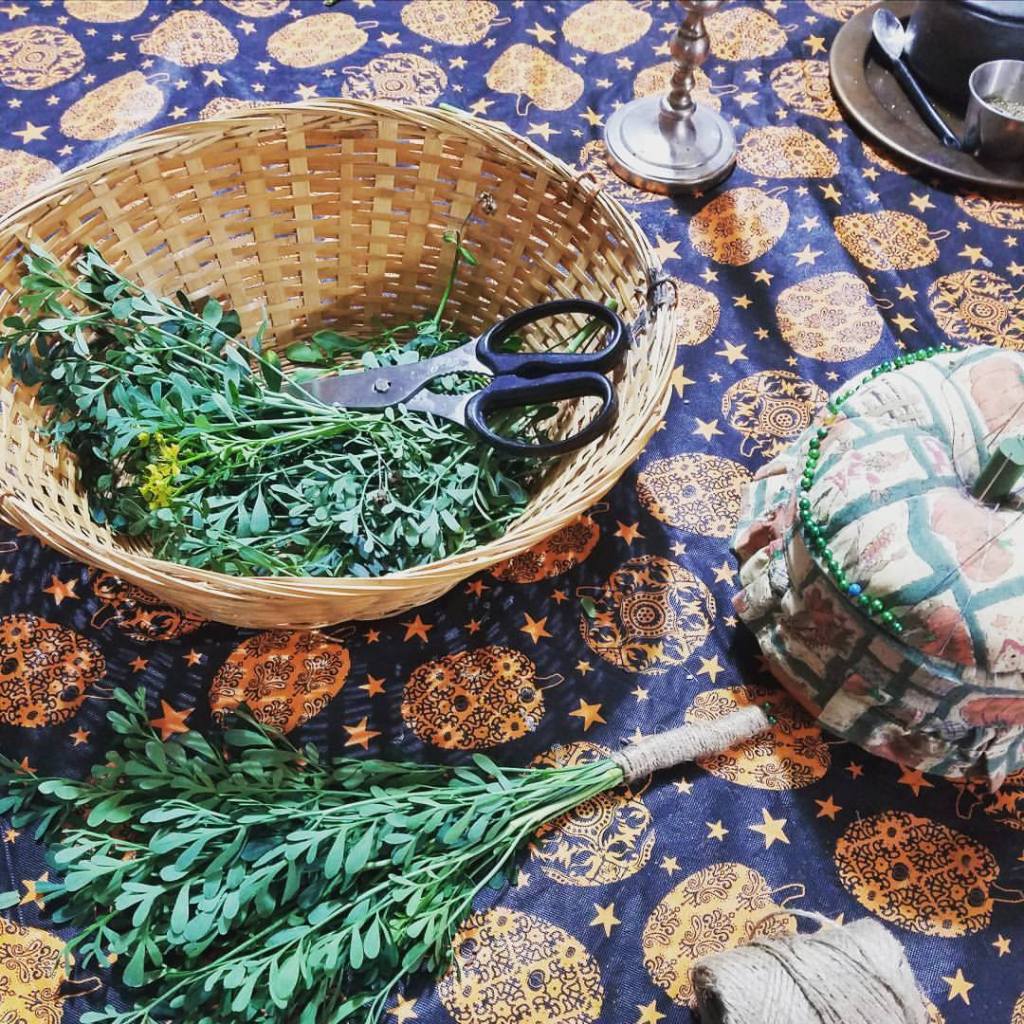
It is considered important to be respectful of the aes sidhe this evening, and people also take measures to protect themselves. It’s often written that this might be where the custom of dressing in costumes came from, as an attempt to fit in with the visitors from across the veil, but we have no documentation of that. People might sprinkle salt on animals or sprinkle holy water with rue sprinklers. They might carry black-handled knives or some other bit of iron in their pockets.
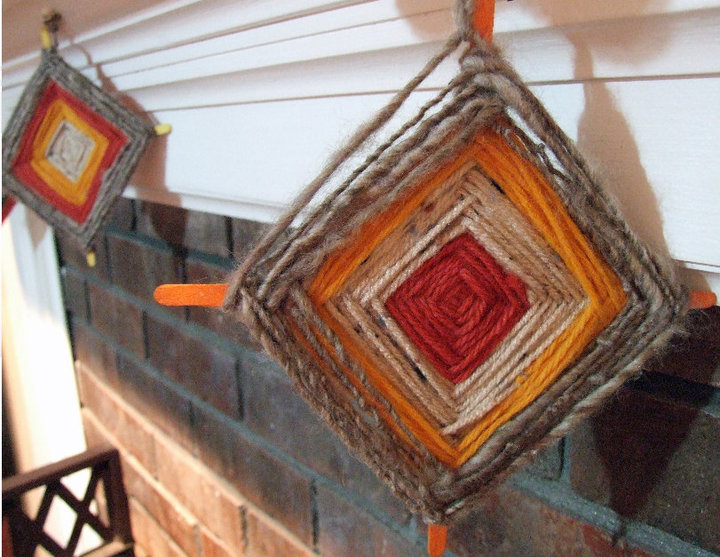
In some areas, people weave the Parshall and hang it in the window against bad fortune in the coming year and to ward off evil spirits. (I’ve also seen these called Ojo de Dios by Spanish Catholics, but I am not sure if they are made at the same time of the year.)
Catholics were generally expected to abstain from meat for the vigil, so cál ceannann (colcannon) or other meatless dishes were commonly served. You might see berries mentioned as traditional fare because this was the last day you could pick them. Some people left berries out for the fae to ensure a good harvest the following year. Báirín breac might be baked up with various trinkets tucked inside that would divine your future. In other areas, these trinkets would be tucked in your champ, cál ceannann, or crowdie. In English homes the matriarch of the house would mix her wedding ring into a mash of nine sorts and whoever found it would be the next to marry.
Ring – Early Marriage
Dried Pea- Poverty
Dried Fava Bean – Wealth
Wishbone- Heart’s Desire
Thimble- Spinsterhood
Button – Bachelorhood (understand bachelor’s buttons now?)
Religious medals – Priesthood or Nun

Guisers were youth who would dress in costumes and go door-to-door begging for apples, nuts, and other treats. Sometimes they would sing songs or act out plays, in return. After they had collected the goodies for their festivities, the village would have a grand Hallowe’en Party during which people would play games.
Divination games were a big part of this evening. Melting lead into a bowl of water and interpreting the shapes to tell the future was a popular game. There was also a game where young people of marriageable age would put beans near the fire and watch to see which way they jumped when they popped. This gave partygoers clues about who their best mate might be.
In the game, “Ducking in the Water” people would also take a go at retrieving apples or silver coins from a large tub of water with their mouths. Another game played at parties was snap-apple during which they would hang a stick with apple at one point and a lighted candle at the other, twirl the stick, and try to catch the apple, not the candle, in the mouth. I have read examples of people replacing the candle flame with bars of soap and this seems safer. I have also seen the game explained as just hanging apples on cords from the ceiling. Here’s a fun little booklet published in 1911 that you could use when planning your next Halloween party.
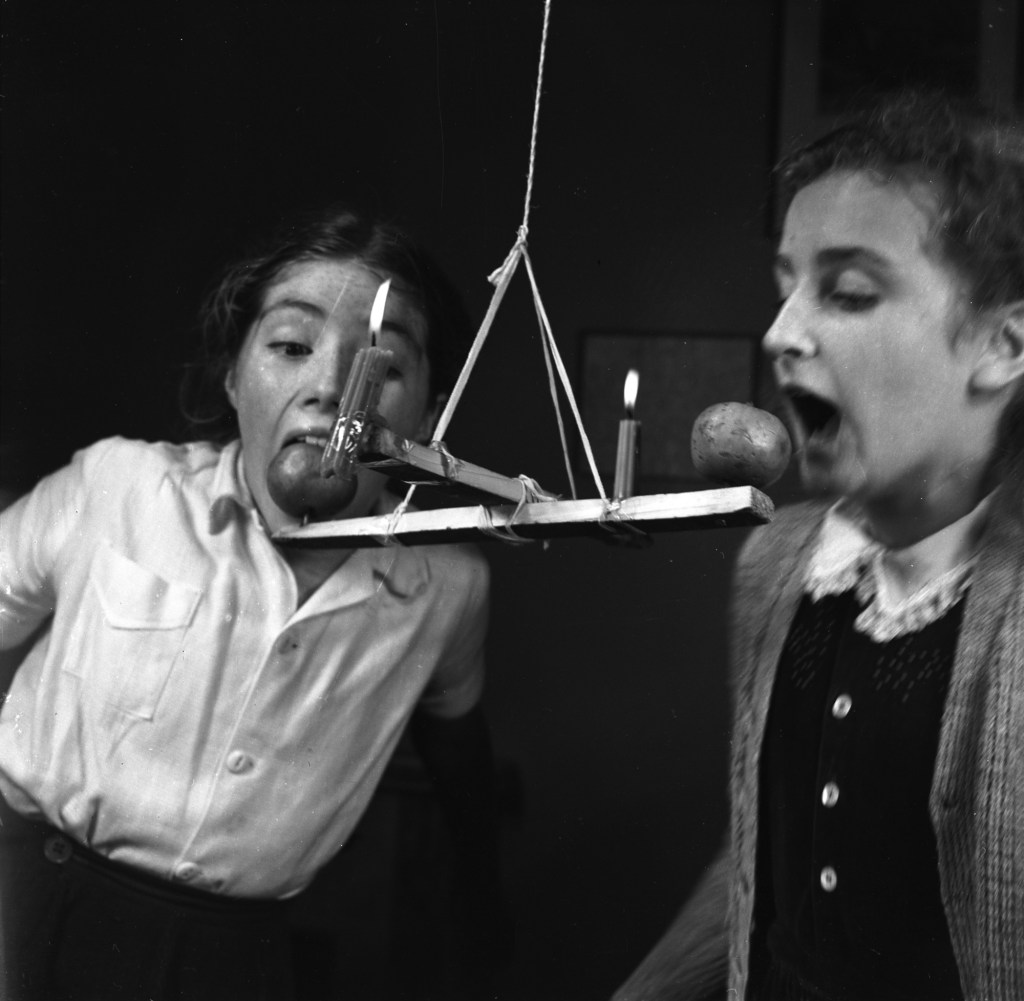
Photographer: Maurice Curtin /Archive: National Folklore Collection, UCD N013.06.00026
The Irish might also speak of oídhche na, h-aimléise, (the night of mischief or con) or simply Mischief Night as it’s called in Scotland. This was once observed on the night before Lá Bealtaine (May Day), but like all the holidays seems to have jumped around the calendar. Young men of the village liked to carouse this night after the parties and cause mischief of one sort or another, challenging one another with elaborate dares or pranking people who had denied them goodies for their parties. The tricksters capitalized on the fear of otherwordly visitors. Sometimes they would dress in costumes. Other times they carved turnips (American: rutabaga) into lanterns with frightening faces and used them to scare people.
In Irish folklore, this night is also called Púca night, and it is believed that the púca or “pookies” as they were sometimes called, poison the blackberries and other haws that remains on the vine on this night so that the berries can’t be eaten after that. This is like the Michaelmas, Devil’s Night tradition in English festival calendar.

November 1st – Hallowmas, Allerheiligen, Feast of All Saints, All Soul’s Eve
All Saints Day is a holy day of obligation in the Catholic church. It is devoted to lengthy masses in honor of the saints and feasting. The evening of All Saint’s Day is observed as the vigil of All Soul’s Day. In some areas this is thought to be the night that the dead are likely to visit their ancestral homes. In many cultures the living would set out a grand feast for their dead visitors. They might use sounds or light to guide the spirits. In England they rang bells, while the French might rattle bones in pails. In France and Italy, the lights were sometimes placed in graveyards. This is one account of how All Soul’s Night was celebrated in the early 20th century in parts of Ireland.
On “All Souls Night” the Irish people keep up the custom of lighting candles on all the windows to guide the souls on their way.
It is believed that the souls visit their old homes on earth. Anyone does not go out on the night, for fear that he might meet any of the dead on his way. It is counted unlucky
Everybody is present for the family rosary, and the all the souls are earnestly prayed for. The head of the house leaves the door opened, a fine fire is put on the hearth.
There is a bucket of fresh spring water, and a plentiful supply of food is placed in the kitchen. This is done in order that the souls may find warmth and comfort in their old homes.
About mid-night the head of the house gets up again and waves a white cloth after the souls, bidding them farewell, and asking them to come back again next year.
All Souls Day – Jour Des Morts – Día de los Muertos
All Souls Day is the most recent addition to the triduum. All Soul’s Day and Día de los Muertos are the same holy day to the church with different names and both have been observed for a very long time now. It was established some 160 years (ca. 995 CE) after All Saints Day. This feast is celebrated on November 2nd across Western Europe with rituals to honor the ancestors. Many cultures have special confections they make for this feast that are shaped like bones or incorporate bones in some way like the ossa dei morti in Italy.
The church declared November 2nd a day that almsgiving would insure one could “have a mass said for the repose of a loved soul gone before.”14To make it a little more compelling, Saint Odilo also introduced the idea of Purgatory at that time, so people were more motivated to participate to assure their ancestors release from suffering.
The fyrst dey of nouembere,
Men forto hallow fro all werkis,
To here seruys of prestys & clerkis;
all-salle-dey be on̄e þe morow, [ 575]
Fro peynes of purgatory them (to) borow,
And euer-more amonge man-kynde
To praye fore them & haue in mynde;
As all seyntys be halowyd ryȝht
To pray fore vs to god all-myȝht, [ 580]
So all saules in þer manere
Be relesyd throw preyers here
And come to Joy of paradis clere15
The first day of November
Men relieved from work in order to sanctify,
To hear service of priest and clerics;
all soul day be on the next day
Relief from pains of purgatory them to secure
And evermore among mankind
To pray for them and have in mind
As all saints be hallowed right
To pray for us to God almighty
So all souls in their form
Be released through prayers here
And come to Joy of Paradise clear
In medieval England the poor would sell their prayers to their wealthy neighbors in return for alms or food. This became a standing tradition called souling, with special songs and plays for people to perform in return for Soul Cakes and spiced ale. Souling is like the guising, mumming, and wassailing traditions which developed during the feudal times when landholders were obligated to provide the less fortunate with a proper feast day celebration.
French priests would lead processions around brightly decorated graveyards on jour des morts (Day of the Dead), blessing the graves and then commencing a community feast.16 I have a friend whose family are long time inhabitants of New Orleans. His grandmother told him that the All-Saints procession was once very beautiful there.
On the eve of Giorno dei Morti in Italy and Jornu di li morti in Sicily the souls of the dead bring gifts to children while they are sleeping which they find on this morning. The day is celebrated by visiting relatives’ graves and placing food on the graves. In some parts of Italy, they make fave dei morti (beans of the dead) almond cakes baked in the shape of a bean. In other regions they are called ossa dei morti, or bones of the dead and shaped like finger bones.
Día de los Muertos is the Spanish name for the feast day, and it is celebrated throughout Latin America. In some parts of Spain, the people eat almond paste confections shaped like bones and filled with cream filling “marrow” called huesos de santos (saints’ bones) and buñuelos– a pastry which was probably borrowed from the Jewish culture – resembling the bimuelos they make for Hanukkah.
In Mexico, many Aztec practices from two older feasts called Hueymiccaihuitl and Miccailhuitontli (traditionally held in August) have undoubtedly been incorporated into the holiday, but practices from the Old World including taking food to the graves of your ancestors, persist.17 Sweet breads called panes de muerto that have small skeletons baked into the loaves are popular treats.
I hope this helps you understand how Allhallowtide reflects the pervasive influence of Catholic tradition on European customs as it was blended with older practices. Through the Church’s syncretic approach, local customs of honoring the dead were woven into the holidays, creating a cultural observance that redefined ancestral veneration and grounds our modern customs in in this much older framework.
References
- Any three-day holiday is known in the Catholic Church as a triduum. ↩︎
- ‘Halwen – Middle English Compendium’. Accessed 20 October 2017. ↩︎
- Pearse, Roger. ‘All Saints: The Edict of Louis in 835 Establishing the Date as 1st November’. Roger Pearse (blog), 8 October 2019. ↩︎
- Standish CD, Dhuime B, Hawkesworth CJ, Pike AWG. A Non-local Source of Irish Chalcolithic and Early Bronze Age Gold. Proceedings of the Prehistoric Society. 2015;81:149-177. doi:10.1017/ppr.2015.4 ↩︎
- Cassidy, Lara M., Rui Martiniano, Eileen M. Murphy, Matthew D. Teasdale, James Mallory, Barrie Hartwell, and Daniel G. Bradley. ‘Neolithic and Bronze Age Migration to Ireland and Establishment of the Insular Atlantic Genome’. Proceedings of the National Academy of Sciences 113, no. 2 (2016): 368–73. ↩︎
- This month eventually came to be called Samhain (Irish), Samhuinn (Scottish Gaelic) and Sauin (Manx). ↩︎
- Meyer, Kuno. Hibernica Minora . Oxford: Clarendon Press, 1894 ↩︎
- The most controversy seems to be over the word grinde. I have seen n-grinde translated as merriment. I have also seen it translated to “with a company” as well. N-grinde, could simply refer to using bundles of twigs bound together to use as firewood and you see this phrase in the Sanas Cormiac. This would be my guess as I am a keep-it-simple kind of person, but I usually defer to Meyer. No one knows and anyone who translates something without offering you alternative possibilities is cherry-picking their favorite. ↩︎
- Spenser, Edmund. A View of the Present State of Ireland, 1596. ↩︎
- Roy, Christian. Traditional Festivals. A Multicultural Encyclopedia. Santa Barbara, CA: ABC-CLIO, 2005. ↩︎
- James, Simon. The Atlantic Celts: Ancient People Or Modern Invention? 1st edition. Madison: University of Wisconsin Press, 1999. ↩︎
- Wilde, William Robert. Irish Popular Superstitions. Dublin, Ireland: James McGlashan, 1852. ↩︎
- Hutton, R. ‘Witch-Hunting in Celtic Societies’. Past & Present 212, no. 1 (2011): 43–71. https://doi.org/10.1093/pastj/gtr003. ↩︎
- Holms, Douglas. “All Souls’ Day.” The Irish Monthly 38, no. 449 (1910): 609–612. ↩︎
- Horstmann, Carl, ed. Nachträge Zu Den Legenden., 1879-1888. http://name.umdl.umich.edu/CME00063. ↩︎
- Muir, Edward Ritual in Early Modern Europe. Cambridge: UK, University of Cambridge Press. (2005) p. 78 ↩︎
- Lucier, V. A. “‘Offrenda’ on All-Souls’ Day in Mexico.” The Journal of American Folklore 10, no. 37 (1897): 106–7. ↩︎
 Domestic Medicine
You must be logged in to post a comment.