I want to preface this by saying that nationalism is a modern construct. Medieval people swore allegiance to much smaller political or religious entities and carried on the traditions of their region of birth and their families. Nationalism was invented in the 19th century and led to two disastrous World Wars, so I am not so much a fan of the concept.
When those people moved around they took those traditions with them and undoubtedly picked up new ones as they inter-married into new populations. Recent genetics projects are beginning to show that even “The Vikings” weren’t so much a culture as a profession and people from many cultures were Vikings, just like people from many cultures were later Pirates.
Towards the end of the eighteenth century, a cultural movement arose in Europe called national romanticism. This movement resulted in people thinking of themselves as having much broader shared traditions and culture. National identities are products of that time.
It’s not my area of expertise so I don’t want to go too far into it I will simply state that there is really no such thing as a uniform national practice, but sometimes it is easier to talk about these cultures in that way because it’s what people understand.
So one day when I was transcribing in the Schools Collection I came across this entry:
There is a very good ointment made from nine herbs, lard, woodbine, ivy, alderbark, marshmallows, planting leaf, rib grass, daisyleaves and Dandelion.
Mrs. Fleming Co Galway
It occurred to me that this was not the first time I had read of an ointment made of nine herbs. Nearly everyone who talks about the history of plant medicine has taken a look at the Lacnunga manuscript. It’s an Anglo-Saxon document dating c. 1050CE. One leechdom (receipt) that many pay attention to is the Lay of Nine Herbs. The version I linked to is translated by Karen Louise Jolly in her book, Popular Religion in Late Saxon England: Elf Charms in Context (1996).
My favorite translation is Stephen Pollington’s in Leechcraft: Early English Charms Plantlore and Healing because I like that when he talks about “flying venoms” and onflyge (onfliers) he chooses the more measured approach considering them an “airborne assault on the body’s defenses” and translates them as infection. I appreciate that sort of respect. Because really is calling a pathogen a “flying venom” any less accurate than calling it a seed? (The Latin word “germ” is derived from means seed or bud.)
That lay in its entirety is so long I feel like we need a jump to receipt moment so let’s pull the preparation out of Pollington’s translation.
Mugwort, waybroad which has opened from the east, lamb’s cress, attorlathe, maythe, nettle, wood sour apple, chervil and fennel, old soap; work the herbs to a powder, mix them with the soap, and with the apple’s juice. Work then a paste from water and from ashes; take fennel, boil it in the paste and warm it with the mixture.
Lacnunga 1050CE
The fact that the receipt mentions ashes along with the astringency of some of the herbal ingredients, leads me to believe this was meant as a drawing salve. Charcoal was frequently an ingredient in those. Finally, I want to talk about the ingredients Mrs. Fleming used. In Jolly’s version of the Lay, she identifies Maythe as chamomile which makes the most sense as a variant spelling of Mageþe, but I have also seen Mageþe identified as ox-eye daisy which is interesting given Mrs. Fleming’s list of ingredients.
Folks were not always so hung up on botanical identification. They mostly used organoleptic identification which, for what is worth, is still acceptable to the FDA. Many plants of distinct species have similar phytoconstituents. If you want to experience this, I invite you to taste a daisy flower and then a chamomile flower. I think then you will understand.
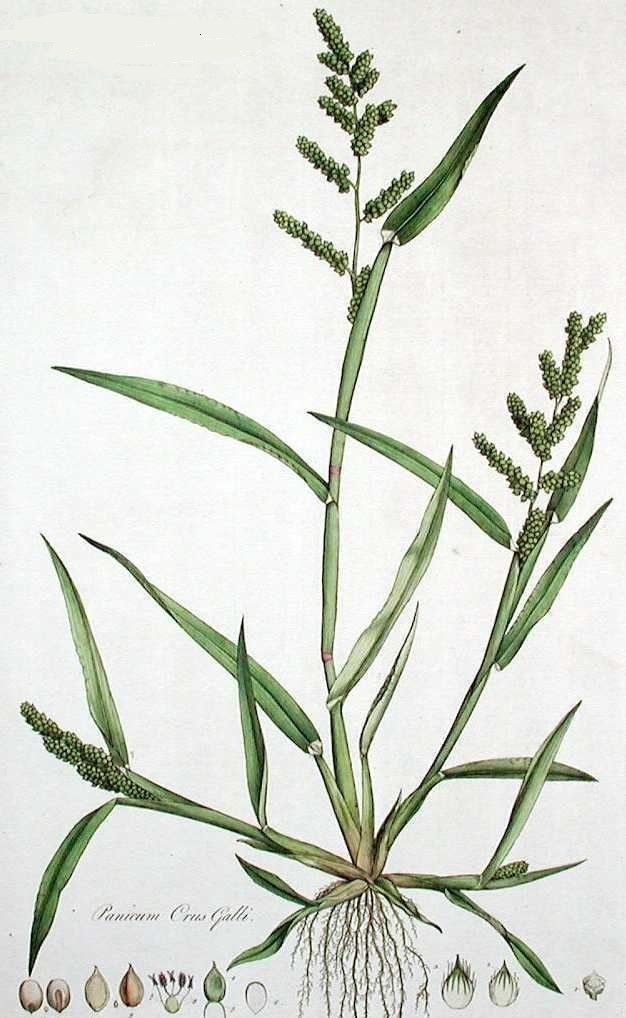
It is exciting, if rib grass can be taken to be cockspur (Echinochloa crus-galli), that Mrs. Fleming might have solved what has been an exceptionally long scholarly conversation. Attorlathe means “venom loathing” and seems to have been used to refer to a specific medicinal herb.
The problem is that it is despite what you might read in Cockayne’s glossary there has never been a firm agreement as to which one. Other scholars have suggested fumitory, betony, cyclamen, and black nightshade as possibilities. Given the fact that Cockspur is known for its conspicuous white mid-rib and plantain is already mentioned in the receipt, I think it’s worth considering that Cockayne may be correct.
I also don’t want to make it seem as though it really matters if it is historically accurate. I am sure that Mrs. Fleming’s receipt makes a fine ointment regardless of whether the ingredients line up precisely, I just like to make these connections. I looked around a bit for more entries that mentioned “nine herbs” and it wasn’t really helpful in terms of mentioning ingredients, but it gives an idea what the ointment was used for.
A man, named Corcoran who lives in this district, has the cure for burst. The ointment is made in this manner. Nine herbs are got and fried with butter on a pan.
Phyllis O’Hara Co. Westmeath
What I think is important to take from this is that there is a direct line of practice from a document written by Anglo-Saxons to Irish “modern” use that changed as it incorporated local plants. I think this is just a good example of information exchange between cultures that has existed for as long as humans have.
Irish medicine is also mentioned in the Anglo-Saxon chronicles. There are stories of people studying medicine in Ireland before the Saxons came to England. There are instances of Old Irish and Old English in the Lacnunga manuscript. Most of the information that we have about antiquity passed through the Toledo translators who lived in Muslim Spain.
There was a lot more exchange of information between cultures than modern people realize. It’s sometimes easier to think of Western Europe more cohesively than it is to pinpoint practices unique to one culture – especially when it comes to Ireland and the UK.
 Domestic Medicine
You must be logged in to post a comment.